
Ultimate Guide to Barndominium Refinancing

Refinancing your barndominium in Canada can help lower mortgage payments, consolidate debt, or fund renovations. However, it comes with unique challenges like passing the federal mortgage stress test and navigating appraisals for non-standard properties. Here’s what you need to know:
- Eligibility: You can refinance up to 80% of your home’s appraised value (90% for properties with secondary suites). A credit score of 600+ and debt service ratios below 39% (GDS) and 44% (TDS) are required.
- Options: Choose between rate-and-term refinancing, cash-out refinancing, or converting construction loans into long-term mortgages.
- Challenges: Barndominiums often face stricter appraisals due to their mixed-use and steel-frame construction. Proper documentation, like blueprints and permits, is key.
With 76% of Canadian mortgages set to renew by the end of 2026, now is the time to explore refinancing options and leverage your home equity effectively.
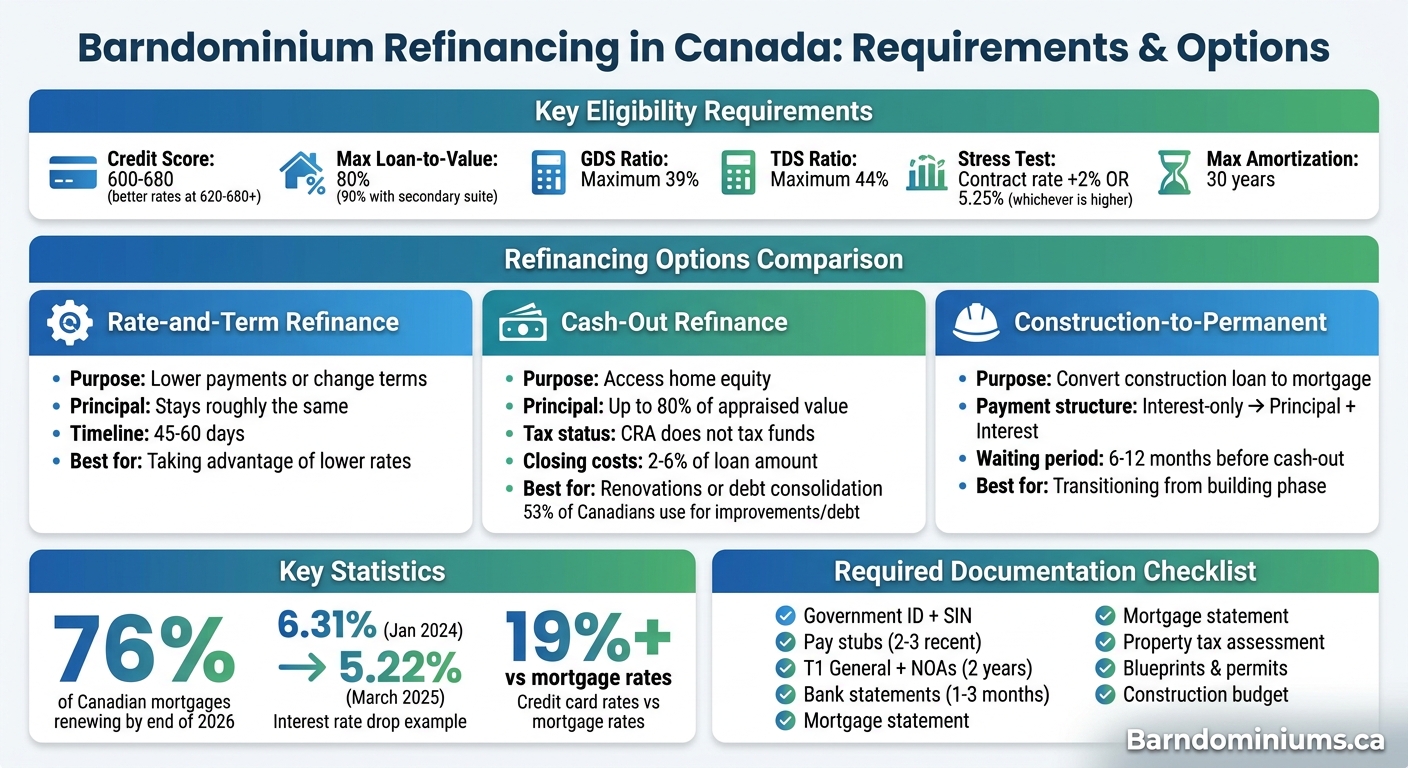
Canadian Barndominium Refinancing Requirements and Options Comparison
Refinancing Real Estate in Canada | 10 Top Tips You NEED To Know
sbb-itb-d6e8a6a
Why Refinance Your Barndominium
For barndominium owners in Canada, refinancing can be a smart move, especially when interest rates drop. A great example of this occurred between January 2024 and March 2025, when 5-year fixed rates fell from 6.31% to 5.22%. Lower rates like these can significantly reduce your monthly payments.
Refinancing also helps with debt consolidation. By rolling high-interest debts, like credit cards, into a single payment at a lower mortgage rate, you can simplify your finances and save a lot of money. As Jeff Dinsmore from VeloMortgage explains:
Instead of paying 19%+ on a credit card, you’re paying mortgage rates.
Another benefit? You can tap into your barndominium’s equity for things like renovations, investments, or even emergencies. Typically, you can access up to 80% of your property’s appraised value, or as much as 90% for properties under $2 million that include legal secondary suites.
Refinancing also gives you the option to extend your amortization period to 30 years, which lowers your monthly payments. Plus, switching between variable and fixed rates allows you to adjust based on your comfort level with risk.
One refinancing option worth noting is a readvanceable mortgage. This combines a traditional mortgage with a Home Equity Line of Credit (HELOC). As you pay down your mortgage principal, your available credit increases – without the need for new application fees.

Eligibility Requirements for Barndominium Refinancing in Canada
If you’re considering refinancing your barndominium in Ontario or elsewhere in Canada, you’ll need to meet specific lending requirements. These standards are designed to balance the interests of both borrowers and lenders. A key hurdle is the federal mortgage stress test, which ensures you can handle payments at either your contract rate plus 2% or a minimum of 5.25%, whichever is higher.
Credit Score and Debt-to-Income Ratio
Lenders typically look for a credit score between 600 and 680. If your score falls in the 620 to 680 range or higher, you’ll likely qualify for better interest rates. Borrowers with lower scores may still be approved but could face higher rates or require more equity.
Debt service ratios are another critical factor. These ratios evaluate how much of your income goes towards housing and overall debt:
- Gross Debt Service (GDS): Measures housing costs as a percentage of your gross income. It should stay below 39%.
- Total Debt Service (TDS): Includes all debt obligations and should not exceed 44%.
Both ratios are calculated using the stress test interest rate. If your numbers are too high, consider strategies like reducing debt or increasing your income before applying.
| Requirement | Standard Refinance | Secondary Suite Refinance |
|---|---|---|
| Max GDS Ratio | 39% | 39% |
| Max TDS Ratio | 44% | 44% |
| Max Loan-to-Value (LTV) | 80% | 90% |
| Min Credit Score | 600 | 600 |
| Max Amortization | 30 Years | 30 Years |
| Max Property Value | N/A | $2,000,000 |
Property Appraisal Challenges for Barndominiums
Barndominiums often face unique hurdles during the appraisal process, as their design – typically steel-frame or post-frame – classifies them as "non-standard construction" in the eyes of many lenders. This classification can complicate the process since appraisers may struggle to find comparable properties nearby.
"Because barndominiums aren’t as common as traditional homes, some lenders consider them non-standard construction, which can make getting a mortgage or construction loan more difficult."
– Trusscore
Appraisals for barndominiums can be conservative, which might limit the amount you can borrow. If you’re refinancing to fund improvements – like adding a secondary suite – Canada Mortgage and Housing Corporation (CMHC) uses a dual appraisal method. This process considers both the "as-is" value (the current market value) and the "as-improved" value (the projected value after renovations). The lending value is typically the lesser of the as-improved value or the as-is value plus the cost of renovations.
To navigate these challenges, prepare a thorough documentation package, including:
- Detailed blueprints
- A construction budget
- All necessary permits
Additionally, ensure your land is zoned for residential use, as incorrect zoning can delay your refinancing process. Working with a mortgage broker who specializes in rural or unique properties can also help smooth the way.
For mixed-use barndominiums – such as homes that include large commercial workshops or agricultural spaces – lenders and insurance providers may apply additional scrutiny. To meet CMHC requirements, your property must be suitable for year-round living and have reliable vehicular access.
Refinancing Options for Barndominiums
Once you’ve determined your eligibility, the next step is picking the refinancing method that aligns with your financial goals. In Canada, barndominium owners have three main options, each tailored to specific needs. Whether you’re looking to cut monthly costs or fund upgrades, these choices provide flexibility.
Rate-and-Term Refinance
This approach involves replacing your current mortgage with a new one, either at a different interest rate or for a different loan term. The principal remains roughly the same, but the revised terms can reduce your monthly payments. If interest rates have dropped since you first financed your barndominium, this option could save you thousands over the life of your mortgage.
In Canada, the refinancing process typically takes 45 to 60 days from application to closing. Some closing costs – if they stay under 2% of the loan balance – can be added to the loan itself.
Cash-Out Refinance Using Home Equity
A cash-out refinance replaces your existing mortgage with a larger loan and provides the difference as a lump sum. In Canada, you can borrow up to 80% of your barndominium’s appraised value. This option is especially appealing for funding significant renovations or consolidating high-interest debt.
The Canada Revenue Agency (CRA) does not tax these funds. While cash-out refinance rates are often lower than those for personal loans or credit cards, they may be slightly higher than standard mortgage rates. Using your home equity in this way can help lower your overall interest costs.
Interestingly, about 53% of Canadian homeowners who refinance use the funds to improve their property’s value or consolidate debts. Closing costs typically range from 2% to 6% of the loan amount, and for primary residences, there’s a 3-day rescission period.
Construction-to-Permanent Refinance Conversion
If you financed your barndominium’s construction with a short-term loan, this option allows you to convert it into a standard, long-term mortgage. Construction loans usually cover building costs until the project is complete.
During construction, you’ll make interest-only payments based on the amount drawn. Once you’ve received your Certificate of Occupancy, the loan transitions to a structure that includes both principal and interest payments. Some Canadian lenders, such as Meridian Credit Union and Conexus Credit Union, offer "one-time close" programs. These combine land purchase, construction financing, and the permanent mortgage into a single package. With one application and one set of closing costs, this can simplify the process and save you money.
This option is ideal for those moving from construction financing to a stable, long-term mortgage. However, most lenders require a 6- to 12-month waiting period after the conversion before you can apply for a cash-out refinance. If you managed the construction yourself, be prepared to provide detailed documentation, as Canadian credit unions typically require verifiable proof.
How to Refinance a Barndominium: Step-by-Step Process
Refinancing a barndominium in Canada involves a detailed process. Since these properties have unique characteristics, proper documentation is key to avoid unnecessary delays.

Gathering Documentation and Plans
Start by organizing all necessary personal and financial documents. This includes a government-issued photo ID with your current address and your Social Insurance Number (SIN). You’ll also need recent pay stubs, your latest T1 General, and two years of Notices of Assessment (NOAs).
If you’re employed, an employment confirmation letter is required. This letter should be on company letterhead, signed, and dated within the last 30 days, confirming your position, salary, and employment duration. For self-employed individuals, additional paperwork is necessary, such as two to three years of financial statements, NOAs, and, if applicable, articles of incorporation or a business licence.
Your financial overview should include:
- Bank statements from the last one to three months
- A list of assets (e.g., investments, RRSPs, vehicles)
- A breakdown of liabilities, like credit card balances or personal loans
Don’t forget property-specific records, such as your current mortgage statement, property tax assessments, and a copy of your homeowners insurance policy.
For barndominiums, additional documents like detailed blueprints, barndo house kit floor plans, construction budgets, and building or occupancy permits are essential – especially if you’re refinancing for upgrades or adding a secondary suite.
| Document Category | Specific Items Required |
|---|---|
| Identification | Government ID, SIN |
| Income | Pay stubs (2-3), T1 General, NOAs (last 2 years), Employment Letter |
| Financials | Bank statements (1-3 months), Asset list, Debt/Liability list |
| Property | Mortgage statement, Property tax assessment, Home insurance policy |
| Barndominium Project | Blueprints, Construction budget, Building/Occupancy permits |
Once your documents are ready, it’s time to find lenders who are familiar with barndominiums.
Finding Canadian Lenders Familiar with Barndominiums
Not every lender understands the nuances of barndominiums, so it’s important to seek out those who do. Mortgage brokers can be a great resource, as many specialized lenders work exclusively through them. For instance, Haventree Bank caters to unique financing needs, such as self-employed individuals or those with credit challenges, through broker partnerships.
"We work directly with Mortgage Brokers to offer you the right mortgage solution." – Haventree Bank
Look for lenders or programs that focus on rural or agricultural properties, as they are more likely to understand barndominiums’ steel-frame construction and mixed-use nature. If you’re transitioning from a construction loan, confirm that the lender provides a smooth conversion to a standard mortgage. A well-prepared portfolio, including blueprints, a construction budget, and a clear timeline, can help showcase your property’s value.
Appraisal and Underwriting for Barndominiums
Once you’ve chosen a lender, they will arrange an appraisal to determine your barndominium’s market value. This process typically involves an on-site inspection, which can take anywhere from 30 minutes to a few hours. The appraiser will compare your property to similar homes recently sold in the area. Appraisal fees in Canada generally range from $300 to $400, but costs may vary depending on location and complexity.
To prepare for the appraisal, have the following on hand:
- Property survey or blueprint
- Recent property tax assessment
- A list of renovations with their costs
Highlight any notable upgrades, such as updated plumbing, electrical systems, or insulation, as these can reduce the effective age of your home.
"If you’ve done renovations and upgrades, you’ve changed the effective age of the home. A home appraisal could show a century home with an effective age of just five to seven years." – CanadaLend
During underwriting, lenders assess your creditworthiness and property value in accordance with OSFI Guideline B-20. They calculate your Gross Debt Service (GDS) and Total Debt Service (TDS) ratios to ensure your monthly housing expenses don’t exceed 39% of your gross income and your total debt obligations stay under 44%. For refinancing, you can typically borrow up to 80% of the appraised value, less your remaining mortgage balance.
Closing the Refinance Deal
After the appraisal and underwriting, the final step is addressing the lender’s conditions. You’ll receive a commitment letter outlining the specific requirements you need to meet before closing. Carefully review this document and work with your lawyer or notary to handle any outstanding items.
Be prepared for closing costs, which may include:
- Legal fees (starting at $1,000, depending on the province)
- Mortgage discharge fees (ranging from $200 to $450 if switching lenders)
- Mortgage registration fees (e.g., $77 in Ontario or $146 in Quebec)
Once all conditions are met, your lawyer will coordinate the release of funds, finalizing the refinance process.

Common Challenges in Barndominium Refinancing
Refinancing a barndominium comes with its own set of hurdles, even after meeting the initial eligibility criteria. Two major sticking points are lender concerns about appraisals and dealing with provincial differences in refinancing regulations. Knowing these challenges ahead of time can help you avoid unnecessary delays and headaches.
Lender Concerns About Barndominium Appraisals
Barndominiums often face scrutiny during appraisals because of their unconventional construction. Lenders are sometimes wary of steel-frame buildings, viewing them as non-traditional and harder to evaluate due to limited comparable properties.
"Lenders may be hesitant due to… Unconventional Construction: Barndominiums often utilize metal building kits, which some lenders view as less traditional and potentially riskier than stick-built homes." – Jonathan Reed
To address these concerns, it’s essential to show that your property meets residential building standards. If your barndominium is built to residential codes, it can qualify for standard mortgage financing through Canadian banks. Be prepared to provide detailed documentation, such as stamped structural drawings, foundation details, and site plans, to prove compliance. Highlight the benefits of steel construction, like its resistance to rot, pests, and warping, as well as its energy efficiency, to help alleviate lender doubts.
If traditional banks are reluctant, consider working with local credit unions or rural-focused lenders. These institutions often have more experience with unique properties like barndominiums. Farm and ranch lenders, in particular, understand the dual-purpose nature of these structures and may be more accommodating. Mortgage brokers can also connect you with niche programs tailored to rural or agricultural properties.
Beyond these lender-specific issues, provincial regulations add another layer of complexity.
Provincial Differences in Refinancing Requirements
Refinancing requirements for barndominiums vary widely across Canada, as each province has its own building codes, zoning laws, and land use rules. These local regulations can significantly impact your ability to qualify for residential refinancing. Lenders will often require proof that your barndominium complies with provincial standards, including climate-specific building requirements.
In provinces such as Manitoba and Quebec, refinancing is relatively straightforward, as their processes closely resemble those for traditional homes. However, areas like the Northwest Territories pose unique challenges due to environmental and logistical factors, which can complicate appraisals and extend timelines. Some provinces also offer specialized programs for rural or farm properties, which differ from standard urban refinancing options.
Before starting the refinancing process, check local municipal regulations to ensure your project aligns with zoning and permitting requirements. This step can help you avoid setbacks that might delay lender approval. Working with a mortgage broker or financial advisor familiar with your province’s rules can make a big difference – they’ll know which lenders are more open to steel-frame residential properties. Additionally, making sure your barndominium meets provincial residential building codes, rather than just agricultural standards, is critical for accessing standard mortgage rates.

Conclusion
Refinancing a barndominium involves extra steps, but the financial advantages can make it worthwhile. To set yourself up for success, it’s crucial to understand the key requirements. These include the typical 80% refinancing limit, Canada’s federal mortgage stress test, and ensuring your debt service ratios stay below 39% for GDS and 44% for TDS.
Once you’ve explored your refinancing options, focus on gathering detailed documentation. This is especially important when working with lenders who may not be familiar with steel-frame homes. A comprehensive builder’s package – including blueprints, construction budgets, and timelines – can showcase the viability of your project. Partnering with mortgage brokers or lenders experienced in non-traditional properties can also streamline the approval process and help avoid appraisal delays.
"A refinance isn’t just about chasing a lower rate. It’s about using your home equity strategically." – Jeff Dinsmore, Mortgage Broker, VeloMortgage
Local regulations are another critical aspect to consider. Provincial differences in building codes and zoning laws can vary widely. For instance, what might be acceptable in Manitoba or Alberta could require adjustments in the Northwest Territories. Lenders will expect proof that your property complies with local residential standards. With about 76% of Canadian mortgages set for renewal by the end of 2026, now is the time to organize your paperwork, improve your credit standing, and determine the best refinancing approach.
FAQs
What qualifies as a barndominium for Canadian lenders?
For lenders in Canada, a barndominium refers to a properly constructed and engineered structure made from steel or similar materials. It must adhere to provincial and municipal building codes, zoning regulations, and land use laws. Meeting these requirements ensures the property qualifies for financing.
How can I improve my appraisal if there are no local comparables?
If you’re looking to strengthen your appraisal in a situation where local comparables are unavailable, focus on showcasing evidence of your home’s worth. Highlight any recent renovations, upgrades, or distinctive features that set your property apart. Another option is to hire an independent appraiser for a second opinion. This can either confirm or challenge the initial appraisal, offering a more accurate picture of your home’s value, particularly in areas where standard comparables are hard to find.
Is a HELOC or a cash-out refinance better for renovations?
A cash-out refinance is often the go-to option for big renovation projects. It allows you to access up to 80% of your home’s value as a lump sum, paired with steady, predictable payments. This setup works well for planned, large-scale upgrades.
In contrast, a HELOC functions more like a revolving credit line, giving you the flexibility to borrow as needed. This makes it a good fit for smaller or ongoing projects. However, its variable interest rates can make it less predictable if you’re tackling a significant one-time expense.