
Ultimate Guide to Barndominium Flooring Materials

Barndominiums combine living spaces with industrial functionality, making flooring choices especially important. In Canada, flooring needs to withstand temperature swings, moisture, and heavy use while maintaining comfort and style. Here’s what you need to know:
- Climate considerations: Flooring must handle extreme cold, snow, and moisture. Waterproof options like luxury vinyl or porcelain tile work well for entryways and mudrooms.
- Durability: High-traffic areas need tough materials like tile or vinyl with thick wear layers. Workshops benefit from epoxy-coated concrete.
- Comfort and noise: Engineered hardwood and luxury vinyl offer sound absorption and warmth for living spaces.
- Foundation type: Concrete slabs require level surfaces for proper installation, while raised foundations allow for more insulation.
- Budget: Costs vary widely, from $3.00–$15.00 per square foot depending on material and installation.
The right flooring balances practicality, durability, and design to suit each space. Keep reading for detailed material comparisons and room-specific recommendations.
Barndominium Tile Flooring Update
sbb-itb-d6e8a6a
What to Consider When Choosing Barndominium Flooring
Picking the right flooring for your barndominium means finding the perfect mix of durability, climate adaptability, and functionality for each space. The type of foundation plays a big role in installation, while how you use each area determines which materials will last the longest. Striking this balance can save you from expensive repairs down the road. And don’t forget – Canada’s unpredictable weather adds another layer to these decisions.
How Canadian Climate Affects Flooring Choices
Canada’s wide temperature swings can be tough on flooring. Winters can plunge to -30°C or colder in some regions, while summers might hit 30°C. These fluctuations cause materials to expand and contract, which can lead to cracks or gaps if the flooring isn’t installed properly or lacks flexibility.
Moisture is another major factor. From November to March, snow, slush, and mud often get tracked indoors, making waterproof flooring a must for entryways and mudrooms. Materials like luxury vinyl and porcelain tile work well here. They’re completely waterproof and won’t warp or stain, even when exposed to wet boots or salt residue.
But beyond climate, the type of foundation in your barndominium also influences your flooring options.
Foundation Types and Flooring Options
Most barndominiums sit on concrete slab foundations, which offer plenty of flexibility for flooring choices. If you’re using vinyl or laminate, ensure the slab is level to avoid gaps or uneven spots. For workshops, polished or epoxy-coated concrete is a great choice – it’s tough, long-lasting, and can handle industrial-level wear and tear.
High-Traffic Areas and Multi-Purpose Spaces
Different zones in a barndominium have different demands. Spaces like hallways, kitchens, and entryways need flooring that can handle heavy foot traffic, while living areas might focus more on comfort and appearance.
"Luxury vinyl floor types are the best for a high-traffic office or house. Porcelain and ceramic tiles are also a good flooring option as they offer a lot of strength." – David Santiago, Flooring Specialist
When choosing vinyl flooring for high-traffic areas, pay attention to the wear layer thickness. A wear layer between 12 and 30 mils is ideal for durability. For tiles, look for a PEI (Porcelain Enamel Institute) rating of 4–5, which indicates they can withstand heavy use. If you’re considering laminate, an AC3–AC5 rating ensures it can handle intense foot traffic.
Workshops and garages, however, require a different approach. Epoxy-coated concrete is the go-to option here. It’s built to resist damage from heavy machinery, tools, and spills, making it far more practical than standard residential flooring. In these areas, durability and impact resistance take priority over comfort.
These factors lay the groundwork for exploring specific flooring materials in the next section.
Barndominium Flooring Materials: Options and Comparisons
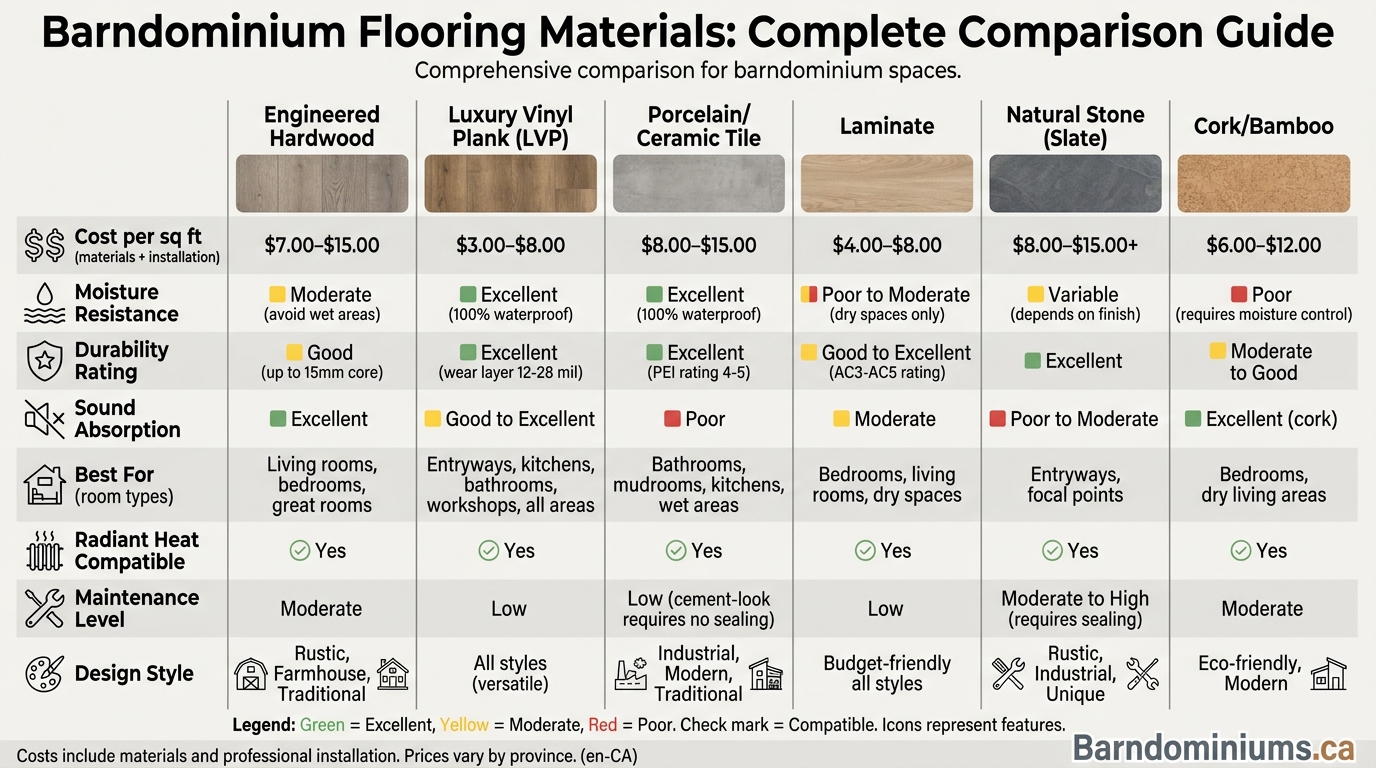
Barndominium Flooring Materials Comparison: Costs, Durability & Best Uses
Picking the right flooring for your barndominium means finding a balance between durability, moisture resistance, and style – all while considering your budget and lifestyle. Whether you’re drawn to the classic look of hardwood or the practicality of vinyl, each option has its strengths and trade-offs. Below, we’ll break down the most popular choices to help you decide what works best for your space.
Hardwood Flooring
While traditional hardwood may not handle moisture or temperature swings well, engineered hardwood is a smarter choice for barndominiums. It combines a real wood veneer with a composite core (up to 15 millimetres thick), offering better stability and sound absorption – key for open-concept spaces. Engineered hardwood works beautifully in living areas or great rooms, but it’s best to avoid using it in moisture-prone areas like mudrooms or bathrooms.

Vinyl Flooring
Luxury vinyl flooring is a standout option for barndominiums, especially in Canada’s climate. Its waterproof construction makes it perfect for entryways and other areas that deal with snow, slush, or mud during winter. Many modern vinyl planks include wear layers up to 28 mil thick, providing excellent durability for high-traffic spaces. It’s easy to install over concrete slabs and adapts well to the structural shifts of metal-framed buildings. Vinyl is also versatile enough for bathrooms, kitchens, and living areas, and it pairs seamlessly with in-floor heating systems.
Tile and Porcelain Flooring
For unmatched durability and water resistance, porcelain and ceramic tiles are hard to beat. They’re ideal for bathrooms, mudrooms, and other wet spaces. Wood-look porcelain tiles mimic the warmth of hardwood without the moisture issues, while cement-look tiles create a sleek, industrial vibe with minimal upkeep. However, tile doesn’t absorb noise as well as softer materials.
"Because tile is a hard material, it won’t absorb noise as effectively as luxury vinyl or hardwood, making it a better choice for secondary rooms rather than main living spaces." – Eimile Campbell, Marketing Copywriter, The Tile Shop
Tiles with a PEI rating of 4–5 can handle heavy use, and natural stone options like slate can add a striking touch, though they require more maintenance. Cement-look porcelain tiles, on the other hand, eliminate the need for resealing, making them a low-maintenance choice.
Laminate Flooring
If you’re looking for an affordable option that mimics the look of wood or stone, laminate is worth considering. It’s durable, low-maintenance, and simple to install, thanks to click-lock systems that work well on concrete slabs. Laminate is best suited for dry spaces like bedrooms or living rooms. For high-traffic areas, choose products with AC3–AC5 ratings for added durability. While it doesn’t absorb sound as effectively as engineered hardwood or vinyl, it still provides moderate sound dampening and works well with in-floor heating systems – perfect for cold Canadian winters.
Stone, Cork, and Bamboo Flooring
Natural stone flooring, like slate, adds a unique and durable touch to barndominiums, especially in entryways or as focal points. However, stone typically offers limited sound absorption and requires some maintenance, with water resistance depending on the type and finish. Eco-friendly options like cork and bamboo bring their own benefits: cork provides natural insulation and cushioning, while bamboo offers comparable hardness to hardwood but regenerates faster. Both materials require careful moisture control, making them more suitable for dry areas. While these specialty options can cost more than vinyl or laminate, they’re often less expensive than premium hardwood and are a great choice for those prioritizing sustainability or distinctive design.
Best Flooring for Different Barndominium Rooms
Selecting the right flooring for your barndominium means considering each room’s purpose and unique demands. Workshops need tougher materials than bedrooms, while kitchens require surfaces that can handle spills and heavy use. Let’s break down the best options for each space based on durability, style, and practicality.
Kitchen and Dining Areas
For kitchens and dining areas, luxury vinyl and wood-look porcelain tile are standout options. Why? These materials are waterproof, easy to clean, and can handle the daily wear and tear of food prep and family meals.
To maintain a cohesive look, limit your flooring choices to three types throughout the home. As Just Wood puts it:
"A floor should connect your home, not divide it."
For example, if you transition from tile in the kitchen to wood-look flooring in the dining area, ensure the tones, finishes (e.g., satin vs. glossy), and plank directions match. This approach creates a seamless flow, making your space feel larger and more unified.
Living Rooms and Bedrooms
In living rooms and bedrooms, engineered hardwood and luxury vinyl plank are excellent picks. They bring warmth, comfort, and sound absorption – key benefits for large, open spaces. Engineered hardwood, with its real wood veneer over a sturdy composite core (up to 15 millimetres thick), also helps reduce echoes, which can be a challenge in barndominiums with high ceilings.
If you’re working within a tighter budget, laminate flooring offers a convincing wood-like appearance and works well in bedrooms. All three options are compatible with in-floor radiant heating, an essential feature for staying cosy during Canadian winters. For bedrooms, lighter-toned flooring can make the space feel more open and inviting.
Workshops and Utility Areas
For workshops and utility rooms, cement-look porcelain tile and luxury vinyl planks are top contenders. These materials are built to handle heavy tools, equipment, and industrial usage while requiring minimal upkeep. Cement-look tile, in particular, offers durability without the need for regular sealing.
Eimile Campbell from The Tile Shop highlights this advantage:
"Cement is a popular flooring choice for barndominiums, but if you’d prefer to avoid the upkeep of regular sealing, cement-look tile… provides a stylish, durable and low-maintenance alternative."
Luxury vinyl planks are another strong option, especially those with wear layers up to 28 mil. They’re completely waterproof, making them perfect for spaces prone to spills or moisture. Plus, they pair well with in-floor heating, keeping these areas functional and comfortable year-round despite Canada’s challenging climate.
How to Install Barndominium Flooring
The first step in installing barndominium flooring is assessing your foundation. If you’re working with a monolithic slab, it serves as both the foundation and the floor surface. Make sure the slab is properly cured before moving forward. For raised foundations with crawl spaces or basements, you’ll need to install joists and subflooring first. While this adds an extra step, it also makes it easier to access utilities like plumbing and HVAC systems, which is a big plus. These foundation details are especially important to ensure your flooring holds up well in Canada’s varying climate conditions.
Don’t skip moisture barriers and insulation – they’re crucial in Canada’s climate. For concrete slabs, the moisture levels should be below 3 lbs per 1,000 square feet (as measured by a calcium chloride test) or under 75% relative humidity. Plywood subfloors should have a moisture content of less than 12%. In colder zones across Canada (Zones 4-7), aim for floor insulation with an R-value between R-25 and R-30. This helps prevent heat loss and protects pipes from freezing during the winter.
Different flooring materials require specific acclimation periods. For example, vinyl and laminate should sit in the installation room for 48–72 hours with the HVAC running, while solid hardwood needs a longer acclimation time of 5–7 days. Be sure to leave expansion gaps of 8–10 millimetres around walls and fixed objects. This is particularly important in places like Toronto, where humidity levels swing dramatically – from over 60% in summer to below 25% in winter. Following these steps not only ensures proper installation but also keeps maintenance costs manageable in the long run.
It’s also a good idea to plan the installation for the entire property rather than tackling it room by room. Absolute Steel offers this practical advice:
"Be sure to saw-cut expansion joints in the slab, within an appropriate time after the pour, or troweled-in expansion joints done during the concrete finishing steps."
These joints are essential for preventing random cracks that could show through your finished floor.
For barndominiums with heavy loads or two-storey designs, consider increasing the slab thickness from 100 mm to 150–200 mm. Use 4000-psi concrete reinforced with #3 rebar or fibre mesh for added strength. To protect against moisture damage, install vapour barriers, which cost between $0.10 and $0.25 per square foot, and underlayment, priced at $0.25 to $0.60 per square foot. Taking these precautions can save you from costly repairs down the road.
Flooring Costs and Budget Planning
When planning your barndominium flooring budget in Canada, it’s all about balancing performance with cost. Flooring materials and installation prices vary widely, so understanding these differences is key. Here’s a quick breakdown of average costs per square foot, including materials and professional installation:
- Vinyl planks: $3.00–$8.00
- Laminate: $4.00–$8.00
- Engineered hardwood: $7.00–$15.00
- Porcelain tile: $8.00–$15.00
Labour costs also vary across provinces. For instance, vinyl installation averages $3.75 per square foot in Quebec but only $2.65 in Alberta.
Budget Scenarios for a 1,000-Square-Foot Barndominium
Your overall budget will depend on the materials you choose. Here’s what you might expect for different flooring strategies:
- Budget-friendly option: Using vinyl plank throughout could cost $3,000 to $8,000.
- Mid-range option: Combining laminate in living spaces with tile in wet areas might cost $5,000 to $10,000.
- Premium option: Engineered hardwood paired with porcelain tile could range from $8,000 to $15,000.
- Luxury option: Wide-plank white oak and heated tiles could push costs to $12,000 or more, potentially exceeding $20,000.
Additional Costs to Consider
Beyond materials and installation, there are hidden expenses to account for:
- Floor removal: $1.15 to $2.75 per square foot, with tile being the priciest to remove.
- Underlayment: Adds $0.25 to $0.75 per square foot.
- Heated floors: Expect $8.00 to $15.00 per square foot plus installation.
- Taxes: Provincial tax rates vary – Alberta’s 5% GST versus Quebec’s 14.975%.
To avoid surprises, order 10% extra material (15% for intricate patterns) and be aware that complex layouts can increase labour costs by 25–40%. It’s also wise to set aside a contingency fund of 10–20% for unexpected expenses.
"The right flooring choice delivers a return on investment of 70–80% at resale, according to the Canadian Real Estate Association." – RenoHouse
Investing in quality flooring not only enhances your space but also boosts resale value. Durable, low-maintenance options are especially appealing for long-term benefits.

Matching Flooring to Your Barndominium Design
Choosing the right flooring for your barndominium means balancing style with practicality. You want materials that not only look great but can also handle the wear and tear of daily life.
Stick to the Rule of 3. This simple guideline suggests limiting your flooring choices to three types. Why? It helps avoid a mismatched look and makes open spaces feel more cohesive – especially important for barndominiums that often range between 1,500 and 2,500 square feet. A unified look can make these large, open spaces feel intentional and inviting.
"The Rule of 3 streamlines choices and unifies your space." – Just Wood
For rustic or farmhouse designs, consider engineered hardwood or luxury vinyl planks that mimic natural wood. These materials bring warmth and texture to your space. For example, in September 2025, designer @saramoltumyr used Adoni Black slate tile in a prefab barndominium entryway, creating a striking contrast that complemented a rustic aesthetic. Natural stone like slate is another great option, offering unique patterns that add character. Just keep in mind that stone doesn’t absorb sound as well as softer materials, which can affect acoustics.
If you’re leaning toward industrial or modern styles, cement-look porcelain tiles are a solid choice. In the same month, West Bay Homes, led by Rick and Kelli Vogelgesang, featured Softcement Graphite porcelain tiles in an industrial-style bathroom, extending the material onto the walls for a seamless, modern vibe. Patterned tiles are another way to add personality. Designer @plmdesignsllc used Laura Ashley Mr Jones Charcoal patterned porcelain tile in a barndominium mudroom to create a playful yet stylish touch.
When planning your flooring, don’t overlook acoustics. Open floor plans can amplify noise, and hard surfaces like stone or tile tend to create echoes. To combat this, look for flooring products designed to improve sound absorption in main living areas. If you’re mixing materials, aim for harmony by matching tonal ranges (light, medium, or dark) and finishes (matte or glossy). Also, keep the flooring direction consistent across rooms to maintain visual flow.
Conclusion: Choosing the Right Flooring for Your Barndominium
Picking the perfect flooring for your barndominium comes down to balancing durability, style, and budget. One key step? Confirm your foundation type early to avoid unexpected issues.
Canada’s climate plays a major role in flooring decisions. Choose materials that work well with energy-saving measures like spray foam insulation to handle the country’s temperature swings. For cold-weather comfort, options like tile, stone, or engineered wood pair beautifully with radiant in-floor heating, thanks to their excellent thermal conductivity. In moisture-prone areas such as entryways or bathrooms, go for 100% waterproof options like luxury vinyl or porcelain tile. These practical considerations help ensure your flooring suits each space’s unique needs.

Think about how you’ll use each area of your barndominium. These spaces often combine living areas with workshops or hobby zones, so your flooring should transition smoothly between high-traffic and more relaxed spaces. Keeping costs in check can also leave room in your budget for standout finishes.
Long-term performance is another factor to weigh. While cheaper materials may save money upfront, they often require frequent replacement. For example, high-quality laminate flooring can last 10 to 15 years, whereas lower-grade versions may wear out much sooner. Stained concrete can be a durable choice, but professional sealing with a quality polyurethane finish is essential for longevity. If you’re considering tile, check product reviews to ensure they resist cracking over time.
Finally, take site-specific factors into account – things like moisture levels, foot traffic, pets, and even rental potential. Neutral colours, such as warm greys, offer timeless appeal and flexibility. For open floor plans, consider sound-absorbing materials like engineered hardwood or luxury vinyl to keep noise levels in check. The right flooring not only ties your design together but also stands the test of time.
FAQs
What flooring works best with radiant in-floor heating in a Canadian barndominium?
Tile and stone are great options for radiant in-floor heating in Canadian barndominiums. These materials conduct heat efficiently and hold onto warmth for longer periods, making them both effective and comfortable for this heating method.
How do I test and control moisture before installing flooring on a concrete slab?
To ensure a concrete slab is ready for flooring installation, it’s essential to test and monitor moisture levels. Measure the percentage moisture content (%MC), surface temperature, and ambient conditions to confirm the slab is sufficiently dry. This step helps prevent future flooring problems caused by excess moisture. Be sure to follow industry-recommended testing methods for accurate results.
How do I choose flooring that reduces echo in an open-concept barndominium?
One way to tackle echo in a spacious barndominium is by choosing flooring materials that help absorb sound. Luxury vinyl flooring is an excellent option. Not only does it reduce noise, but it also provides a comfortable surface to walk on. Thanks to its durable wear layers, this flooring helps muffle sound, making it a practical solution for large, open areas. Opting for sound-absorbing flooring can make a big difference in creating a more acoustically pleasant space.