
Steel Sourcing Tips for Eco-Friendly Barndominiums

If I want lower-carbon steel for a Canadian barndominium, I need to check the paperwork first, not the sales pitch. The short version is simple: I compare recycled content, EAF production, A1–A3 carbon data, EPDs, MTRs, coatings, and delivery scope before I sign anything.
A few numbers stand out. Canadian EAF steel can use 95%+ scrap and cut energy use by about 74% versus virgin steel. Embodied carbon can also vary a lot: some blast-furnace steel lands around 1.8 to 2.5 kg CO2e/kg, while some EAF steel can be closer to 0.5 kg CO2e/kg. Over a full shell, that gap can mean a lot for both carbon and cost.
If I were buying steel for a barndominium or shouse in Canada, I’d focus on these points first:
- Ask for proof of recycled content
- Check whether the steel was made in an EAF
- Request EPDs, MTRs, and mill origin records before approving the quote
- Match coatings to the site, especially near saltwater, farm use, or damp areas
- Use local snow, wind, and moisture conditions in the quote brief
- Work with a P.Eng to avoid ordering more steel than the building needs
- Check transport distance, delivery terms, and foundation data
- Think about end-of-life recovery, including bolted connections and easy disassembly
Quick comparison
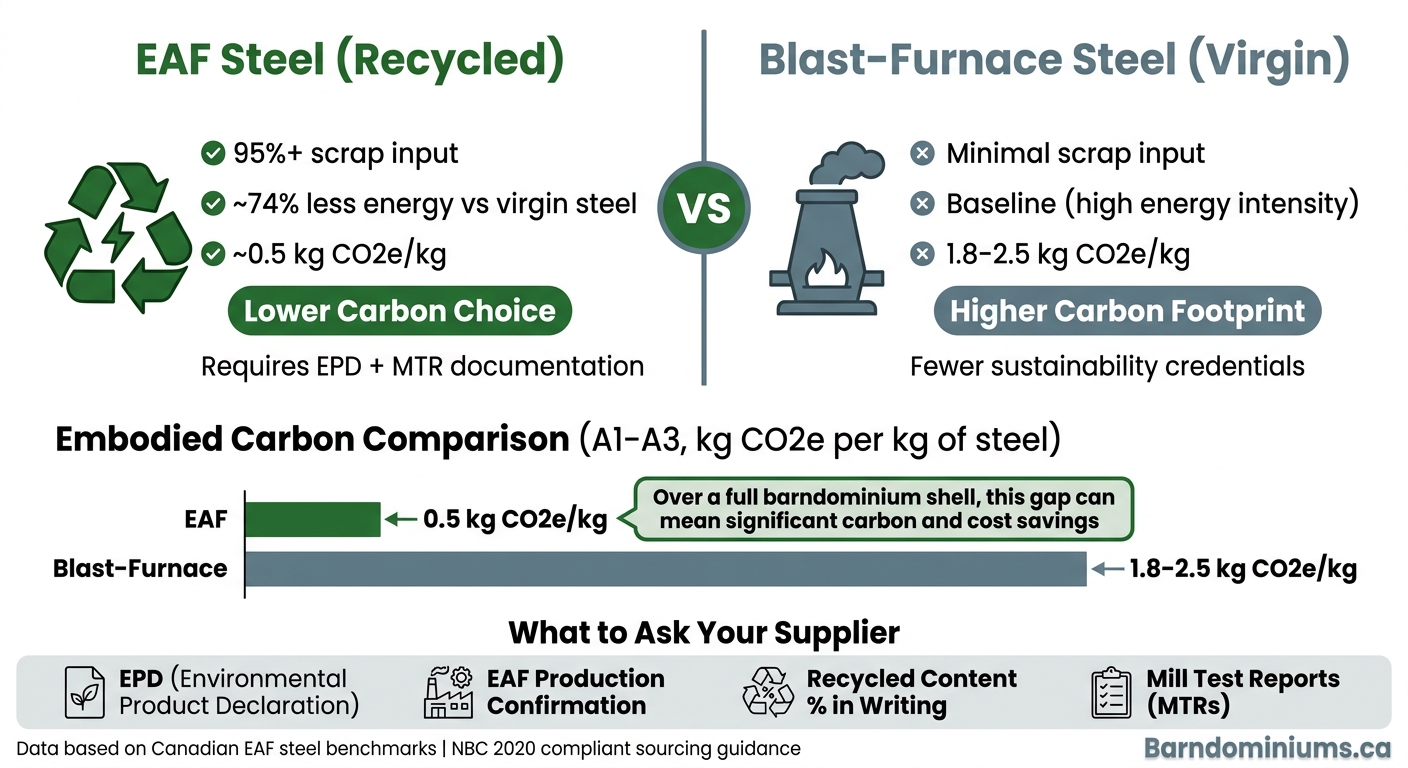
EAF vs Blast-Furnace Steel: Embodied Carbon & Eco Impact for Canadian Barndominiums
| What I compare | What I want to see | Why it matters |
|---|---|---|
| Production method | EAF steel | Often lower carbon and high scrap input |
| Recycled content | Written proof with percentages | Confirms supplier claims |
| Carbon data | A1–A3 values in an EPD | Makes quotes easier to compare |
| Mill records | Mill origin docs + MTRs | Shows what I’m buying |
| Coating system | Spec suited to inland, coastal, or farm exposure | Helps steel last longer |
| Engineering | Local load design under NBC 2020 | Fits Canadian snow and wind conditions |
| Quote scope | Delivery, anchor bolt plans, reaction data | Reduces surprise costs |
| End-of-life | Bolted connections, separated materials | Makes reuse and recycling easier |
Put simply, I’d buy steel the same way I’d buy a roof or foundation package: by checking fit, paperwork, and long-term performance, not just the lowest price in CAD.
sbb-itb-d6e8a6a
How to tell whether a steel product is actually sustainable
Treat sustainability claims as unproven until the supplier shows the paperwork. For a Canadian barndominium, the steel framed houses and shells account for most of the steel-related footprint. Start by checking recycled content, then confirm it with EPDs and mill records.
Check recycled content, recyclability, and embodied carbon
If a supplier says their steel is "recycled", ask for proof of the percentage of post-consumer and post-industrial recycled content. Also ask whether the steel was made in an Electric Arc Furnace (EAF). EAF steel usually contains much more recycled material and has a lower carbon footprint than blast-furnace steel.
Embodied carbon is where steel products often differ the most, especially A1–A3 emissions, which cover extraction through to the factory gate. Conventional blast-furnace steel usually falls between 1.8 to 2.5 kg CO2e/kg, while recycled-content EAF steel can be as low as 0.5 kg CO2e/kg. Across a full barndominium shell, that gap adds up fast. This is a key consideration when evaluating barndominium kits for your project.
Steel can be recycled again and again, but don’t just take that at face value. Get the recycled content and mill process confirmed in writing.
Ask for EPDs and sourcing documentation
An Environmental Product Declaration (EPD) verifies a product’s cradle-to-gate impact, especially its GWP.
CISC industry-average EPDs apply only to steel from Canadian and American mills. They’re a decent starting point, but mill-specific EPDs are better when you can get them. That lets you compare the actual GWP of the steel in the quote, not just an average. It also helps to check the expiry date, since many EPDs are valid for five years.
Ask for these documents in writing before accepting a quote:
- EPD
- Mill origin records
- Mill-specific sourcing documents, if available
If a supplier can’t provide an EPD or clear origin and mill documentation, that’s a red flag.
Compare coatings, durability, and maintenance needs
After recycled content is confirmed, look at the protection system the steel will need on site. Coatings add embodied carbon, but they also help protect steel in humid or corrosive conditions. That trade-off matters. The right coating depends on the site.
There’s another angle here too: upkeep over time. In practice, steel buildings can have 30% to 50% lower maintenance and operating costs over a 25-year window than wood-frame equivalents.
"A steel structure that quietly does its job for 60 years with one mid-life coating refresh carries less unmeasured lifecycle carbon than a wood structure that requires two roof replacements and ongoing pest management." – Green Building Canada
Use A1–A3 GWP to compare products side by side instead of looking only at price per tonne. When you add embodied carbon, coating data, and corrosion resistance into the mix, you get a much clearer view of long-term site fit.
Step-by-step steel sourcing for a Canadian barndominium
Set clear goals before requesting quotes
After you’ve checked sustainability claims, turn those priorities into a plain-language quote brief.
Set a target for lower-carbon steel, such as recycled-content EAF steel. Pick a sourcing region that fits both your budget and your delivery window. If you may expand later, say that at the start so the building can be designed for future expansion at the end wall before the design is locked in.
Put everything into a one-page design brief. Include your postal code so the quote reflects local snow, rain, and wind loads under NBC 2020. That one detail matters more than people think. It also makes quotes much easier to compare in CAD.
Work with engineers to avoid over-specifying steel
Once your brief is ready, get the structure sized before you start comparing suppliers.
Bring in a structural engineer early to right-size members and avoid steel you don’t need. That can save money without cutting performance.
If your layout doesn’t need a clear span, interior columns may reduce steel use. It’s a simple trade-off: more columns, less steel. Review that with your engineer.
State CSA G40.21 compliance, recycled content, and EPD requirements in the design brief.
Collect and compare quotes using a simple scorecard
With the structure sized, compare suppliers on documentation, coatings, and delivery scope. Use one scorecard so each quote is judged on the same basis.
Once you have at least three quotes, place them side by side in one document. Compare:
- Price in CAD
- Recycled content and EPD availability
- Coating spec and delivery scope
For coastal projects within 5 km of saltwater, ask for ISO 12944 C5-Marine rated coatings or hot-dip galvanizing instead of standard primers. Standard primers may look fine on paper, but near saltwater, that’s often not enough.
Also check whether the quote includes sequenced flatbed delivery to your site address or only factory-only pricing, which shifts transport cost and liability to you. And make sure the quote includes foundation reaction data and anchor bolt setting plans.
Request Mill Test Reports (MTRs), Environmental Product Declarations (EPDs), and CSA-A660 certification letters at the quote stage, not after you’ve signed.
Canadian Climate and Regional Factors That Affect Steel Selection
Managing Snow Loads, Condensation, and Thermal Bridging
Your steel spec needs to match the snow, moisture, and temperature conditions at the site. In Canada, that can change a lot from one city to another. Ground snow loads range from 1.1 kPa in Calgary to 3.3 kPa in St. John’s. Under NBC 2020, that gap has to be built into the engineering from the start.
Steel transfers heat fast. If that heat path isn’t broken, you can end up with cold spots, condensation, and long-term moisture trouble inside the wall. That’s why the wall assembly matters just as much as the steel itself. Use the engineer’s wall assembly to limit thermal bridging and control condensation.
In very cold parts of the country, such as Manitoba and Saskatchewan, cold-weather performance needs extra attention. Ask for a steel grade with notch toughness suited to deep-freeze conditions. Your engineer should also confirm the required notch toughness at the site’s design temperature.
After the structure is sized for snow load and low temperatures, the next step is corrosion. Local exposure can change what coating system makes sense.
Corrosion Risks in Coastal, Humid, and Agricultural Areas
Where the building goes has a direct effect on how much corrosion protection the steel needs. Standard Z275 galvanized steel works well in many Canadian conditions and can deliver 25 to 40+ years of service life. The right coating system depends on the exposure level.
If the site is within 5 km of saltwater – for example, in Atlantic Canada or coastal BC – move up to Z350 galvanized, Galvalume, or Zinc-Magnesium (ZM) substrates for better edge protection. Farm sites bring a different problem. Ammonia, fertilizers, and animal waste can be hard on steel, so these settings often call for high-build epoxy or epoxy-urethane coatings to resist organic acids.
Some areas fail first, and they usually aren’t a surprise:
- Fasteners
- Panel edges
- Cut ends
These are common early failure points. Sealed fasteners with corrosion-resistant washers can help. So can rounded or sealed cut edges. Small detailing choices here can save a lot of repair work later.
Plan for Deconstruction and Recycling at End of Life
Service life is one part of the picture. You also need to think about what happens if the building is changed, taken apart, or removed years down the road. If you want the steel to be recovered, design for disassembly.
Bolted connections make deconstruction much easier than welded ones. With accessible fasteners, crews can remove, repair, or recover individual members with less trouble. That helps during future renovations and at the end of the building’s life.
Ask your engineer to keep material types clearly separated in the design. Steel framing, cladding panels, and fasteners should each be easy to identify and remove on their own. That kind of separation makes reuse and recovery more practical.
Conclusion: Build a Lower-Impact Steel Package Without Losing Practicality
The best steel package comes down to three things: good records, the right size, and a fit for the site.
Before you ask for quotes, set a recycled-content target. Then ask suppliers to show proof that the steel is EAF-produced. In the RFQ, ask for EPDs, MTRs, and CSA G40.21 compliance as well. That paperwork matters. It gives you a clearer view of what you’re buying, not just the price on the page.
In Canada, carbon-conscious building design can cut embodied emissions by up to 41% while also saving hundreds of thousands of dollars in material costs. That’s a big deal. It shows that lower-impact choices don’t have to mean giving up budget control.
Coatings and detailing should match local exposure. Pick coatings based on the site’s actual conditions so the steel lasts longer and needs less upkeep. Near the coast, for example, salt exposure changes the equation. Inland, the demands may be very different.
It also pays to work with a licensed structural engineer (P.Eng) to size members for actual loads. If steel is over-specified, you’re paying for more material than the job needs, and that adds both cost and embodied carbon.
If you need pricing and planning help, Barndominiums Canada can connect you with a verified Canadian Top provider.
FAQs
How do I verify low-carbon steel claims?
Ask your supplier for an Environmental Product Declaration (EPD). An EPD is a standard document that shows the environmental impact and global warming potential of a steel product across its full life cycle.
You can get industry-average EPDs through the Canadian Institute of Steel Construction. But if you want the best project data, facility-specific EPDs are the better pick. They give you a closer look at the emissions tied to the exact steel source you may use.
Comparing EPDs also makes it easier to assess emissions intensity, so you’re not judging products on claims alone.
What documents should I request before I sign?
Before you sign anything, ask for stamped structural drawings from an engineer licensed in your province. You should also get proof that the supplier’s facility is certified to CSA-A660:21.
It’s also smart to ask for a written package list. That list should spell out what’s included:
- framing
- panels
- trim
- fasteners
- freight costs
On top of that, get written confirmation that the steel meets CSA G40.21. And make sure there’s a written warranty that clearly covers both structural issues and material defects.
Which coating is best for my site in Canada?
The right coating comes down to how much stress the site puts on the metal.
For most homes, especially for roofing and cladding, Z275 galvanized steel is the standard choice. It gives you a solid middle ground between corrosion protection and cost.
If the building is near the coast or in an industrial area, Z350 galvanized steel is usually the better fit because it stands up longer in harsher conditions.
Galvalume (GL) is often chosen for roofing when long service life is the main goal. Zinc-Magnesium (ZM) tends to give the best all-round performance, with one big plus: it performs especially well at cut edges, where corrosion often starts.
If looks matter just as much as protection, pre-painted steel with systems like PVDF is a strong option. It’s well suited to UV exposure and salt-heavy air.