
How to Prevent Rust on Canadian Barndominiums

Rust on a Canadian barndominium usually starts in the same places: panel bases, fasteners, seams, scratches, and anywhere water sits after snowmelt. If I want to keep steel in good shape, I need to focus on coatings, drainage, fastener care, scratch repair, and set inspection dates.
Here’s the short version:
- Pick the right steel and finish for the site, such as G90 galvanized steel, Galvalume in coastal areas, and PVDF or SMP paint systems.
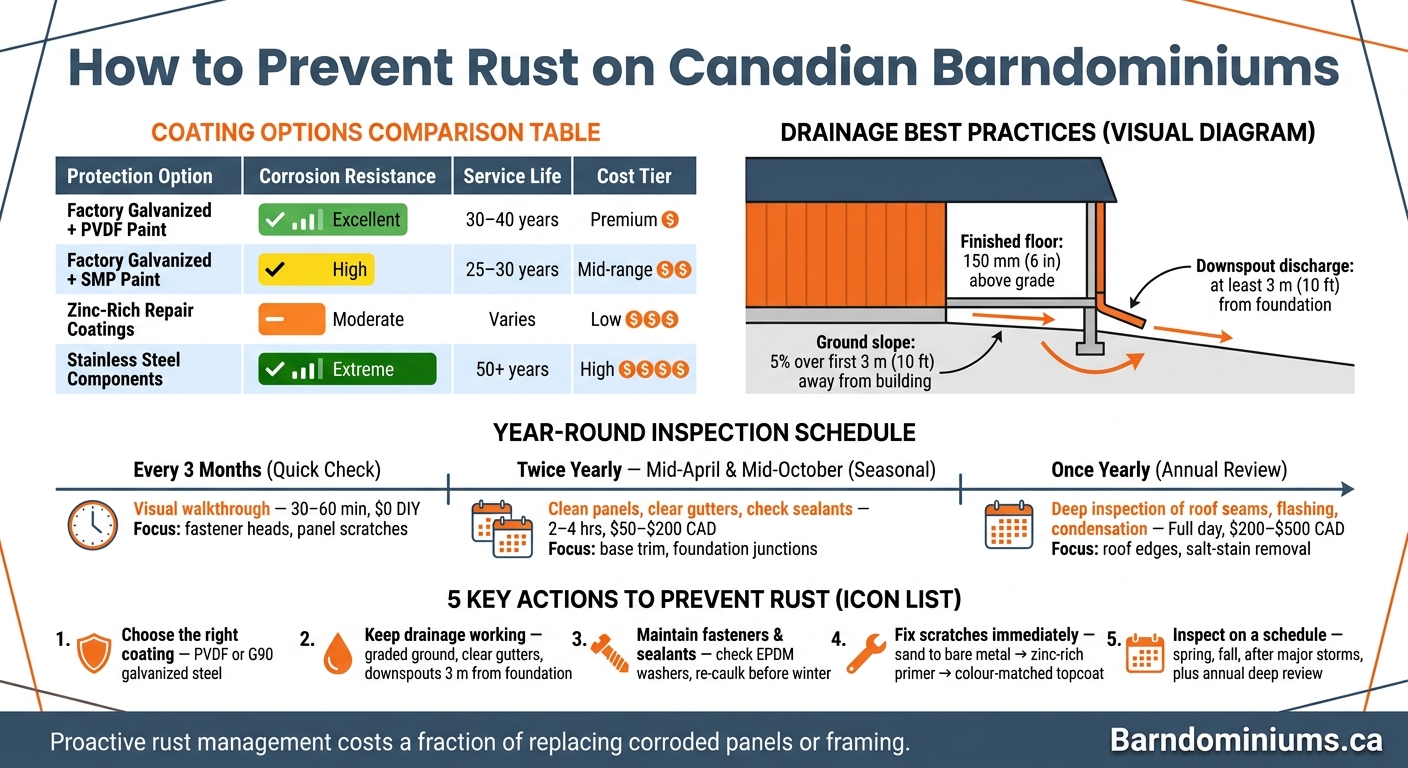
- Keep water moving away with grade that slopes about 5% over the first 3 m (10 ft), a finished floor about 150 mm (6 in) above grade, and downspouts that discharge at least 3 m (10 ft) from the foundation.
- Watch fasteners and seams because freeze-thaw weather can crack washers, loosen screws, and let water in.
- Fix scratches right away by cleaning the spot, sanding to bare metal, applying a zinc-rich coating, and painting over it.
- Inspect twice a year, with a close look in mid-April after snowmelt and again in mid-October before hard freeze. After big storms, I should also do a short visual check.
A few numbers stand out. Painted galvanized panels can last about 25–40 years depending on the coating, while stainless parts can last 50+ years. On the cost side, small upkeep jobs may run about $50–$200 CAD in supplies for seasonal work, while a yearly pro review may cost about $200–$500 CAD.
Canadian Barndominium Rust Protection: Coatings & Inspection Guide
Will A Barndominium Rust?
sbb-itb-d6e8a6a
Quick comparison
| Area | What I should do | Key detail |
|---|---|---|
| Coatings | Use steel and paint suited to local weather | PVDF lasts longer than SMP; coastal sites often suit Galvalume |
| Drainage | Keep snowmelt and runoff off the walls | 5% slope for first 3 m; downspouts 3 m from foundation |
| Fasteners | Check screws, washers, and sealant | Look for red streaks, cracked EPDM, loose heads |
| Surface damage | Repair chips and light rust early | Sand, zinc-rich coating, touch-up paint |
| Inspections | Follow a set routine | Spring, fall, and after major storms |
If I keep water away, repair damage early, and stick to a simple schedule, I can stop most rust before it turns into a costly panel or framing repair.
Choose coatings and materials that handle snow, salt, and cold
Coatings slow corrosion, but they only work when the system fits the site. Start with the base steel, then pick the coating based on how harsh the conditions are.
Galvanized steel, painted panels, and zinc-rich repair products
G90 galvanized steel is a zinc-coated steel standard often used in metal buildings. The zinc layer corrodes first, which helps protect the steel underneath, even if the surface gets scratched.
In coastal parts of Canada, such as British Columbia and Nova Scotia, or when building a barndominium in Ontario, Galvalume is often a better fit. It contains 55% aluminium, 43.5% zinc, and 1.5% silicon. That mix gives it stronger corrosion resistance in humid and coastal air, where standard galvanized steel often has a shorter service life.
The topcoat matters too. PVDF coatings offer the highest resistance to fading, chalking, and weathering. Silicone-modified polyester (SMP) costs less and still provides strong weathering resistance. If you’re trying to balance budget and performance, that’s usually the next option people look at.
Damage needs fast attention. Once a coating gets scratched, rust can start working its way in. Sand or wire-brush the damaged spot down to bare metal, then apply a zinc-rich repair coating to bring back the sacrificial layer. After that, add a colour-matched, rust-resistant topcoat.
Where upgraded components are worth the extra cost
Some parts take more abuse than others. Put the money into panel bases, gutters, downspouts, fasteners, and roof seams.
Stainless steel fasteners with EPDM sealing washers are worth the higher price in these spots. Lower-grade screws can corrode fast, and once that happens, they create an easy path for rust to spread into the panel. Formed base trim that extends steel panels past the foundation edge also helps. It keeps panel bases farther from standing water and snowmelt, which is often where trouble starts.
Comparison table: common rust-protection options for Canadian sites
Common coating options for Canadian sites:
| Protection Option | Corrosion Resistance | Maintenance Needs | Service-Life Expectancy | Cost |
|---|---|---|---|---|
| Factory Galvanized + PVDF Paint | Excellent | Low (regular washing) | 30–40 years | Premium |
| Factory Galvanized + SMP Paint | High | Low (regular washing) | 25–30 years | Mid-range |
| Zinc-Rich Repair Coatings | Moderate (small areas) | As needed for damage | Varies by application | Low |
| Stainless Steel Components | Extreme | Very low | 50+ years | High |
Coatings lower the risk, but standing water often does the most damage, so drainage is the next piece to fix.
Control water with grading, roof runoff, and snow management
Even the best coating won’t last if water sits against the building. Drainage is the next line of defence. The goal is simple: keep water off panels, trim, and fasteners, and move it away fast.
Grading and foundation drainage to keep base panels dry
Set the finished floor about 150 mm (6 in) above the surrounding grade. That gap helps keep base panels out of pooling water and snowmelt.
The ground should slope away from the building at about 5% for the first 3 m (10 ft). In plain terms, that’s a drop of about 150 mm over 3 m. It’s not fancy, but it works.
Downspouts should discharge at least 3 m (10 ft) from the foundation. If they empty too close to the wall, water just circles back to the same trouble spot.
Spring melt can also bring road salt from nearby driveways or roads, which speeds up corrosion. And one rule is worth making non-negotiable: never pile snow against exterior walls.
Gutters, downspouts, and roof details that reduce standing water
Blocked gutters are a common source of rust staining on lower wall panels. When water spills over instead of moving through the downspouts, it runs down the steel cladding and collects at the base.
That’s why clear gutters every spring and fall. It’s a small maintenance job that can prevent a bigger repair later.
Roof details matter too. Flashing at roof seams, valleys, and lean-to junctions should stay tight and intact. These areas are the first to trap snow and ice. After major storms, check whether sliding snow is blocking runoff or setting up ice dams near the eaves. Spring thaw tends to expose the trouble spots first, especially around panel bases, fasteners, and seams.
Once water is under control, the next weak points are fasteners and scratches.
| Drainage Component | Best Practice |
|---|---|
| Gutters | Clear every spring and fall; check for overflow staining on wall panels below |
| Downspouts | Discharge at least 3 m (10 ft) from the foundation |
| Base trim | Extend past the foundation edge to direct water away from the slab |
| Eaves | Monitor for ice dams after major storms to keep runoff paths open |
| Roof Valleys & Lean-Tos | Check for snow and ice accumulation that can trap moisture |
Protect fasteners, fix scratches early, and stop small rust spots from spreading
Once runoff is under control, the next rust risks are fasteners, seams, and scratched coatings.
Good drainage helps, but it doesn’t solve everything. Chipped edges, loose fasteners, and failed sealant can still open the door to rust once snowmelt and road salt hit bare metal.
Fastener and joint care in freeze-thaw cycles
Fasteners are one of the most common starting points for corrosion on steel buildings. Here’s why: water slips in around a screw head, freezes, expands, and weakens the seal. Then winter does the same thing again and again.
Inspect rust-resistant screws with EPDM sealing washers for looseness, cracking, or rust. During your spring inspection, look at fastener heads for surface rust and make sure the washers aren’t brittle or cracked. Check sealant around seams, flashings, doors, and windows, and reseal worn joints in dry weather.
| Maintenance Point | Early Warning Sign | Action |
|---|---|---|
| Fasteners | Red streaks around heads; cracked EPDM washers | Replace the screw and washer |
| Cut Edges | Orange rust along the edge line | Sand, prime, and touch up |
| Seams & Joints | Peeling sealant; moisture pooling | Re-caulk or reseal |
| Panels | Pitting or deep pitting in the metal | Call a qualified building professional for pitting or flaking |
Step-by-step repair for scratches and minor surface rust
Thin orange or red streaking without pitting is still a DIY job. Once you spot pitting – small craters in the metal – or flaking, bring in a qualified building professional to assess it.
For surface rust you can deal with yourself, follow this basic process:
- Clean and dry the area, then abrade the spot down to bare metal
- Apply a zinc-rich or rust-inhibitive coating
- Finish with matching touch-up paint
"The cost of proactive rust management is a fraction of the expense involved in replacing corroded panels, framing components, or fasteners." – Herbert Broderick, CEO at Metal Pro Buildings
Fix chips and scratches early. One wet season can turn a small mark into a much bigger repair.
Build these checks into your spring and fall inspections.
Build a year-round inspection routine and review the key actions
Seasonal checks for spring, fall, and after major storms
A simple routine keeps your coating, drainage, and repair work doing its job all year.
The riskiest point in the year is right after winter. Snowmelt, road salt, and freeze-thaw wear tend to show up at the same time, which makes spring the best time to spot issues before they get worse.
Plan your spring walkthrough for mid-April, after snowmelt and ground saturation have passed. Pay close attention to base trim at the foundation junction, fastener heads, roof edges, and any spots where ice may have pushed water into seams. Check gutters and downspouts for clogs. Then wash the exterior panels to remove salt residue before it keeps eating away at the surface.
Your fall inspection in mid-October, before the first hard freeze, should focus on prep for winter. Re-caulk or reseal joints that show wear, clear debris from the foundation area and roofline, and make sure drainage is moving water away from the building.
After major storms – heavy snow, hail, or high winds – do a quick visual check of the eaves, gutters, and downspouts. Watch for new dents or scratches that may expose bare steel.
Comparison table: quick checks vs. seasonal inspections vs. annual reviews
A set schedule is much easier to stick with than fixing things only when something goes wrong.
| Inspection Type | Typical Tasks | Frequency | Approx. Cost/Time (CAD) | High-Snow/Salt Priority |
|---|---|---|---|---|
| Quick check | Visual walkthrough for scratches, dents, and debris | Every 3 months | 30–60 minutes / $0 (DIY) | Fastener heads and panel scratches |
| Seasonal (Spring/Fall) | Cleaning panels, clearing gutters, checking sealants/caulking | Twice yearly (Apr/Oct) | 2–4 hours / $50–$200 (supplies) | Base trim and foundation junctions |
| Annual Review | Deep inspection of roof seams, flashing, and condensation points | Once yearly | Full day / $200–$500 (if pro) | Roof edges and salt-staining removal |
Conclusion: five actions that prevent most rust problems
With a basic routine, most rust on a Canadian barndominium can be avoided. The main trouble spots are worn coatings, blocked drainage, and damage that goes unnoticed too long.
These five actions handle most rust risk:
- Choose the right coating from the start – PVDF-coated panels or G90 galvanized steel.
- Keep drainage working – graded ground, clear gutters, and downspouts that move water away from the foundation.
- Maintain fasteners and sealants – check EPDM sealing washers and re-caulk worn joints before winter.
- Fix scratches immediately – sand to bare metal, apply zinc-rich primer, and finish with a colour-matched topcoat.
- Inspect on a schedule – spring, fall, and after major storms, plus a deeper annual review of roof seams, flashing, and condensation points.
Steady, low-cost upkeep – a tube of sealant, a can of touch-up paint, an afternoon twice a year – costs far less than replacing corroded panels or framing. Barndominiums Canada connects you with verified Canadian providers who can walk you through rust-resistant materials and design choices before you break ground.
FAQs
What parts of a steel barndominium rust first?
Rust usually starts in the spots that take the most wear or hold moisture the longest.
That often means fastener heads, panel edges, and cut ends. If the coating gets damaged in any of those areas, bare steel can be exposed and rust can start to form.
The joint where steel panels meet the concrete foundation is another common trouble spot. Snowmelt and standing water can reach the panel edges there, which makes that area more likely to rust.
Scratches and chipped paint matter too. Even small surface damage can expose the steel underneath, so it’s smart to check those areas on a regular basis.
How do snow, salt, and freeze-thaw speed rust?
In Canada, snow, road salt, and freeze-thaw cycles can speed up rust in a big way. They keep moisture sitting against steel and help oxidation move along faster.
Snowmelt often collects around panel bases, fasteners, and roof seams. Those spots are common starting points for rust because water tends to linger there.
Road salt makes the problem worse. It sticks around on metal surfaces and pushes corrosion further.
Freeze-thaw cycles add another layer of trouble. Moisture can slip into edges and joints, then freeze and expand. That expansion can crack protective coatings, widen small gaps, and let even more water in.
When should I call a professional for rust?
Call a professional when rust has moved past surface discolouration and starts showing pitting or structural deterioration.
At that point, this isn’t just a cosmetic issue. A qualified inspector can check whether the steel’s integrity has been affected, remove the rust safely, and apply protective coatings.
Basic owner maintenance is fine for small scratches and fastener checks. But when corrosion could affect performance or safety, it’s time to bring in a pro.
Related Blog Posts
- Research: Metal Roof Lifespan for Barndominiums in Canada
- FAQs About Weather-Resistant Coatings for Barndominiums
- Steel Sourcing Tips for Eco-Friendly Barndominiums
- HVAC Integration for Steel Barndominiums
{“@context”:”https://schema.org”,”@type”:”FAQPage”,”mainEntity”:[{“@type”:”Question”,”name”:”What parts of a steel barndominium rust first?”,”acceptedAnswer”:{“@type”:”Answer”,”text”:”Rust usually starts in the spots that take the most wear or hold moisture the longest. That often means fastener heads, panel edges, and cut ends. If the coating gets damaged in any of those areas, bare steel can be exposed and rust can start to form. The joint where steel panels meet the concrete foundation is another common trouble spot. Snowmelt and standing water can reach the panel edges there, which makes that area more likely to rust. Scratches and chipped paint matter too. Even small surface damage can expose the steel underneath, so it’s smart to check those areas on a regular basis.”}},{“@type”:”Question”,”name”:”How do snow, salt, and freeze-thaw speed rust?”,”acceptedAnswer”:{“@type”:”Answer”,”text”:”In Canada, snow, road salt, and freeze-thaw cycles can speed up rust in a big way. They keep moisture sitting against steel and help oxidation move along faster. Snowmelt often collects around panel bases, fasteners, and roof seams. Those spots are common starting points for rust because water tends to linger there. Road salt makes the problem worse. It sticks around on metal surfaces and pushes corrosion further. Freeze-thaw cycles add another layer of trouble. Moisture can slip into edges and joints, then freeze and expand. That expansion can crack protective coatings, widen small gaps, and let even more water in.”}},{“@type”:”Question”,”name”:”When should I call a professional for rust?”,”acceptedAnswer”:{“@type”:”Answer”,”text”:”Call a professional when rust has moved past surface discolouration and starts showing pitting or structural deterioration. At that point, this isn’t just a cosmetic issue. A qualified inspector can check whether the steel’s integrity has been affected, remove the rust safely, and apply protective coatings. Basic owner maintenance is fine for small scratches and fastener checks. But when corrosion could affect performance or safety, it’s time to bring in a pro.”}}]}