
Mound vs Conventional Septic for Barndos

If your lot has good native soil and enough dry depth, I’d usually expect a conventional septic system to cost less and need less service. If groundwater, bedrock, or clay get in the way, I’d expect a mound system to be the path that gets approved.
Here’s the short version:
- Conventional septic is often the lower-cost option at about C$15,000 to C$30,000
- Mound septic often costs more, at about C$22,000 to C$55,000+
- A conventional system usually needs about 0.9 m of unsaturated soil below the bed
- Mound systems are common when the lot has high water table, shallow bedrock, or poor drainage
- Both systems usually need tank pumping every 3 to 5 years
- A mound system also uses a pump, floats, and alarm, so power use and service needs are higher
- For barndos, septic choice can affect building placement, driveway layout, shop access, parking, and reserve area planning
If I were planning a barndominium in Ontario or elsewhere in Canada, I’d get soil test pits and percolation testing first, before locking in the footprint. That one step can save time, cut redraws, and give a more accurate site budget.
Quick Comparison
| Factor | Conventional septic | Mound septic |
|---|---|---|
| Best fit | Lots with suitable native soil | Lots with shallow limits or wet soil |
| Installed cost | C$15,000 to C$30,000 | C$22,000 to C$55,000+ |
| Power use | Usually none | Yes, for pump and controls |
| Yard impact | Buried and less visible | Visible sand mound |
| Upkeep | Lower | Higher |
| Common reason to choose it | Lower cost on a suitable lot | Needed when in-ground field won’t pass |
Bottom line: I’d treat this as a site question first and a price question second. If the lot supports a standard field, conventional is often the simpler route. If it doesn’t, a mound may be the only code-approved option for the build.
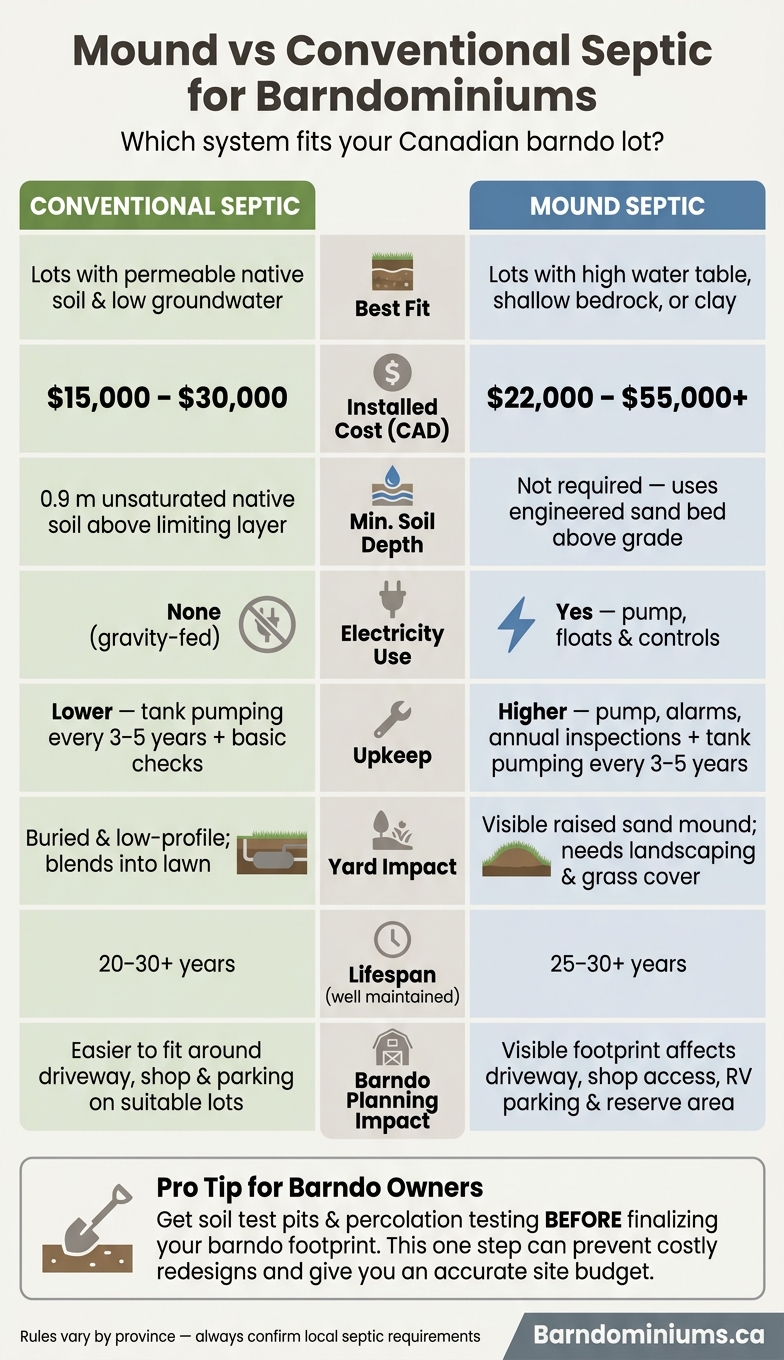
Mound vs Conventional Septic for Barndominiums: Cost, Upkeep & Site Fit
Explaining An Above Ground Septic System
sbb-itb-d6e8a6a
How each septic system works
Both systems follow the same basic path: first treatment happens in the tank, then the soil does the rest. The big split is how the effluent gets to that soil, and what kind of site each setup can handle. On a barndo lot, that usually comes down to one thing: can the land support a gravity-fed field, or do you need a pumped mound?
Conventional septic: tank and in-ground leaching bed
Wastewater from the barndo flows into a septic tank, where it sits for about two days. During that time, solids drop to the bottom as sludge, while fats float to the top as scum. What’s left in the middle is the liquid layer, called effluent, and it leaves the tank by gravity for a buried leaching bed.
That leaching bed uses perforated pipes set in gravel-filled trenches below grade. Effluent trickles out through the pipes and into the surrounding unsaturated native soil. From there, the soil finishes the treatment before the water reaches groundwater. For this to work, the site needs enough unsaturated soil above bedrock or the seasonal high water table, based on local code. That reliance on site soil is usually what rules a conventional system in or out.
Mound septic: tank, pump chamber, and raised sand bed
A mound system begins the same way. Wastewater goes into a septic tank for primary settling. After that, the effluent moves into a pump chamber instead of heading straight to a buried bed.
The pump sends the effluent in controlled doses into a raised sand mound built above the natural ground surface. Inside the mound, there’s a gravel bed with distribution pipes, and the sand layer gives the treatment depth the native soil below grade can’t provide. That’s the key difference. A conventional field depends on suitable native soil below ground. A mound does not. It uses an engineered sand bed, not simple fill. When a site can’t support a standard bed, the mound is often the fallback.
The pump, floats, and high-water alarm also mean more mechanical parts and more upkeep. That’s what creates the cost and maintenance gap covered next.
Site conditions, land needs, and approval limits
Once you know how each system works, the lot usually makes the call.
Soil type and usable depth determine whether a property can handle a conventional bed or whether it needs a mound. Before either system is approved, local regulators review the soil profile, groundwater depth, and required setbacks.
When a conventional system is usually allowed
A conventional leaching bed is usually approved in moderately permeable soils, like loam and some sandy soils, where effluent can move through the native ground without reaching groundwater too fast. In Ontario, the Building Code requires at least 0.9 m of unsaturated soil between the bottom of the leaching trenches and the seasonal high water table or bedrock.
Depth alone isn’t enough. Percolation rate matters just as much. Guidance from the Ontario Rural Wastewater Centre notes that soils with a T-time faster than 1 min/cm or slower than 50 min/cm are not suitable for conventional in-ground systems.
Setbacks also change what fits on the lot. In Ontario, common examples include:
- 15 m from a drilled well
- 30 m from a dug or bored well
- 3 m from the property line
These setbacks are measured to the nearby feature itself, not backward from your lot line. So even if your own layout looks fine on paper, a neighbour’s well or a nearby stream can still limit where the system goes.
When a mound system is usually required
A mound system is usually required when test pits show that the seasonal water table or bedrock is too close to the surface. If there’s only about 30–40 cm of workable soil above high groundwater, or if dense clay layers slow downward flow, regulators will often require a mound instead. Mound systems are also used when the site’s percolation rate falls outside the range needed for a conventional field.
The raised sand bed is visible in the yard and needs stable side slopes. It also has to stay clear of vehicles, heavy equipment, paving, patios, sheds, and deep-rooted plants. Shallow-rooted grass is the usual cover. On a working barndo property, that usually means keeping shop traffic, RV parking, and farm equipment away from the mound area.
On a barndo lot, that surface footprint can shape the whole plan, especially where you put the driveway, shop, and parking.
How barndo layouts affect septic placement
A barndominium footprint can leave less room than owners expect for both the house and a compliant septic area. On smaller or oddly shaped rural lots, the space that meets both soil and setback rules can get tight fast.
A smart approach is to place the well and septic field on opposite sides of the building, then route driveways around the leaching area so you don’t cause rutting or soil damage. That works best when septic is part of the site plan from day one, not something added later.
Getting 2–3 test pits dug early, usually to 1–2 m deep, gives you the soil profile data needed to tell whether the lot can support a conventional field or needs a mound. If the results are borderline, you may still be able to shift the building location or plan for a mound before permits are drawn. Hire a Registered Onsite Wastewater Practitioner (ROWP) or septic engineer to read the test pits and confirm the rules in your province.
That site call has a direct effect on install cost and what you’ll deal with over time.
Cost, upkeep, and side-by-side comparison
Once a lot is buildable for your dream home, the next big choice is septic cost and upkeep. And that choice shapes both your upfront spend and what you’ll deal with over time.
Installation cost differences in CAD
A conventional system usually costs about CAD $15,000 to $30,000 installed. A mound system usually lands closer to CAD $22,000 to $55,000+.
Why the gap? A mound system usually needs more parts, more labour, and more site work, including:
- Imported sand or specified aggregate that has to be brought in and layered with care
- A dosing pump chamber, effluent pump, float switches, and controls
- Engineered drawings, often required when groundwater is high or bedrock is shallow
- Extra grading and landscaping to shape the raised bed and help it fit into the yard
Access matters too. If trucks and equipment can’t get in easily, mound costs can climb fast. So use these numbers as planning ranges, not firm prices. The best move is to get two or three site-specific bids from local installers.
Maintenance, electricity use, and lifespan
The install price is only one part of the story.
Both systems share the same basic tank care. Canadian guidance keeps coming back to the same advice: pump the tank every 3 to 5 years, or when solids reach about one-third of the tank’s volume.
After that, the differences start to show.
A conventional gravity system usually has no regular power use and very few moving parts. Day-to-day care is pretty simple: inspect the tank and baffles from time to time, check the distribution box, and keep an eye out for odours or wet spots near the leaching bed.
A mound system needs more attention. It adds a pump, control checks, and surface monitoring. Because of those mechanical parts, annual inspections by a septic pro are recommended. If the pump needs replacement later, that adds to the long-term cost.
With proper design and regular care, conventional systems tend to last about 20 to 30+ years, while mound systems usually last about 25 to 30+ years. By contrast, replacing a clogged leaching bed can cost around CAD $15,000 to $25,000. That’s far more than routine pumping over the same stretch of time.
Comparison table: conventional vs mound septic
| Factor | Conventional septic | Mound septic |
|---|---|---|
| Ideal soil conditions | Permeable loam or sandy soils | Clay, restrictive, or high-water-table soils |
| Groundwater / bedrock limits | Needs adequate unsaturated native soil above the limiting layer | Used when native soil separation is inadequate |
| Typical installed cost (CAD) | $15,000–$30,000 | $22,000–$55,000+ |
| Electricity use | Usually none | Ongoing, for pump and controls |
| Upkeep | Lower; tank pumping and basic checks | Higher; pump, controls, alarms, mound surface |
| Lifespan (well maintained) | 20–30+ years | 25–30+ years |
| Yard impact | Low-profile; blends into lawn | Visible raised feature; needs landscaping |
| Best barndo fit | Lots with good drainage and enough area for a standard field | Sites where high groundwater, shallow bedrock, or clay rules out in-ground septic |
The trade-off is pretty simple: cost versus site fit. Conventional systems usually mean lower install and running costs when the soil cooperates. Mound systems cost more to put in and more to look after, but they can make a lot buildable when a standard in-ground system just won’t work. On many rural Canadian properties, that’s what settles the issue. From there, the next step is figuring out which system the lot can actually support.
Which septic option fits your barndo site
Once you know the cost and upkeep, the next thing that matters is simple: will the system work on your lot?
Choose conventional when the lot supports a standard field
A conventional system makes sense when your lot has permeable native soil and low to moderate groundwater. If percolation testing shows good infiltration, and the soil has at least 900 mm of unsaturated depth above any restrictive layer or high groundwater, a gravity-fed system is often permitted.
On the right site, a conventional system is usually the most straightforward code-compliant option. It’s also simpler and often cheaper to install and maintain.
If the lot doesn’t meet those limits, the usual next option is a mound.
Choose a mound when restrictive soil or groundwater conditions rule out in-ground septic
If percolation test results are slow, or the site has a high water table, shallow bedrock, or heavy clay, a conventional field may not be approved. In that case, a mound system is often the only code-compliant route.
The downside is the extra cost and upkeep. Still, for a barndominium on a rural lot that would otherwise fail conventional septic approval, a mound system can be what gets the project moving.
From there, the next step is to check the local approval rules.
Final planning steps for Canadian barndo owners
Start with soil and percolation testing before finalizing your barndo footprint. Those results will tell you if the lot can handle a conventional field or if you’ll need a mound.
Then confirm your provincial and municipal septic requirements. That includes setbacks, allowed system types, and whether you need a professional designer. Rules differ across Canada, so what works in one area may not apply in another.
Before any digging starts, make sure the site plan leaves room for:
- the septic tank
- the leaching bed or mound
- the well
- the driveway
- a reserve area for future repairs
All of that should be mapped out early.
It also helps to price septic alongside grading and site servicing, not on its own. A mound system often comes with extra earthworks and sand fill, which can shift total project cost by a lot. Barndominiums Canada can connect you with verified Canadian providers for pricing and planning help.
FAQs
Can I switch to a conventional system later?
Usually, no. The type of septic system is picked based on site conditions such as soil drainage, percolation, and water table levels. Those checks are normally done before construction starts.
If your property needs a mound system, that usually means the soil isn’t a fit for a standard gravity system. Changing it later would likely involve a major redesign, new permits, and extra excavation costs.
How much yard space should I reserve for septic?
There’s no one-size-fits-all yard size for a septic system. The amount of space you need depends on your site conditions, including the soil, percolation test results, and local setback rules set by your province or municipality.
Before you lock in your site plan, check the septic and well rules with your local authority. That step matters even more if your property has heavy clay, rock, or other tough ground conditions.
What happens to a mound system during a power outage?
The available information doesn’t explain how a mound septic system works or what, exactly, happens during a power outage.
If you need details for your specific setup, the best move is to speak with your site engineer or a licensed local installer. They can tell you how your system is built, what parts need power, and what to expect if the electricity goes out.
If needed, Barndominiums Canada can connect you with verified Canadian providers for planning guidance.