
7 HVAC Tips for Barndominiums in Canada

Heating and cooling a barndominium in Canada presents unique challenges due to the country’s extreme climate and the building’s design, which often includes open spaces, high ceilings, and metal exteriors. Proper HVAC planning can save you money, improve efficiency, and ensure year-round comfort. Here are the top takeaways:
- Focus on insulation and air sealing: A tight building envelope with high-quality materials like closed-cell spray foam can reduce energy loss and HVAC costs.
- Right-size your HVAC system: Avoid oversized or undersized units by conducting proper load calculations based on your climate zone and building design.
- Choose region-specific heating systems: Options like cold-climate heat pumps, radiant floor heating, or hybrid systems work best when matched to your area’s conditions.
- Plan ductwork and zoning early: Shorter duct runs and zoning strategies can reduce installation costs and improve airflow efficiency.
- Install smart controls: Smart thermostats and energy monitors can cut energy bills by 10–15% and extend equipment lifespan.
- Coordinate with professionals early: Involving HVAC experts during the design phase helps avoid costly retrofits and ensures optimal system performance.
Quick Comparison
| Tip | Key Action | Benefits |
|---|---|---|
| Insulation and Air Sealing | Use closed-cell spray foam, seal gaps, and insulate slab before pouring | Cuts energy loss, reduces HVAC load |
| Right-Sizing HVAC System | Conduct Manual J or CSA F280 calculations | Prevents inefficiencies, lowers costs |
| Region-Specific Heating Systems | Match equipment (e.g., heat pumps, furnaces) to local climate and energy rates | Ensures consistent comfort, saves money |
| Ductwork and Zoning | Plan duct routes early, centralize air handlers, add zones | Reduces costs, improves airflow |
| Smart Controls | Install smart thermostats and energy monitors | Lowers bills, boosts efficiency |
| Early Professional Involvement | Engage HVAC experts before construction | Avoids costly errors, optimizes performance |
Proper planning and early decisions are key to creating an efficient and cost-effective HVAC system for your barndominium.
How To Size A HVAC System & Air Seal A Barndominium
sbb-itb-d6e8a6a
1. Design the Building Envelope for HVAC Efficiency
The building envelope – including walls, roof, slab, windows, and air barriers – is one of the most effective ways to cut HVAC costs. A well-designed envelope can accommodate smaller, more affordable HVAC systems, while a poorly planned one can lead to oversized and expensive equipment. Let’s break down how each part of the envelope impacts HVAC performance.
In barndominiums, metal framing tends to conduct heat much faster than wood. To counteract this, thermal breaks and closed-cell spray foam (≈R‑7 per inch) should be used to achieve an R‑35 value within an 8‑inch stud bay. This approach eliminates gaps in the framing and improves insulation efficiency.
Aim for an air exchange rate of ≤1.5 ACH50. Reducing air leakage by 20% can enhance HVAC efficiency by 5–10%.
Large, open spaces often experience temperature differences of 3–5°C between the floor and ceiling. Reversible or destratification fans can help circulate warm air downward, reducing heating demands.
"Address envelope first. Better insulation, continuous air barrier, insulated sheathing, thermal breaks at metal framing, and proper roof vents or radiant barrier will shrink loads and let you buy smaller equipment." – Alldraft Home Design and Drafting Services
To ensure the envelope works seamlessly with the mechanical systems, plan for plumbing sleeves, hydronic loops, and slab-edge insulation before pouring the slab. Nick Gonzalez of Postma Heating emphasizes the importance of early coordination: "These builds demand early mechanical input, sequencing, and pre‑planning before the slab, not problem‑solving after."
2. Insulate and Air Seal Properly
A well-designed building envelope is just the starting point for energy efficiency in Canadian barndominiums. To truly minimise energy loss, proper insulation and air sealing are critical – and in Canada, that often means going beyond the basic code requirements. Krista Hulshof, Architect at VELD architect, highlights this point:
"Ontario’s climate requires far more insulation, air sealing, and mechanical sophistication than typical barndominium content acknowledges."
Thermal bridging is a major concern for steel-frame barndominiums. Steel conducts heat much faster than wood, meaning heat can escape unless this issue is addressed. The solution? Continuous insulation, rather than relying solely on batt insulation between studs. Closed-cell spray foam is an excellent choice for this purpose, helping meet stringent energy standards while reinforcing the cost savings achieved through envelope design.
Here’s how to tackle insulation and sealing effectively:
- Use high-quality spray foam for gaps larger than 6 mm.
- Apply low-expansion foam or butyl tape for smaller cracks.
- Seal all panel-to-panel joints with continuous gaskets or metal-building sealants.
- Ensure proper flashing and insulated jambs around every door and window.
For slab-on-grade construction, install high R-value slab insulation before pouring concrete. This step is non-negotiable since it can’t be retrofitted later. It’s particularly crucial if you plan to incorporate hydronic radiant heating, a practical and efficient option for rural Canadian barndominiums.
If you’re retrofitting an existing barndominium, always air seal before adding insulation. For example, upgrading attic insulation from R‑20 to R‑60 can cut the total heating load by 15% to 25% and cooling load by 10% to 20%. This improvement might even allow you to downsize your HVAC system, saving on upfront costs. In Ontario, such upgrades could also qualify for rebates, offering additional financial benefits.
3. Match HVAC Equipment Size to Your Climate Zone
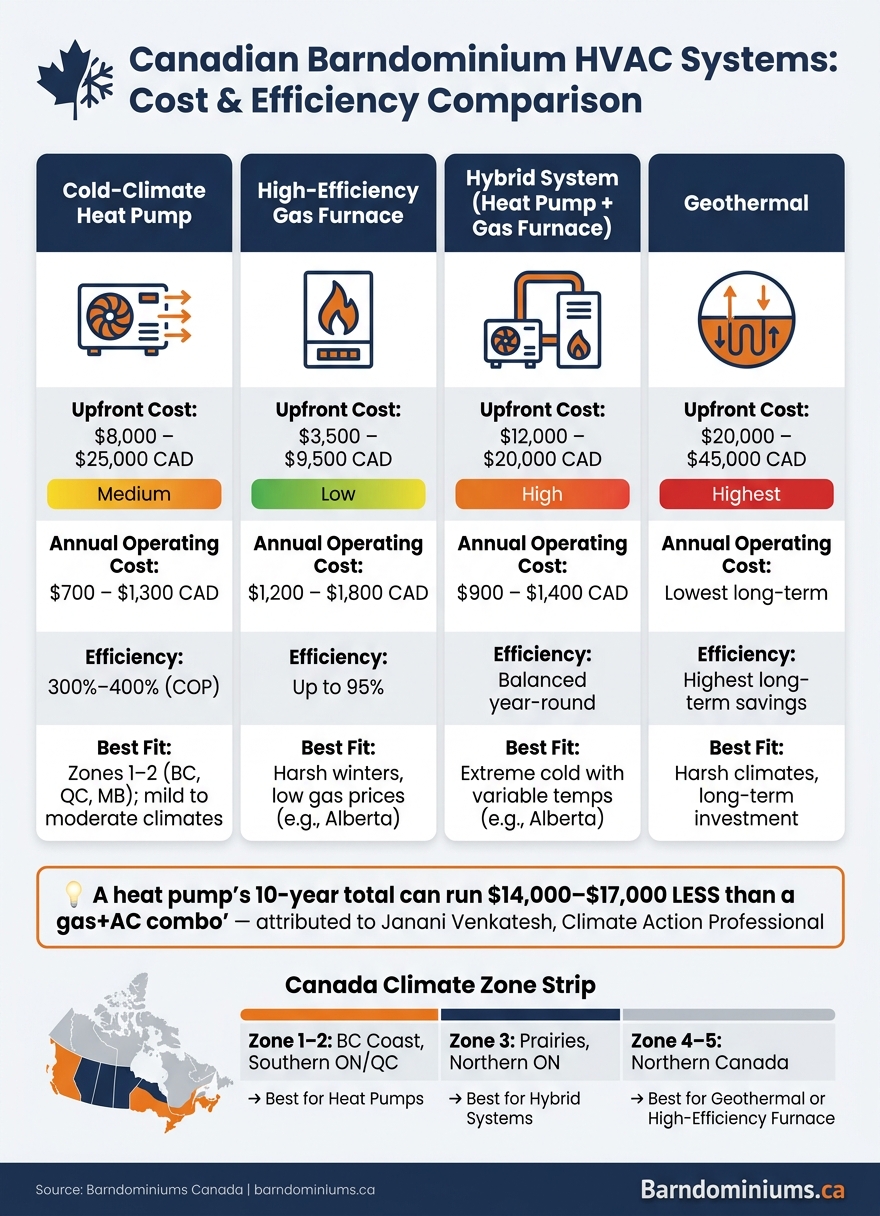
Canadian Barndominium HVAC Systems: Cost & Efficiency Comparison
When it comes to HVAC systems, size matters – and not just in the way you might think. An oversized system can short-cycle, causing wear and tear on components and struggling to manage humidity levels. On the other hand, an undersized system will run non-stop and still fail to keep up during extreme cold spells. Neither scenario is ideal.
Canada’s climate is incredibly diverse, spanning five distinct zones – from the mild, rainy conditions of coastal British Columbia to the frigid, sub-arctic territories. Because of this, HVAC equipment needs to be tailored to local conditions, specifically the statistical coldest 1% to 2.5% of winter hours in your area, rather than relying on annual averages.
"A contractor recommending the same equipment for Calgary and Vancouver isn’t paying attention to the fundamentals." – Coolheatcomfort.ca
Barndominiums, with their high ceilings and wide-open layouts, add another layer of complexity. Heat tends to rise in these spaces, leaving living areas cooler. To ensure accurate sizing, ask for a Manual J or CSA F280 load calculation that takes into account factors like ceiling height, air volume, insulation levels, and local design temperatures. If you’re planning insulation or air sealing upgrades, complete these first – they can reduce your heating load by 25%–40%, potentially allowing for a smaller, more efficient system.
HVAC System Options and Costs
Here’s a quick breakdown of common HVAC systems, their typical costs, and where they work best:
| System Type | Typical Cost Range (CAD) | Best Fit |
|---|---|---|
| Cold-Climate Heat Pump | $8,000 – $25,000 | Zones 1–2; can also work in Zone 3 when used as part of a hybrid system |
| High-Efficiency Gas Furnace | $3,500 – $8,500 | Ideal for regions with extreme cold |
| Multi-Zone Mini-Split | $12,000 – $20,000 | Perfect for open-concept barndominiums without ductwork |
| Geothermal | $20,000 – $45,000 | Best for long-term energy savings in harsh climates |
Choosing the right HVAC system isn’t just about upfront costs – it’s about finding the best fit for your specific climate and home design.
4. Pick a Heating System That Fits Your Region
Once you’ve sized your HVAC system properly, the next step is picking a heating solution that works for your specific region. In Canada, heating needs vary widely depending on the climate, energy costs in your province, and the layout of your barndominium. There’s no universal answer – what works in one area might not be suitable for another.
One heating option gaining traction is the cold-climate heat pump. These systems are incredibly efficient, even in harsh Canadian winters. Modern models can operate effectively in temperatures as low as −25°C, offering efficiency rates of 300%–400% (producing three to four units of heat for every unit of electricity used). Compare that to gas furnaces, which max out at about 95% efficiency, and the difference is striking.
"A heat pump’s ten-year total can run $14,000 to $17,000 less than a gas-plus-AC combination, even accounting for its higher upfront cost." – Janani Venkatesh, Climate Action Professional
For barndominiums, radiant floor heating is another excellent choice, especially for slab foundations. It provides steady, efficient warmth and can be paired with a mini-split system to maintain comfort throughout the year.
Regional Considerations
- Alberta: A hybrid system combining a heat pump with a gas furnace works well here. The heat pump handles moderate weather efficiently, while the gas furnace kicks in during extreme cold. This setup balances upfront costs with long-term savings.
- Quebec and Manitoba: Fully electric systems, like cold-climate heat pumps, are ideal in these provinces due to their low electricity rates. This makes them a cost-effective and eco-friendly choice.
Heating System Comparison
| System | Upfront Cost (CAD) | Annual Operating Cost | Best Fit |
|---|---|---|---|
| Gas Furnace | $4,100 – $9,500 | $1,200 – $1,800 | Harsh winters, low gas prices (e.g., AB) |
| Cold-Climate Heat Pump | $8,000 – $25,000 | $700 – $1,300 | Mild to moderate climates (e.g., BC, QC) |
| Hybrid System | $12,000 – $20,000 | $900 – $1,400 | Extreme cold with variable temperatures |
| Radiant Floor Heating | $6,000 – $20,000 | Efficient for slab foundations and high-ceiling spaces | Slab foundations, high-ceiling spaces |
Key Takeaways
Before making your decision, take a close look at the electricity-to-gas price ratio in your area. If electricity is affordable, a heat pump is usually the best long-term option. On the other hand, if gas prices are low and winters are severe, a hybrid system could be the way to go. By tailoring your heating choice to your region, you can ensure efficient performance and keep your HVAC costs manageable over time.
5. Plan Ductwork and Zoning to Reduce Installation Costs
Ductwork can quickly become a major expense in a barndominium build. With installation costs ranging from $4 to $9 per square foot, a poorly thought-out duct layout can lead to thousands of dollars in unnecessary material and labour costs. To avoid these pitfalls, plan your duct routes early – ideally before construction begins.
Barndominiums often feature exposed steel framing and open ceilings, making ductwork retrofits not only expensive but also disruptive. Addressing duct placement from the outset is critical. As Alldraft Home Design and Drafting Services explains:
"Trying to ‘make HVAC fit later’ often leads to compromises that affect comfort for the life of the building."
Centralising your air handler or furnace is a smart way to keep duct runs shorter and airflow balanced. Shorter trunk lines reduce material needs, lower static pressure, and cut down on labour hours. For example, a well-planned central system might need only 30–50 labour hours, while extended duct runs could take 60–120 hours to install.
Include dedicated chase spaces in your plans – these are enclosed pathways that group ductwork, plumbing, and electrical systems together. Make them 20–30% wider than you think you’ll need to allow for future upgrades without damaging finished walls. Always route ducts within the conditioned envelope of the building. Ducts running through unconditioned spaces can lose 15% to 30% of their efficiency due to leakage and heat transfer.
Incorporating zoning strategies can further boost efficiency and cut costs. Zoning is particularly useful in barndominiums with features like tall ceilings, lofts, or attached workshops. A well-designed zoning system can reduce heating and cooling energy use by 15% to 25%, directly lowering your annual operating expenses. For mixed-use spaces, consider giving the workshop or garage its own zone or system. This approach keeps dust and fumes out of the living area and ensures you’re only heating or cooling the spaces in use.
6. Add Smart Controls and Energy Monitoring Early
Investing in smart thermostats and energy monitors early on can lead to noticeable savings. A Wi‑Fi-enabled smart thermostat, which typically costs between $150 and $600, can lower HVAC bills by 10–15% by learning your daily habits and automatically adjusting settings to match your routine.
Another major benefit is the ability to track your energy usage in real time. Whole‑home energy monitors like Emporia or Sense offer a detailed look at which systems are consuming power. Studies show that when homeowners have access to real-time energy data, they tend to reduce their usage by an additional 6–8%. This is especially valuable given the steady rise in Canadian utility rates, which have been increasing by about 4.5% annually as of May 2025. By incorporating these tools during construction, you can maximize savings and avoid the added expense of retrofitting later.
Pre-installing smart systems during the construction phase is a smart move. Running conduits and sensor wiring during framing can save you from retrofit costs that can exceed $5,000. Additionally, designing the HVAC system alongside the building’s construction ensures smoother integration of smart controls and keeps overall costs lower.
Smart controls also help protect your equipment. In Canada’s challenging climate – where winter temperatures can range from −22°C in Toronto to −32°C in Thunder Bay – variable-speed heat pumps need precise management to avoid inefficiencies like short-cycling. A well-configured smart control system ensures the equipment operates efficiently, extending the life of components like compressors and maintaining consistent indoor comfort.
For those considering a dual-fuel system, it’s worth selecting a thermostat with economic crossover logic. This feature automatically switches between the heat pump and gas furnace based on cost-effectiveness. In Ontario and similar regions, setting the switchover temperature between −5°C and −10°C tends to deliver the best results. Additionally, in airtight homes, ensure the controls integrate seamlessly with an HRV or ERV system. This will maintain fresh air circulation without compromising energy efficiency.
7. Work with Canadian HVAC Professionals Early in the Process
Barndominiums, with their high ceilings, open spaces, and steel frames, demand careful mechanical planning right from the start. Just like envelope design and ductwork, involving HVAC professionals early ensures all systems are integrated smoothly.
It’s especially important to plan slab details – things like plumbing sleeves, hydronic loops, and floor drains – before the concrete is poured. Once the slab is set, making changes becomes nearly impossible. A great example of this is a 2026 project in rural Ontario, where Nick Gonzalez, General Manager of Postma Heating, Cooling, Electrical & Plumbing, oversaw the mechanical design for a barndominium. His team installed five zones of radiant in-floor heating and a French drain system, all before the slab was poured. They also coordinated a comprehensive system combining a variable-speed gas furnace, a heat pump, and a dual-fired combi boiler.
"These builds demand early mechanical input. They demand sequencing. They demand pre-planning before the slab, not problem-solving after." – Nick Gonzalez, General Manager, Postma Heating, Cooling, Electrical & Plumbing
Another critical step is insisting on a proper load calculation. In Ontario, the Building Code requires a CSA F280-12 heat loss/gain calculation – not just an estimate based on square footage. Why does this matter? Oversizing a system by designing to extreme record lows instead of the standard 2.5% January design temperature can lead to inefficiencies. Systems that are oversized by 30% to 40% often short cycle, reducing seasonal efficiency by 15% to 25%. Proper calculations prevent these issues and save money in the long run. For instance, a full HVAC design with a BCIN stamp starts at around $695, while a standalone CSA F280 report is typically $395. Compare that to the $5,000 or more you might spend on retrofitting a poorly sized system.
Before finalizing equipment, check heat pump performance on the NEEP database. Look at output ratings for both −15°C and −25°C. For example, a unit rated for 3 tons at 8.3°C might only provide 1.5 tons at −15°C. A qualified Canadian HVAC professional will match the unit’s actual cold-weather output to your home’s calculated load, not just rely on the nameplate rating. Early collaboration also ensures eligibility for rebates, like Ontario’s Home Efficiency Rebate Plus, which requires pre-approval.
Conclusion
Getting the HVAC system right in a barndominium starts with careful, early planning. The seven tips discussed here highlight how decisions made before construction begins can lead to significant savings.
Key factors like a well-sealed building envelope, proper insulation, correctly sized equipment, climate-appropriate heating, efficient ductwork and zoning, and smart controls all contribute to better performance and lower costs. By planning ahead and focusing on precision, you set the stage for long-term energy efficiency and financial benefits.
"The most cost-effective HVAC systems are designed alongside the building, not added afterward." – Alldraft Design
For a typical 1,800–3,000 sq. ft. barndominium, HVAC installation costs can range from $8,000 to $35,000, depending on the type of system and your location. Achieving efficiency doesn’t necessarily mean spending more – it’s about making informed choices early on. The quality of your building envelope and how soon you involve professionals often dictate the final cost.
If you’re still in the planning phase, Barndominiums Canada offers a free pricing service to connect you with trusted Canadian providers. They can help with budgeting, system selection, and project planning to ensure your barndominium is set up for success.
FAQs
What’s the fastest way to lower HVAC costs in a Canadian barndominium?
To cut HVAC costs in a Canadian barndominium, start by focusing on airtightness and proper insulation. Metal buildings tend to lose heat quickly, but sealing gaps with materials like spray foam or quality tapes can improve energy efficiency by 5–10%. Combine this with a high-efficiency system, such as a ductless mini-split or a heat pump rated 16–18 SEER, to avoid wasting energy on unused or drafty areas. For expert advice tailored to your barndominium, Barndominiums Canada can connect you with trusted local professionals.
Do I need a CSA F280 or Manual J load calculation for sizing my HVAC?
Yes, in Canada, HVAC sizing must comply with the CSA F280-12 (R2021) standard. This standard ensures your system is tailored to meet your barndominium’s energy requirements by taking into account factors like the building envelope, window placement, and the local climate. While the U.S. relies on Manual J, CSA F280 is the mandatory standard for Canada. Barndominiums Canada can help connect you with qualified professionals to assist with planning and pricing.
Is a cold-climate heat pump worth it where I live in Canada?
A cold-climate heat pump can be a practical option for Canadian barndominiums. Today’s advanced models can operate effectively even when temperatures drop to -25°C. However, their performance largely depends on factors like the quality of your insulation, local electricity costs, and the specific climate in your area. Ensuring your barndominium is well-insulated is key to keeping heating costs manageable. In regions with harsher winters, some homeowners also opt for a backup heating system to handle those particularly frigid days.