
French Drain vs Swale: Barndominium Water Control

If water is below grade, I’d look at a French drain. If it’s moving across the surface, I’d look at a swale. On many Canadian barndominium sites, I’d plan for both.
That’s the short answer. This choice matters because poor drainage can lead to frost heave, slab moisture, erosion, and repair bills of C$8,000 to C$25,000. In Canada, snowmelt, freeze-thaw swings, and temperatures down to −40°C can make a bad drainage plan cost a lot more later.
Here’s the plain-English breakdown:
- French drain = buried system
- Handles subsurface water
- Sits near the slab or foundation
- Common in clay soils and wet ground
- Needs pipe, gravel, fabric, and a working outlet
- Swale = surface channel
- Handles rain runoff and snowmelt
- Works by grading the land
- Best on larger lots with room to slope
- Needs routine clearing of debris and snow
- Use a French drain when:
- Water is pressing near the slab edge
- Ground stays wet beside the building
- You need below-grade moisture control
- Use a swale when:
- Roof water or yard runoff is heading toward the building
- You have space to shape the lot
- Spring melt is pooling on the surface
- Use both when:
- You have surface runoff and wet soil near the foundation
- Spring thaw brings fast runoff plus seepage
- You want to avoid rework after the slab is poured
Quick Comparison
| Item | French Drain | Swale |
|---|---|---|
| Main job | Move below-grade water away | Move surface water away |
| Best location | Along foundation or slab edge | Across yard or downslope areas |
| Space needed | Low | Higher |
| Visibility | Hidden underground | Visible at the surface |
| Main cost driver | Trenching, pipe, gravel, labour | Grading and excavation |
| Main risk if done wrong | Wet slab edge, backup, frost trouble | Pooling, muddy access, erosion |
| Maintenance | Check cleanouts and outlet | Clear debris, watch flow path |
I’d make this call before excavation wraps up, because drainage fixes after the slab is in place are much more costly than getting the grade and drain layout right from day one.
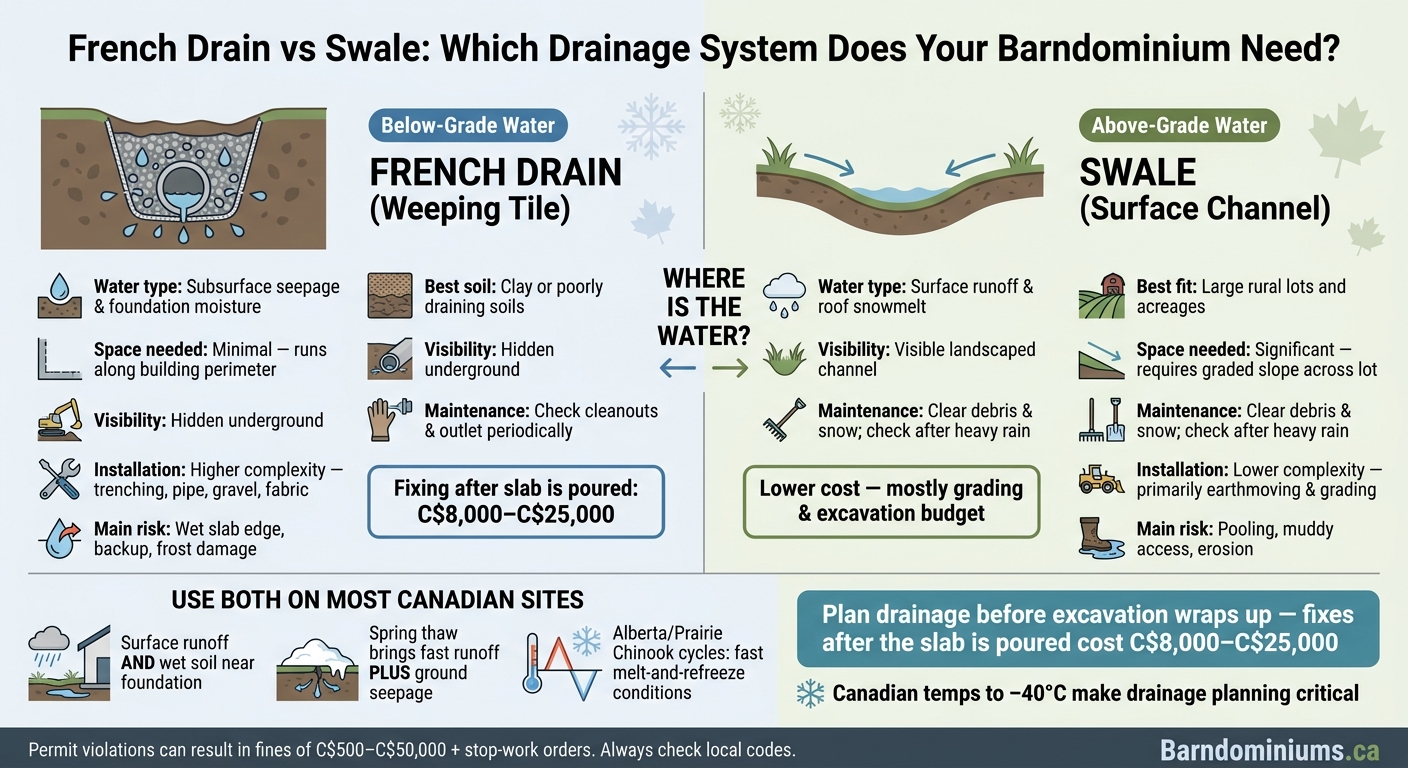
French Drain vs Swale: Barndominium Drainage Comparison Guide
French drains: how they work, where they fit, and what they cost
A French drain, also called weeping tile, is a buried perforated pipe set in gravel and wrapped in filter fabric. Its job is simple: move subsurface water away from the foundation. That makes it useful for subsurface seepage, water sitting just below the surface, and moisture that would otherwise work its way toward the slab edge.
| Attribute | French Drain (Subsurface) |
|---|---|
| Water type handled | Subsurface seepage, perched water, foundation moisture |
| Soil fit | Critical in clay or poorly draining soils near slabs |
| Frost concerns | Can freeze if the outlet sits above frost depth |
| Upkeep level | Moderate – cleanout inspections required |
| Visual impact | Hidden underground |
| Typical use | Directly adjacent to foundation or slab edge |
Best uses near slabs, basements, and wet ground close to the building
A French drain makes sense only when the water issue is coming from below grade. That usually means the perimeter of a slab-on-grade foundation, a basement, or ground beside the foundation that stays wet after rain or snowmelt.
For Canadian barndominiums, which are often built on slab-on-grade foundations, the weeping tile needs to be part of the plan during excavation, not something added after the slab is poured. Once concrete is in place, fixing a failed or badly placed drain line gets expensive fast. Saw-cutting and re-pouring typically cost C$8,000 to C$25,000.
French drains also work best as part of a full moisture-control setup. They pair with a 10-mil poly vapour barrier under the slab and R-10 slab edge insulation to help deal with both moisture and frost.
Soil fit, snowmelt behaviour, and maintenance needs
French drains are a strong fit in clay-heavy or poorly draining soils. In those soils, water tends to sit near the surface instead of draining away. That can put pressure on the foundation over time. A well-installed weeping tile catches that water before it reaches the building.
Canada’s freeze-thaw cycles add another layer to the job. If the outlet freezes during a cold snap, then backs up during spring thaw, the drain can fail at the exact moment you need it most. In frost-prone areas, the outlet should stay below local frost depth or be protected with insulation.
Upkeep sits in the middle. It’s not a set-it-and-forget-it system, but it’s not high-drama either. Check the cleanout access points from time to time, and make sure the discharge outlet stays clear.
Typical Canadian cost factors for French drains
French drain pricing depends on a few main things: excavation depth, total run length, how far the water must travel to reach a proper discharge point, and local permit rules. The details matter here. Skipping permits or taking shortcuts with the drainage plan can lead to fines from C$500 to C$50,000, plus possible stop-work orders during inspection.
Drainage is one of those parts of a build where a cheap fix can turn into a very expensive repair.
If the water problem is happening on the surface instead of below grade, the next option is a swale.
sbb-itb-d6e8a6a
Swales: how they work, where they fit, and what they cost
For surface runoff that stays above grade, a swale is the simpler fix. It’s a shallow, gently sloped surface channel that moves runoff away from the building.
| Attribute | Swale (Surface Channel) |
|---|---|
| Runoff type handled | Surface runoff and roof meltwater |
| Space required | Higher; needs room for graded slope across the lot |
| Snowmelt handling | Critical for managing rapid thaw and preventing ice damming |
| Maintenance tasks | Keeping channels clear of debris and snow |
| Typical fit | Large rural lots and acreages |
Best uses for roof runoff, yard drainage, and large rural lots
Large barndominium roofs can dump a lot of water during rain and fast snowmelt. Swales are a good match for that kind of flow, especially when gutters and wide eaves push water into the channel and away from the foundation.
They make the most sense on rural acreages and larger lots because they need room for proper grading. If the site is tight, there may not be enough open space to carry runoff away across the ground without putting the slab at risk.
Soil fit, spring thaw performance, and upkeep
Swales work because of slope, not absorption. In plain terms, the grade does the work, whether the soil drains well or not.
That matters during spring thaw. When the ground is still frozen, meltwater can’t soak in, so runoff builds up fast. A properly graded swale gives that water a path before it starts pooling near the slab edge. On Canadian sites, where thaw and refreeze can happen in a hurry, keeping meltwater moving is a big deal.
Upkeep is simple, but you can’t ignore it. Keep the channel clear of debris and snow. Then check it after heavy rain and during spring thaw to make sure water is still flowing the way it should.
Typical Canadian cost factors for swales
Swales often cost less to build than French drains because the work is mostly grading and excavation, not buried pipe installation. In practice, that means they should be part of the site-grading budget before the slab is poured.
The choice starts to narrow from here: buried drainage for below-grade water, or grading for water moving across the site.
French drain vs swale: which one fits your barndominium site
At this stage, the right pick comes down to where the water is. Swales deal with surface runoff. French drains intercept moisture below grade, especially near the foundation.
| Criteria | French Drain (Weeping Tile) | Swale (Surface Channel) |
|---|---|---|
| Use when | Below-grade seepage, slab and foundation protection | Surface runoff, large lots, driveway and yard drainage |
| Space needed | Minimal – follows the building perimeter | Significant – needs room for graded slope |
| Visibility | Hidden (buried) | Visible (landscaped channel) |
| Maintenance | Low, if installed with proper fabric and gravel | Moderate – mowing and debris clearing required |
| Installation complexity | Higher – trenching, pipe, gravel, and fabric | Lower – primarily earthmoving and grading |
| Typical cost driver | Labour and materials for buried system | Site grading and excavation |
A simple rule helps: start with the water issue closest to the building.
Choose a French drain for below-grade problems or foundation protection
Use a French drain when water reaches the slab edge or foundation wall. That’s the kind of problem you don’t want to shrug off and deal with later.
It also works well on tight sites because the system runs along the perimeter. If your main concern is keeping water away from the foundation, this is usually the better fit.
Choose a swale for surface runoff when there is room to grade
If the issue is water moving across the yard – from the roof, the driveway, or a neighbouring slope – a swale makes more sense. Think of it as giving runoff an easy path to follow instead of letting it wander toward the slab.
A swale is easier to inspect and easier to maintain, since everything stays above ground. There’s no buried pipe to chase down. On large rural lots, it’s often built into the first round of site grading so the land sheds water away from the slab from day one.
When runoff stays above grade, a swale is usually the simpler fix.
When using both systems together makes more sense
Sometimes it’s not an either-or call. Surface flow and below-grade seepage often need two different fixes, and many Canadian barndominium sites end up needing both.
A swale can move large volumes of surface water across the property during spring thaw. At the same time, a French drain can deal with the moisture that soaks into the ground near the building. One handles what you can see. The other deals with what you can’t.
In Alberta and other prairie provinces, Chinook cycles can create fast melt-and-refreeze conditions. Canadian spring melt often requires both surface grading and subsurface interception. Planning both during excavation helps avoid costly rework.
Conclusion: how to pick the right drainage plan for your barndominium
It comes down to one simple question: where is the water coming from? French drains deal with below-grade moisture. Swales move surface runoff. On most Canadian barndominium sites, you’ll need both.
The right setup depends on your lot. Before you dig, look at four things: slope, soil type, usual snowmelt patterns, and where the water can drain out. Get this wrong after the slab is poured, and fixing it can get expensive fast – usually C$8,000 to C$25,000.
The best time to sort this out is during excavation, not after landscaping is finished.
Start with the source of the water, then build the drainage plan before the slab goes in.
FAQs
How do I know where the water problem starts?
Check your property after rain or snowmelt. That’s when drainage problems tend to show themselves.
Look for:
- standing water
- soft ground
- dark, damp patches that linger
- stagnant water in nearby ditches
Also check that the lot slopes away from your building pad, not toward it. Even a small grade issue can send water the wrong way.
If you suspect hidden soil issues, such as high-plasticity clay or a high water table, a professional geotechnical report can help pinpoint the source.
Can a swale work on a small lot?
Yes – a swale can work on a small lot if you have enough room to guide water away from your foundation and toward a culvert, ditch, or natural outlet.
It’s a practical surface drainage option when grading on its own isn’t enough. The main job is simple: move water away before the soil around your slab and footings gets too wet.
What happens if a French drain outlet freezes?
If a French drain outlet freezes, water can’t move out the way it should. That blockage can cause backup, leave the soil around the foundation saturated, and keep water too close to the building pad. In Canadian climates, where frost can go deep, that means the drain system may stop moving water away from the structure.
To lower that risk, sub-drainage is often paired with a perimeter trench drain and a sump system that handles both passive flow and pumped drainage. Put simply, you’re not relying on just one path for water to escape. That extra layer helps reduce moisture damage and frost-heave shifting.