
Flammable Material Storage in Canadian Barndominiums

If I store fuel, paint, solvents, or propane in a Canadian barndominium, the safest rule is simple: keep indoor amounts low, keep bulk stock in a detached building, and keep the shop sealed off from the living area with a 1-hour fire separation.
Here’s the short version:
- Living space is not for flammable storage.
- Attached shops should hold only day-to-day amounts in certified, labelled containers.
- Bulk fuel, extra solvents, and propane cylinders belong outside the main structure, often in a detached shed or outbuilding.
- A wall between the shop and home should be 1-hour fire-rated, and any door in that wall should be 20-minute fire-rated and self-closing.
- Propane and fuel vapours need detection and ventilation, since gas can collect in low spots and closed rooms.
- Oily rags, aerosols, and half-used paint cans add fire load fast and should not pile up indoors.
A mixed-use barndominium can combine Group C residential space, Group F, Division 2 shop/garage space, and Group F, Division 3 storage space under one roof. That means heat sources, vehicles, welding gear, and stored liquids may sit much closer to bedrooms and kitchens than in a separate house and shop setup.
Flammable Storage Cabinet OSHA Inspection Checklist | flammable cabinet requirements
sbb-itb-d6e8a6a
Quick comparison
| Area | What I’d keep there | What I would not keep there | Main rule |
|---|---|---|---|
| Dwelling area | Normal household items | Fuel, propane, solvents, paint stock | No flammable storage |
| Attached shop | Small working amounts | Bulk fuel, extra cylinders, large solvent stock | Working quantities only |
| Detached outbuilding | Bulk fuel, propane cylinders, larger chemical stock | Sleeping or living use | Best spot for higher-risk storage |
My takeaway: if the amount no longer fits normal daily use, it should move out of the attached shop. The rest comes down to separation, ventilation, sealed penetrations, and keeping ignition sources away from stored products.
Code limits and basic storage rules inside the home and attached shop
Once you know what’s on site, the next step is simple: limit what stays indoors.
In a Canadian barndominium, storage rules come from the National Building Code of Canada, provincial code, and local bylaws. The goal is pretty clear. Keep the home safe, and allow only small, day-to-day amounts inside the shop.
Where flammable materials should not be stored
Keep flammable materials out of living spaces and out of any shared attic areas.
Approved containers, labelling, and quantity limits
Inside the building, keep only working quantities. Use certified containers, and make sure every container is clearly labelled. Install smoke and CO alarms, and add combustible-gas detectors anywhere propane or other fuel vapours could build up.
Bulk fuel, solvents, and similar materials should go in a detached building.
Storage location comparison: typical use and safer strategy
Use these rules to match each storage area to the level of hazard.
| Location | Practical Rule | Typical Use | Recommended Storage Strategy |
|---|---|---|---|
| Dwelling Area (Group C) | No flammable storage; 1-hour fire separation from the shop is required | Day-to-day living space | Avoid flammable storage; keep the space for normal household use |
| Attached Shop (Group F, Div. 2) | Working quantities only, in certified containers | Vehicle maintenance, hobbies, and light shop work | Store away from ignition sources; use combustible-gas detectors where propane and other fuel vapours may accumulate |
| Detached Outbuilding | Best location for bulk flammables; local bylaws still apply | Bulk fuel, propane cylinders, and larger solvent quantities | Move higher-hazard materials here to reduce risk inside the main structure |
Next, separate each hazard into its own storage zone, with ventilation and temperature control.
Storage zones, fire separation, ventilation, and temperature control
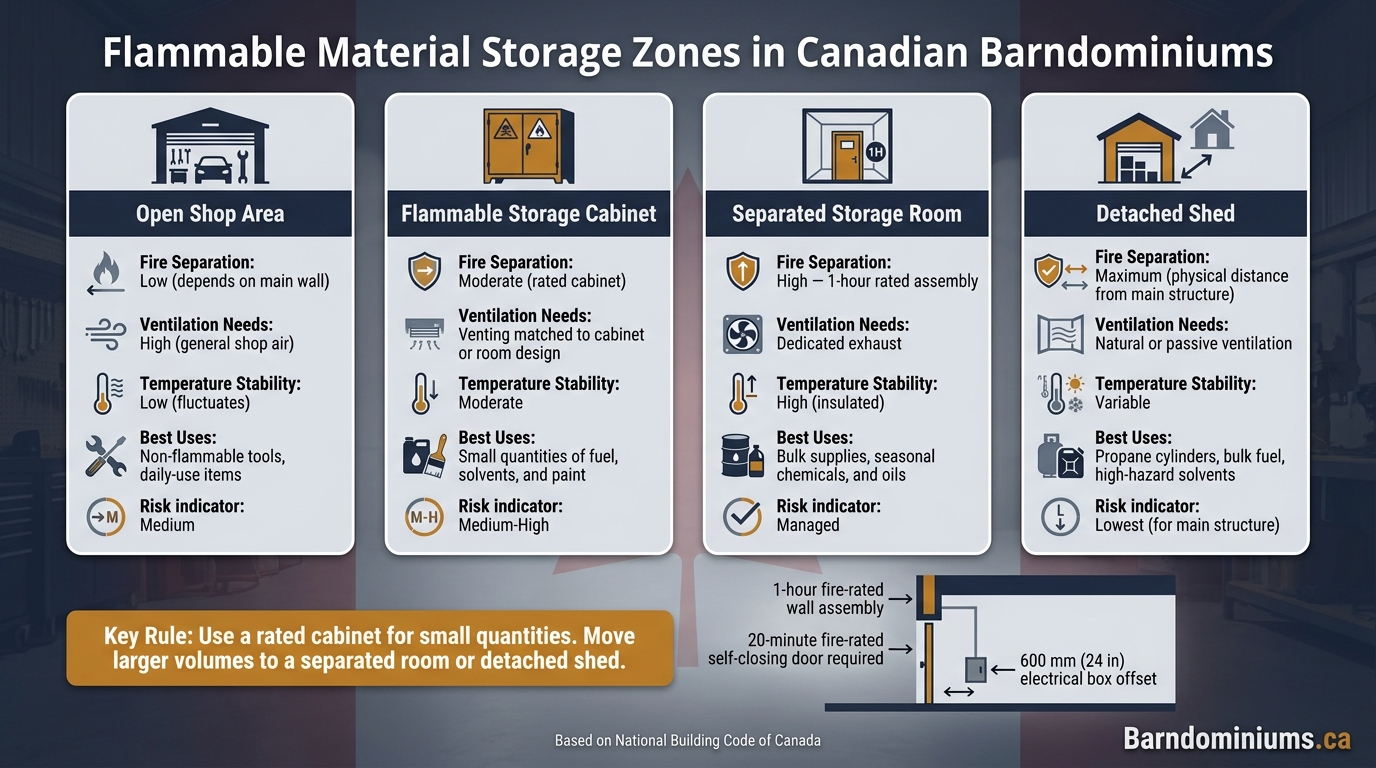
Flammable Material Storage Zones in Canadian Barndominiums
If flammables stay on site, the job isn’t done once you’ve bought the product. You also need to keep those materials away from heat, stop vapours from building up, and protect the living space.
How to set up a dedicated storage zone away from ignition sources
For flammables kept in the shop, set aside one dedicated storage zone well away from welders, chargers, heaters, stoves, and vehicle traffic. Start with physical distance. That first layer of separation matters most when you’re dealing with anything that can ignite.
Fire separation between the shop and dwelling
The wall between the dwelling and shop or storage area needs a continuous 1-hour fire-rated assembly. In plain terms, that wall can’t just look solid – it needs to be built as a full fire barrier.
A common setup uses Type X gypsum, mineral wool, and sealed penetrations. The separation also needs to run all the way to the roof deck so a shared attic or truss space doesn’t let fire slip past the wall.
Every opening for pipes and wires must be firestopped with ULC-listed systems. And if there’s a door between the shop and living area, it must be at least 20-minute fire-rated with a self-closing device. One more detail that’s easy to miss: electrical boxes on opposite sides of the wall must be offset by at least 600 mm (24 inches) horizontally.
Ventilation and seasonal temperature control
The storage area should be ventilated so vapours from fuel, paint, and solvents don’t collect in one place. It should also be insulated to reduce temperature swings through the year. That helps keep the space more stable in both winter and summer.
Storage zone comparison: open shop area, cabinet, storage room, and detached shed
Choose the least exposed zone that still fits the material type and quantity.
| Storage Zone Type | Fire Separation Level | Ventilation Needs | Temperature Stability | Best Uses |
|---|---|---|---|---|
| Open Shop Area | Low (depends on main wall) | High (general shop air) | Low (fluctuates) | Non-flammable tools, daily-use items |
| Flammable Storage Cabinet | Moderate (rated) | Venting matched to the cabinet or room design | Moderate | Small quantities of fuel, solvents, and paint |
| Separated Storage Room | High (1-hour rated assembly) | Dedicated exhaust | High (insulated) | Bulk supplies, seasonal chemicals, and oils |
| Detached Shed | Maximum (physical distance) | Natural or passive ventilation | Variable | Propane cylinders, bulk fuel, and high-hazard solvents |
Use a rated cabinet for small quantities. Move larger volumes to a separated room or detached shed.
Next, match each material type to the right container and storage location.
Storage solutions by material type: fuel, paint, solvents, propane, and shop supplies
Match each material to the storage spot with the least exposure.
Gasoline, diesel, and small-engine fuel
Keep only a working amount of gasoline or diesel in the shop. Add combustible gas detectors in that space, along with smoke and CO alarms.
Paint, stains, solvents, aerosols, and oily rags
Half-used paint cans and solvent-soaked rags increase the fire load. Oily rags can also self-ignite through spontaneous combustion. Keep only what you need for the job in front of you, and move extra supplies to detached storage.
Propane cylinders and compressed gases
Store propane cylinders outdoors or in a detached, ventilated structure. Keep cylinders upright, secure them so they can’t tip, and place them away from doors, windows, and any below-grade space where leaked gas can build up. If propane is stored in the shop, install combustible gas detectors there too.
If storage goes beyond working amounts, move the extra stock to detached storage.
When to move flammables to a detached building and key planning points
Signs it is time to move flammables to a detached building
Once your working quantities no longer fit in a cabinet or storage room, it’s time to move higher-risk materials to a detached building. The clearest sign is simple: too much volume. When flammables go beyond day-to-day working quantities, they shouldn’t stay in the attached shop.
More volume also means more things can go wrong. Storage gets harder to manage, and risk climbs inside a space that shares a structure with a home. A detached building cuts out the need for a complicated fire-rated barrier between the shop and dwelling, and it keeps high-hazard materials farther from the living space.
Plan storage early in the design stage
Detached storage is much easier to plan before the slab is poured and the service layout is locked in. Leave it too late, and changes can get expensive fast. Set the occupancy type, fire-separation needs, and HVAC layout before the slab goes down.
If fuels or propane have to remain in the attached shop, the NBC also requires heat and combustible gas detectors, along with standard smoke and CO alarms. HVAC matters too. Keep the shop and living-space systems separate so vapours don’t move from one area to the other.
Conclusion: keep volumes low, separate hazards, and store bulk materials outside
Keep only small amounts of fuel and other high-hazard materials in the attached shop. Move larger volumes to detached storage. Store bulk flammables outside the main structure.
FAQs
How much fuel can I safely keep in an attached shop?
In an attached shop, you can store up to 50 litres of flammable liquids in total. That total can include no more than 30 litres of Class I liquids, such as gasoline.
Need more room? A ULC/ORD-C1275-compliant cabinet lets you store up to 500 litres in total, with no more than 250 litres of Class I liquids.
Keep all containers clearly labelled, sealed when not in use, and away from exits.
What makes a proper 1-hour fire separation?
A proper 1-hour fire separation is a continuous, code-rated wall and ceiling assembly with at least a 1-hour fire-resistance rating between the shop, or any other hazard area, and the living space.
That means the whole assembly has to work as one system. It should include self-closing 20-minute fire-rated doors, proper firestopping at every penetration, and no gaps or unsealed openings. If the separation isn’t continuous, it doesn’t count. It should also be paired with interconnected smoke and CO alarms.
When should I use a detached shed for flammables?
Use a detached shed if your flammable storage needs go past what’s safe in an attached space, or if you’d rather keep fire risk out of your home.
For attached garages or shops, storage is limited to 50 litres total. Of that, no more than 30 litres can be Class I liquids like gasoline. Once you need more than that, or your work makes indoor storage risky, a detached structure is the safer call.
Place the shed at least 6 metres from property lines and other buildings.