
Builder’s Risk vs. General Liability Insurance

When planning a construction project in Canada, such as a barndominium in Ontario, understanding the difference between builder’s risk insurance and general liability insurance is key to protecting your investment.
- Builder’s Risk Insurance: This covers the physical structure, materials, and equipment during construction. It protects against risks like fire, theft, or vandalism but doesn’t cover contractor liability or injuries.
- General Liability Insurance: This protects your business from third-party claims, such as property damage or injuries caused by your work. It doesn’t cover damage to the construction project itself.
Without both, you risk costly delays or financial losses. Canadian lenders and municipalities often require builder’s risk insurance for permits or financing, while general liability is essential for handling lawsuits or claims during and after construction. Combining these policies ensures comprehensive protection for your project.
Builders Risk vs General Liability Insurance – What You Need To Start Construction
sbb-itb-d6e8a6a
What is Builder’s Risk Insurance?
Builder’s risk insurance, sometimes called "course of construction" insurance, is a type of property coverage designed specifically for construction or renovation projects. It protects the physical structure and materials during the building process, from the start of the project until it’s completed, occupied, or the policy expires. This type of insurance is especially relevant for Canadian barndominium projects, which often involve materials like steel frames and foundation work.
In Canada, many municipalities require proof of builder’s risk insurance before issuing construction permits. Similarly, lenders often demand this coverage before approving financing. Policies can be tailored to include not just the hard costs of construction but also soft costs, such as lost rental income, extra loan interest, real estate taxes, or architectural fees, in cases where property damage causes delays. Premiums vary depending on the project’s size and value. Let’s take a closer look at what this insurance typically covers.
What Builder’s Risk Insurance Covers
A standard builder’s risk policy offers protection against a variety of risks, including fire, lightning, theft, vandalism, windstorms, hail, explosions, and debris removal. For barndominiums in Canada, the use of fire-resistant steel structures instead of wood framing can sometimes result in lower premiums due to reduced fire risk.
The policy also extends to materials and equipment while they are either stored securely on-site or in transit to the construction site. However, certain risks – like earthquakes, floods, or workplace accidents – are usually excluded unless additional endorsements are purchased. Another key consideration is that coverage may lapse if the project remains idle for more than 60 days, making it crucial to plan for potential delays or phased construction timelines.
Who Needs Builder’s Risk Insurance?
Knowing what builder’s risk insurance covers helps identify who benefits most from it. Typically, stakeholders in a construction project – such as property owners, general contractors, subcontractors, real estate developers, architects, engineers, and lenders – require this type of insurance. For Canadian barndominium projects, the property owner or the principal contractor often holds the policy.
In most cases, it’s recommended that the property owner be the policyholder to maintain control over the insurance benefits. However, contractors can also take on this role if the construction contract clearly outlines their responsibilities. Regardless of who holds the policy, it’s important to include all relevant parties, like subcontractors and lenders, as additional insureds to ensure comprehensive protection throughout the project.
What is General Liability Insurance?
General liability insurance (CGL) is designed to shield your business from third-party claims involving bodily injury, property damage, or advertising-related issues. Unlike builder’s risk insurance, which focuses on protecting the physical project itself, CGL addresses risks tied to interactions with clients, visitors, or vendors. For tradespeople and contractors, this type of insurance often forms the backbone of their risk management strategy. It’s also a must-have for bidding on contracts, securing building permits, or meeting the expectations of business partners.
Understanding how CGL works is crucial for pairing it effectively with builder’s risk insurance, ensuring your projects are well-protected.
"General liability is merely the starting point for protecting yourself from potential financial losses." – Jon Hogg, Licensed Broker and Team Lead, Zensurance
CGL policies also cover legal defence costs, sparing your business from the financial strain of litigation.
What General Liability Insurance Covers
A standard CGL policy provides protection against a range of third-party claims, including:
- Bodily Injury: Covers medical expenses and legal fees if a non-employee is injured on your worksite.
- Property Damage: Addresses costs for repairing or replacing someone else’s property that was accidentally damaged – like a broken window or a punctured water pipe.
- Products-Completed Operations: Protects against claims arising after a project is completed, such as issues caused by a faulty installation.
- Legal Defence: Covers expenses like court costs, settlements, and lawyer fees if your business faces a claim.
This type of coverage is especially important for businesses that interact regularly with the public or subcontractors.
In Ontario, coverage limits for general liability insurance usually range between $1,000,000 and $5,000,000 per occurrence. A standard $2,000,000 policy is common among contractors, with premiums starting at approximately $425 annually for small businesses. However, the actual cost depends on factors like the size of your business, your trade, and your claims history. High-risk trades, such as roofing, often face higher premiums.
It’s important to note that CGL policies don’t cover damage to the project itself (that’s where builder’s risk insurance comes in) or injuries to employees, which are typically handled through workers’ compensation. Additionally, risks assumed under contracts are often excluded, but adding a contractual liability endorsement can help close this gap.
Who Needs General Liability Insurance?
General contractors, subcontractors, and anyone involved in construction projects should carry CGL insurance. It’s become an industry standard, symbolizing professional reliability. Larger contractors often require their subcontractors to have their own policies, and homeowners are encouraged to verify a contractor’s insurance before hiring.
"Having that certificate can mean the difference between winning a job and losing out to someone else. It’s like showing up in proper work boots." – Sandbox Mutual Insurance
For barndominium projects in Canada, both general contractors and specialized subcontractors – such as those handling steel erection, plumbing, or electrical work – are advised to maintain CGL coverage. This not only protects property owners from liability if someone is injured during construction but also ensures compliance with financing and building permit requirements. Small business owners can often save by bundling CGL with other policies, like professional liability or cyber liability insurance, while also meeting provincial workers’ compensation regulations.
How Builder’s Risk and General Liability Insurance Differ
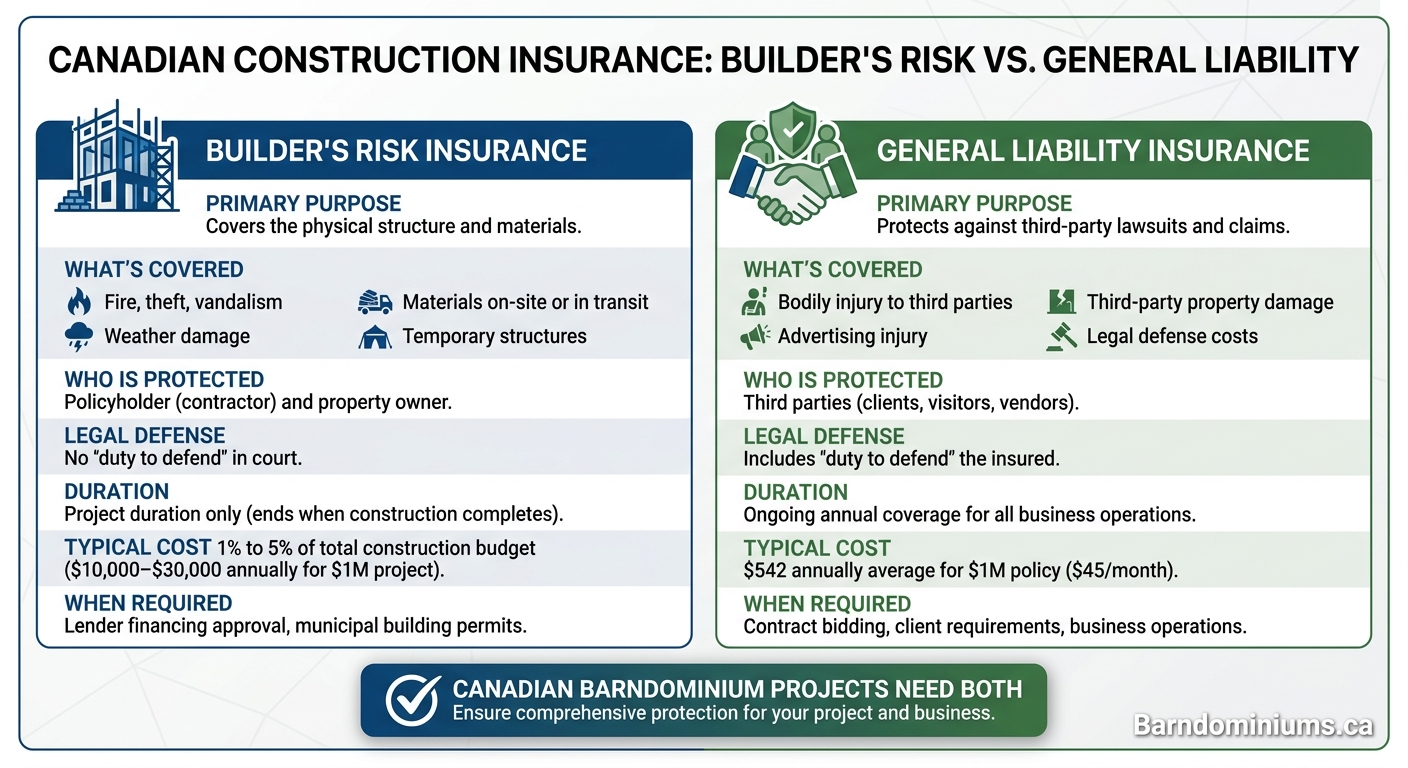
Builder’s Risk vs General Liability Insurance Coverage Comparison
The main distinction between these two insurance policies lies in what they cover. Builder’s risk insurance is designed to protect the physical structure and materials of a project, while general liability insurance focuses on shielding your business from third-party lawsuits and claims. Simply put, builder’s risk safeguards the project itself, whereas general liability protects against external legal risks.
One key aspect of general liability insurance is the insurer’s "duty to defend", meaning they are obligated to represent you in court if you’re sued. Builder’s risk policies, being property-focused, don’t include this legal defence. This was highlighted in the August 2022 case Bridor inc. c. 90784497 Québec inc., where Quebec’s Superior Court ruled that a construction manager’s builder’s risk policy didn’t require the insurer to provide legal defence.
"Builder’s Risk policies are generally property insurance… An insurer is not required to take up its insured’s interest under a Builder’s Risk insurance." – Nathan Hassan Omar, Lawyer, Robinson Sheppard Shapiro
Another difference lies in the duration of coverage. Builder’s risk insurance is specific to the construction phase and ends when the project is completed. General liability insurance, on the other hand, is an annual policy that covers all aspects of your business operations, both on-site and off-site. Additionally, filing a claim under builder’s risk can help maintain your general liability claims history.
Coverage Comparison Table
Here’s a quick overview of how these policies differ:
| Factor | Builder’s Risk Insurance | General Liability Insurance |
|---|---|---|
| Primary Purpose | Covers the physical structure and materials | Protects against third-party lawsuits and claims |
| Coverage | Fire, theft, vandalism, weather damage, temporary structures | Bodily injury, third-party property damage, advertising injury |
| Who is Protected | Policyholder (contractor) and property owner | Third parties (clients, visitors, vendors) |
| Legal Obligation | No "duty to defend" the insured in court | Includes "duty to defend" the insured against claims |
| Policy Duration | Covers the construction site for the project duration | Ongoing coverage for general business operations |
| Typical Cost | 1% to 5% of the total construction budget | $542 annually (average for $1 million policy) |
This table helps clarify how each type of insurance plays a distinct role in managing risk.
When to Use Each Type of Insurance
Builder’s risk insurance is essential when protecting the construction project itself from physical damage. In Canada, most lenders and municipalities require proof of builder’s risk coverage before approving financing or issuing building permits. For a $1 million mid-sized project, annual premiums typically range from $10,000 to $30,000.
General liability insurance, on the other hand, is critical for everyday business operations and interactions with third parties. It’s often needed for bidding on contracts, meeting client requirements, and protecting against lawsuits. For a $1 million general liability policy, the average monthly cost is around $45. Most small businesses opt for coverage limits of $1 million per occurrence and $2 million aggregate.
For projects like barndominiums, having both types of insurance is usually necessary. Builder’s risk will cover the structure during construction, while general liability protects against incidents like a visitor slipping on-site or accidental damage to a neighbour’s property. Many small businesses also bundle general liability with commercial property insurance into a Business Owner’s Policy (BOP) to save on costs. For Canadian barndominium projects, understanding how these policies complement each other is critical to protecting your investment.
Why Barndominiums in Canada Need Both Types of Insurance
Building a barndominium in Canada comes with unique risks, which is why having both builder’s risk and general liability insurance is essential. These two types of coverage address different concerns: builder’s risk protects the physical structure, materials, and equipment from hazards like fire, theft, or extreme weather, while general liability covers third-party injuries and property damage. Without both, you could be left exposed to significant financial risks.
"As a builder’s risk policy is designed to protect construction sites from losses and damages, it does not typically include additional liability such as coverage for third-party bodily injury, property damage or incidents in the workplace." – Aharshan Thangarasa, Licensed Broker and Team Lead, Contractors at Zensurance
Builder’s Risk: Protecting Your Barndominium’s Assets
Many Canadian municipalities require proof of builder’s risk insurance before granting a construction permit. This policy ensures that your materials and on-site assets, such as steel components or equipment, are protected against unexpected events during the build. For barndominiums, which often involve expensive barndo house kits stored on-site or in transit, this coverage is especially important.
General Liability: Addressing Third-Party Risks
While builder’s risk focuses on the structure, general liability insurance provides protection when third parties – like neighbours, inspectors, or delivery drivers – visit your site. It covers incidents such as injuries or accidental damage to nearby properties, ensuring you’re not left paying out-of-pocket for unforeseen accidents.
Customizing Your Coverage
To fully protect your project, it’s smart to tailor both policies to your specific needs. For example, you can add endorsements to cover scaffolding or temporary structures and bundle general liability insurance to include all contractors involved. Naming both the property owner and the general contractor in the builder’s risk policy also ensures everyone’s financial interests are safeguarded.
Wrapping Up
Builder’s risk insurance shields your project’s physical assets from dangers like fire, theft, and severe weather, while general liability addresses third-party injuries and property damage. These two policies serve different purposes but are equally important for protecting your construction project.
In Canada, barndominium builders are often required to carry both types of insurance, with many municipalities making builder’s risk coverage a condition for obtaining a construction permit. This dual coverage not only meets legal requirements but also reduces the financial risks associated with construction.
"General liability and builder’s risk work together to fully protect your business from potentially expensive liability claims." – Insureon
As outlined, combining these two policies provides a solid safety net through every construction phase. Considering the high financial stakes, even one uninsured incident could jeopardize your project. Customizing your coverage to fit your specific needs and including all relevant stakeholders ensures you’re fully protected from start to finish.
For expert advice and a free pricing service tailored to your barndominium project, visit Barndominiums Canada. They’ll help you secure the right insurance to safeguard your investment.
FAQs
Do I need both builder’s risk and CGL?
Yes, most construction projects need both builder’s risk insurance and commercial general liability (CGL) insurance, as each addresses different types of risks. Builder’s risk insurance safeguards the property, materials, and ongoing work from incidents like fire or theft. On the other hand, CGL insurance protects against third-party claims for injuries or property damage caused by your operations. When combined, these policies offer broad protection, covering both project-specific risks and potential liabilities.
Who should be the policyholder on builder’s risk?
The policyholder for builder’s risk insurance can be either the property owner or the contractor managing the construction project. This insurance provides coverage for the property and materials while construction is underway.
What add-ons should I consider (flood, earthquake, soft costs)?
When selecting add-ons for builder’s risk insurance in Canada, it’s worth looking into coverage for flood, earthquake, and soft costs. If your project is in an area susceptible to flooding or seismic activity, these risks are often excluded from standard policies, making additional protection crucial.
Soft costs coverage can also be a smart choice. It helps cover indirect expenses like permits, design fees, or even temporary living costs that arise from delays or unexpected damages. These add-ons allow you to address specific risks and better safeguard your project’s financial health.