
Best Moisture Barriers for Canadian Barndominiums

Building a barndominium in Ontario or elsewhere in Canada? Moisture control is a must to protect your investment. Without proper barriers, you’re risking mould, wood rot, and insulation failure – especially in a country with extreme climates. Here’s what you need to know:
- Why it matters: Wet insulation can lose up to 20% of its R-value, increasing heating costs by $200–$500 annually for a 200 m² home.
- Moisture threats: Air-driven moisture carries 30x more water than vapour diffusion. Poor sealing around outlets or seams can lead to condensation and damage.
- Key climates: Vancouver’s high humidity (85–95%) demands barriers that dry out in summer, while the Prairies’ frigid winters require strong interior barriers.
Top Options:
- Spray Foam: Insulates and seals in one step, ideal for steel frames.
- Rigid Foam Panels: Combines structural strength and moisture resistance.
- Smart Vapour Barriers: Adjust permeability based on humidity, great for mixed climates.
- 6-mil Polyethylene: Best for cold regions with consistent outward moisture movement.
Pro Tip: Seal every seam and edge with proper tape to prevent air leaks. Choose a barrier tailored to your climate and construction type to avoid costly issues later.
Installing Vapor Barrier and Insulation In Our Barndo
sbb-itb-d6e8a6a
What Are Moisture Barriers in Barndominiums
A moisture barrier is a material used in a barndominium’s walls to manage water vapour. Its main role is to stop indoor moisture from condensing on cold surfaces, which can lead to mould, rot, and even structural issues.
Traditional vapour barriers, such as polyethylene sheets, have very low permeability (around 0.05 perms), which means they effectively block moisture. On the other hand, smart vapour retarders, made from materials like polyamide or polymer films, adjust their permeability based on humidity levels. In colder months, they limit moisture movement (around 0.1–1.0 perms), while in warmer months, they allow walls to dry more easily (5–20 perms). This adaptability is particularly useful in mixed climates, where static barriers could trap moisture and cause problems.
In Canada, moisture barriers are typically installed on the interior side (the warm side) of wall assemblies, before drywall, to prevent indoor moisture from reaching the colder exterior sheathing. For steel-framed barndominiums, moisture control becomes even more essential since metal surfaces are prone to condensation. Solutions like spray foam or insulated metal panels can create thermal breaks and ensure proper air sealing.
How Moisture Gets Inside
Moisture can enter a barndominium’s building envelope through two main pathways: diffusion and air-driven movement. Diffusion is a slower process where water vapour passes through materials, but air-driven moisture is a much bigger concern.
Air leaks are particularly problematic. Gaps around electrical outlets, plumbing, or poorly sealed seams can let humid air flow into wall cavities, where it may condense on cold surfaces. To prevent this, all seams and edges should be sealed with compatible air-sealing tape to create a continuous barrier.
For metal-frame and post-frame structures, the issue is even more pronounced. Metal conducts cold quickly, creating condensation points if insulation and sealing aren’t up to par. Without effective barriers, moisture can degrade insulation performance and lead to higher heating costs.
Canadian Climate Zones and Moisture Needs
Canada’s diverse climate zones require moisture barrier strategies tailored to local conditions. For instance, Vancouver (Climate Zone 5) experiences about 1,200 mm of annual rainfall and relative humidity levels between 85% and 95%. In such areas, barriers need to prevent winter condensation while allowing walls to dry during the humid summer months.
In contrast, the Prairie provinces endure extremely cold and dry winters, making it crucial to control outward moisture movement. In consistently cold regions, traditional polyethylene barriers work well because the dominant moisture drive is outward during the heating season. However, in mixed climates like coastal British Columbia, static barriers can trap moisture when summer humidity reverses the drying direction. Smart vapour retarders address this issue by adjusting their permeability with the seasons, making them ideal for regions where the dew point often hovers around 10°C.
Choosing the right moisture barrier depends on your climate zone and wall assembly design. In colder areas (Zone 4A and above), interior vapour control is essential to manage the outward moisture drive during long heating seasons. These climate-specific challenges underline the importance of selecting adaptable barrier solutions that meet the needs of your barndominium.
Best Moisture Barrier Products for Canadian Barndominiums
Choosing the right moisture barrier for your barndominium depends on factors like climate, budget, and construction timeline. Below are some of the most effective options for managing moisture in Canadian barndominiums, each with its own strengths.
Spray Foam Insulation with Moisture Control
Closed-cell spray polyurethane foam (SPF) is a multi-functional solution that combines insulation, air sealing, and vapour control in one product. This makes it especially useful for steel-framed barndominiums, where preventing condensation on metal surfaces is crucial.
With its high R-value per inch, closed-cell spray foam offers exceptional insulation performance. It fills every gap and cavity, creating a seamless barrier that eliminates drafts – something traditional materials struggle to achieve. For barndominiums in colder regions like the Prairies, this insulation also prevents outward moisture movement during extended heating seasons.
"In a typical residential home, almost 60% of the heat loss is somehow related to the moisture in the air, so it makes sense to stop undesirable moisture movement." – Great Northern Insulation
Modern spray foam uses eco-friendlier HFO blowing agents, such as Heatlok Soya, which have a Global Warming Potential (GWP) of just 1 – significantly lower than older HFC-based products. While it requires professional installation and specialized equipment, closed-cell spray foam is an excellent choice for those prioritizing top-tier thermal efficiency and integrated moisture protection.
If you’re looking for a more structural option, rigid foam panels are worth considering.
Rigid Foam Panels
Rigid foam panels, including insulated metal panels (IMPs), combine structural strength and insulation in one system. Designed for steel-frame buildings, these panels are a great fit for barndominiums. They create the necessary thermal breaks to prevent cold from conducting through metal framing, which otherwise leads to condensation inside the structure.
These panels simplify installation by serving as both an exterior skin and an insulation layer, reducing labour time and providing a clean, finished look. Even when exposed to moisture, they retain their R-value, ensuring consistent performance.
Rigid foam panels are particularly effective in areas with wide temperature fluctuations. When paired with proper air sealing at seams and penetrations, they create a continuous thermal barrier that performs well throughout the year.
For flexible moisture control, traditional and smart vapour barriers offer additional solutions.
Polyethylene and Synthetic Vapour Barriers
Traditional 6-mil polyethylene is a budget-friendly vapour barrier with a static permeance of about 0.05 perms. It works best in consistently cold regions where moisture typically moves outward during the heating season. However, in mixed climates like coastal British Columbia, polyethylene can trap moisture when summer humidity reverses the drying direction.
Smart vapour barriers, such as SOPRASEAL HVM and Intello Plus, address this issue with variable permeability. Their permeance ranges from 0.8 perms at low humidity to 3–13 perms at high humidity. This adaptability allows them to block moisture in winter while enabling walls to dry inward during humid summers, which is key to preventing mould in airtight barndominiums.
"Smart barriers are forgiving, adapting to construction imperfections and seasonal shifts." – Simon Green, Simon Green Works
Proper installation is crucial for these barriers. All overlaps must be sealed with compatible tape, and specialized sealants should be applied to the perimeters to ensure airtightness. Since smart barriers aren’t UV stable, they need to be covered with interior finishes like gypsum board soon after installation. Although they cost 10–20% more than polyethylene, they can save $200–$500 annually on heating for a 200 m² home in areas with significant seasonal humidity changes.
For projects requiring year-round flexibility, spray-applied polyurea barriers are another option. These barriers, like Insulaire 2K, can be applied in temperatures below 0°C and remain flexible even at -40°C. Their seamless application eliminates gaps at joints and fasteners, achieving an air leakage rate of less than 0.02 L/s·m² at 75 Pa. This makes them perfect for winter construction schedules often seen in Canadian barndominiums.
Moisture Barrier Comparison
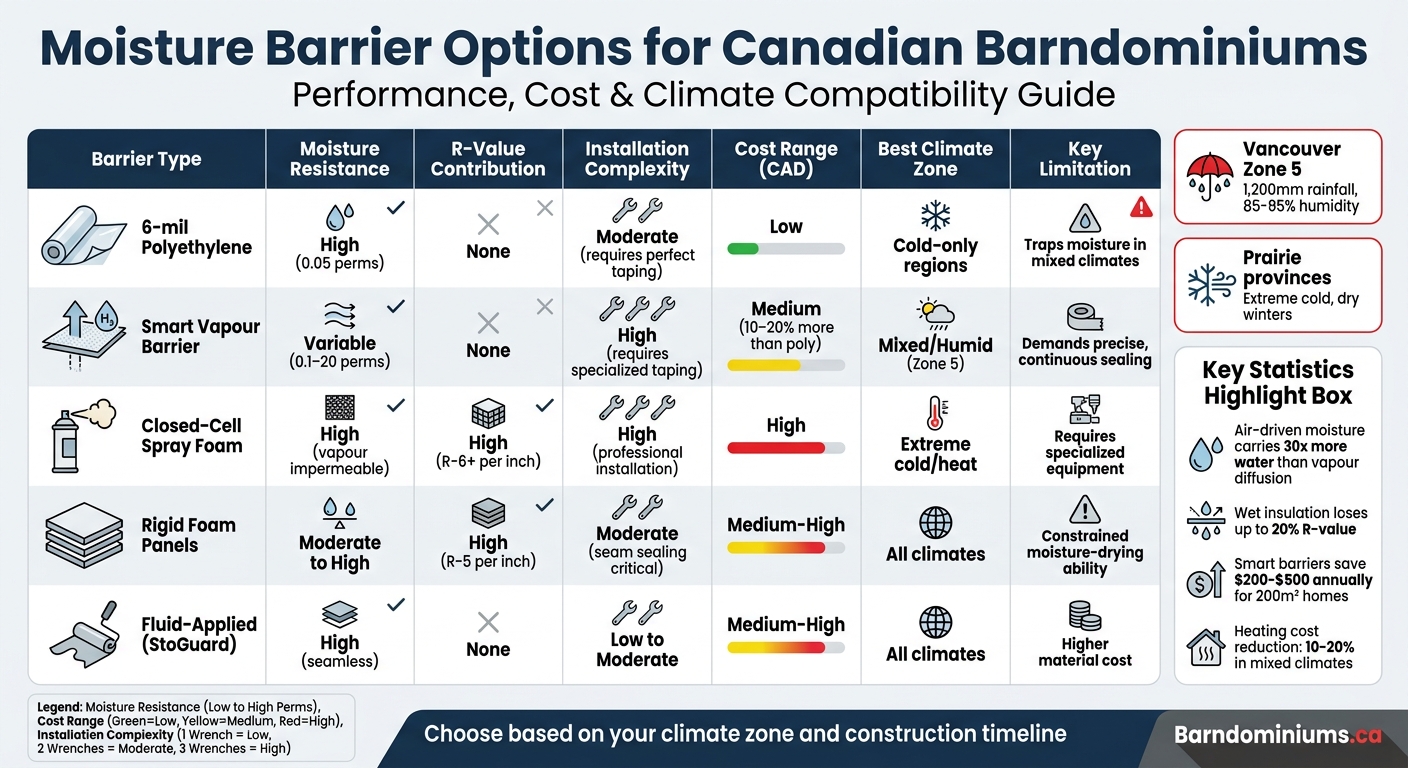
Moisture Barrier Comparison for Canadian Barndominiums by Climate Zone and Performance
Selecting the right moisture barrier involves balancing its performance, cost, and suitability for your specific climate. Each option has its own advantages, making it essential to consider your building’s location and your budget. Here’s a detailed comparison to help you find the best moisture barrier for your Canadian barndominium.
Comparison Table: Moisture Barrier Options
The table below outlines the key differences in performance, cost, and climate compatibility for various moisture barriers.
| Barrier Type | Moisture Resistance | R-Value Contribution | Installation Complexity | Cost Range (CAD) | Best Climate Zone | Key Limitation |
|---|---|---|---|---|---|---|
| 6-mil Polyethylene | High (0.05 perms) | None | Moderate (requires perfect taping) | Low | Cold-only regions | Traps moisture in mixed climates |
| Smart Vapour Barrier | Variable (0.1–20 perms) | None | High (requires specialized taping) | Medium (10–20% more than poly) | Mixed/Humid (Zone 5) | Demands precise, continuous sealing |
| Closed-Cell Spray Foam | High (vapour impermeable) | High (R-6+ per inch) | High (professional installation) | High | Extreme cold/heat | Requires specialized equipment |
| Rigid Foam Panels | Moderate to High | High (R-5 per inch) | Moderate (seam sealing critical) | Medium-High | All climates | Constrained moisture-drying ability |
| Fluid-Applied (StoGuard) | High (seamless) | None | Low to Moderate | Medium-High | All climates | Higher material cost |
Smart vapour barriers, for example, can lower heating costs by 10–20% for a 200 m² home in areas with fluctuating seasonal humidity. On the other hand, wet insulation can lose its effectiveness quickly – cellulose, for instance, may lose up to 20% of its R-value when exposed to moisture.
For barndominiums in Vancouver’s Climate Zone 5, where annual rainfall reaches approximately 1,200 mm and humidity levels hover between 85–95%, smart vapour barriers are a better choice than polyethylene. This is because they avoid the moisture entrapment issues polyethylene often faces in mixed climates. Meanwhile, in the Prairie provinces, where winters bring extreme cold, closed-cell spray foam is a more reliable option. It effectively seals against drafts, outperforming traditional barriers in harsh conditions.
How to Choose the Right Moisture Barrier
Evaluating Your Climate and Insulation Requirements
Your local climate plays a huge role in determining the right moisture barrier for your barndominium. For example, in Vancouver’s Climate Zone 5 – where annual rainfall averages 1,200 mm and humidity levels hover between 85% and 95% – smart vapour barriers are a solid choice. These barriers adapt to seasonal changes, restricting vapour flow in winter (0.1–1.0 perms) while allowing walls to dry in summer (5–20 perms). To ensure effective moisture control, it’s crucial to seal every seam, edge, and penetration with compatible tape, creating a continuous, airtight barrier.
Your insulation type also matters when selecting a barrier. Mineral wool or cellulose (about R-3.7 per inch) pairs well with smart vapour barriers because they allow for seasonal drying. If you’re using spray foam insulation, it often doubles as both insulation and a vapour barrier, so a separate membrane may not be necessary. Placement is key – install the vapour barrier on the warm side of the wall assembly to maintain its integrity during Canada’s cold winters. To further protect the membrane, consider adding a 25 mm service cavity with strapping to prevent punctures from electrical or plumbing installations.
Once you’ve matched your barrier to your climate and insulation, it’s time to think about its durability and maintenance.
Durability and Maintenance Factors
Durability is just as important as climate compatibility when choosing a moisture barrier. For example, fluid-applied barriers like StoGuard fully adhere to surfaces and resist tearing caused by staples or fasteners. If your barndominium’s shell will be exposed to the elements during construction, opt for a UV-resistant barrier – such as 3M 3015VP, which can withstand up to six months of UV exposure.
For concrete slab foundations, heavy-duty polyethylene films (10–15 mil) are a common choice to block ground moisture and soil gases. The thicker, 15-mil films provide better puncture resistance on rough construction sites. Before installing floor barriers, test the concrete’s moisture levels using a calibrated meter or a calcium chloride kit to ensure proper conditions.
A durable, properly installed barrier not only protects your structure but also helps maintain energy efficiency during Canada’s harsh winters. Look into local rebates, like CleanBC incentives offering $2,000 to $12,500, and make sure your chosen product meets Canadian building standards. Lastly, confirm that your barrier is compatible with the materials it will come into contact with to prevent long-term issues.
Conclusion
Selecting the right moisture barrier for your Canadian barndominium means considering both your climate zone and the specifics of your wall assembly. In colder regions, vapour barriers installed on the interior side of the insulation are key to preventing warm, moist indoor air from condensing on cold structural elements. Pairing these barriers with proper thermal breaks is crucial to avoid long-term moisture damage and heat loss.
The ideal approach often depends on the climate. For mixed climates, smart vapour barriers with variable permeability (ranging from 0.1 to 20 perms) are an excellent choice. They limit vapour flow during the winter while allowing walls to dry out in the summer months. Fluid-applied systems like StoGuard provide seamless protection, avoiding the tears and punctures that traditional wraps are prone to, and they can withstand twice the water-column pressure. These advanced systems not only tackle immediate moisture concerns but also enhance energy efficiency over time.
It’s worth noting that air-driven moisture can bring in up to 30 times more water into a building envelope than vapour diffusion alone. This makes continuous air sealing at every seam a must for long-term durability. A well-chosen moisture barrier safeguards your insulation’s thermal performance, reduces the risk of mould, and can lower heating costs by 10–20%. For a 200 m² home, this could mean annual savings of $200–$500.
FAQs
Do I need a vapour barrier, an air barrier, or both?
For managing moisture effectively in a barndominium, you’ll need both a vapour barrier and an air barrier. The vapour barrier helps control moisture diffusion, while the air barrier prevents moisture from entering through air movement. This combination is particularly crucial in Canada, where the climate can vary significantly.
Which moisture barrier is best for my Canadian climate zone?
The ideal moisture barrier for Canada’s diverse climate zones really hinges on your specific requirements. MemBrain™ by CertainTeed stands out as an excellent option for mixed climates. It functions as both a continuous air barrier and a smart vapour retarder, making it a solid choice for areas where homes face the dual challenge of being heated during the winter and cooled in the summer.
Where exactly should the vapour barrier go in a barndominium wall?
The vapour barrier belongs on the warm side of the wall assembly, positioned between the interior living space and the insulation. In colder climates, such as Canada, this usually means placing it on the interior side of the insulation. This setup helps prevent moisture from inside the home from reaching the colder exterior surfaces, which reduces the chances of condensation and mould development.