
Best Cooling Systems for Barndominiums in Canada

Cooling a barndominium in Canada can be challenging due to their open layouts, high ceilings, and the country’s extreme weather. Choosing the right system depends on your space, budget, and climate. Here are the top options:
- Ductless Mini-Splits: Zoned control, energy-efficient, and ideal for targeted cooling. Costs range from $3,000 to $6,000 per zone.
- Central Air Conditioning: Consistent cooling but requires ductwork. Installation costs $4,000–$20,000, with annual operating costs of $300–$1,000.
- HVLS Fans: Great for tall ceilings, reducing air stratification and HVAC energy use by up to 30%. Costs $4,000–$10,000 installed.
- Hydronic Radiant Cooling: Quiet, efficient, and long-lasting, but expensive ($28,000–$60,000 for 2,000 sq. ft.). Best for slab-on-grade builds.
- Thermally Driven Systems: Solar and gas-powered, cutting electricity use, but with high upfront costs ($20,000–$40,000).
Each system has pros and cons, with energy efficiency, installation costs, and climate suitability being key factors. Below is a quick comparison to help you decide.
Quick Comparison
| System Type | Cost (CAD) | Energy Use | Best For |
|---|---|---|---|
| Ductless Mini-Splits | $3,000–$6,000/zone | High efficiency | Zoned cooling |
| Central Air Conditioning | $4,000–$20,000 | Moderate, 16–18 SEER | Whole-home cooling |
| HVLS Fans | $4,000–$10,000 | Low, up to 30% HVAC savings | Large, open spaces |
| Hydronic Radiant Cooling | $28,000–$60,000 | 20–40% lower than forced air | Quiet, allergy-friendly |
| Thermally Driven Systems | $20,000–$40,000 | Minimal electricity use | Eco-conscious, off-grid |
Select a cooling system based on your barndominium’s needs, insulation quality, and local climate. Proper design and professional installation ensure maximum comfort and efficiency.
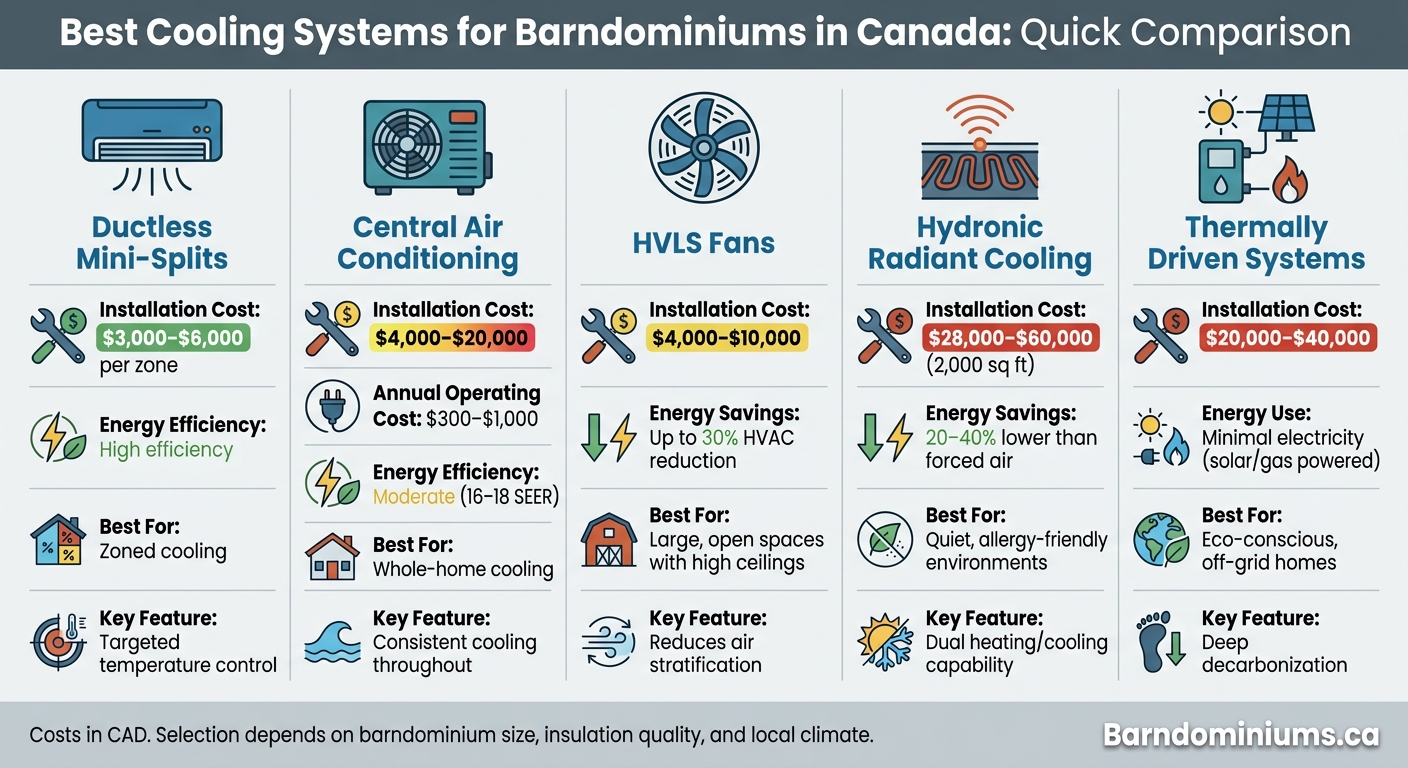
Comparison of Cooling Systems for Canadian Barndominiums: Costs and Efficiency
Mini Split Heating and Cooling Review // Is It Good For Our Barndo?
sbb-itb-d6e8a6a
Cooling System Options for Barndominiums
Barndominiums in Canada come with unique cooling challenges, thanks to their open layouts and high ceilings. Standard residential systems often struggle to provide effective airflow in these spaces. Here are a few cooling options that work well in these environments:
Heat pumps are a versatile choice, offering both heating and cooling. Ductless mini-split systems are especially useful for barndominiums, as they allow you to control the temperature in specific zones, even in areas with high ceilings. Modern heat pumps have SEER ratings between 16 and 25, with some top-tier models reaching as high as 38–42. They’re also energy efficient, delivering 2–4 kW of cooling power for every 1 kW of electricity used.
Central air conditioning provides consistent cooling throughout a space using ductwork. However, it can be expensive, especially if you need to install new ducts, which can add $3,000–$8,000 to the overall cost. Plus, ductwork can lose over 30% of cooling energy during operation. For areas where ductwork isn’t practical, fan-based alternatives might be a better fit.
HVLS fans (high-volume, low-speed fans), which range from 1.8 to 3.7 metres in diameter, are an excellent solution for managing air stratification. These fans circulate large amounts of air at low speeds, making spaces feel up to 5.5°C cooler while also boosting energy efficiency. They’re especially useful in barndominiums with cathedral ceilings, where hot air tends to rise and stay trapped.
Radiant cooling systems work differently by cooling surfaces rather than the air, absorbing heat and maintaining a comfortable indoor temperature of 24–25°C. This is slightly higher than the sub-22°C range typical of traditional air conditioning. However, in humid areas, you’ll need an additional system to handle moisture removal.
1. Central Air Conditioning Systems
Central air conditioning stands out for its specific cost and efficiency aspects when cooling barndominiums.
Initial Installation Cost (CAD)
Installing a central air system typically costs between $4,000 and $7,500. However, barndominiums, with their high ceilings and open layouts, often require detailed load calculations, which can drive costs higher. For larger or more complex setups, costs can range from $4,000 to $20,000, with equipment accounting for about two-thirds of the total expense. Factors like rural locations or limited contractor availability can also increase prices. If your barndominium lacks ductwork – a common scenario for metal building kits – additional expenses will apply.
System size and efficiency ratings also influence pricing. Smaller 1.5-ton units generally cost $3,750–$4,750, while 5-ton systems for larger spaces range from $6,000–$8,500. Units with higher SEER (Seasonal Energy Efficiency Ratio) ratings come at a premium: 13–15 SEER systems cost $3,750–$6,000, while 18+ SEER models range from $5,500–$8,000.
Annual Operating Costs
Canadians typically spend $300 to $1,000 or more annually to run and maintain central air systems. Monthly electricity bills during the cooling season range from $50 to $250, depending on the size of your barndominium, insulation quality, and local electricity rates. Maintenance costs add another $100–$250 per year.
Barndominiums, often made of metal, conduct heat efficiently. Without proper insulation, cooling costs can climb as the system works harder to maintain comfortable temperatures. High-quality insulation, such as spray foam, can significantly reduce cooling demands and lower monthly energy bills.
Energy Efficiency
Central air conditioners are evaluated using the SEER rating, with higher numbers indicating greater efficiency. ENERGY STAR-certified models use about 8% less energy compared to standard units.
"Replacing an air conditioner that is over 10 years old can easily save you upwards of 30%." – Natural Resources Canada
For Canadian climates, 16–18 SEER units generally offer the best balance of cost and efficiency. Models exceeding 18 SEER often don’t justify their higher price due to Canada’s shorter cooling season. Proper sizing is essential – oversized systems waste energy by cycling on and off too frequently, while undersized units struggle to cool effectively and manage humidity.
Climate Suitability
Variable-speed models are particularly effective for maintaining consistent indoor temperatures as outdoor conditions fluctuate. Barndominiums present unique challenges, such as high ceilings and open spaces, which can strain undersized systems during peak summer heat. This can lead to excessive wear and shorten the unit’s lifespan. With professional installation and regular maintenance, central air systems typically last 15–20 years.
These factors highlight the importance of carefully considering cost, efficiency, and climate suitability when selecting a cooling system for your barndominium.
2. Hydronic Radiant Cooling Systems
Hydronic radiant cooling systems work by circulating chilled water through PEX tubing embedded in floors, effectively absorbing heat from the room. This type of system is especially suited to slab-on-grade construction, as the tubing can be installed before pouring the concrete. The beauty of these systems lies in their dual-purpose functionality – they can heat during the winter and cool in the summer. Unlike traditional central systems, hydronic radiant cooling combines both heating and cooling capabilities in one efficient setup.
Initial Installation Cost (CAD)
Installing a hydronic radiant cooling system typically costs between $18 and $35 per square foot. For a 2,000-square-foot home, the total cost ranges from $28,000 to $60,000, covering tubing, manifolds, controls, and a heat source. If you’re only installing tubing in slabs, the cost drops to $6–$12 per square foot. Adding an air-to-water heat pump to the system increases the price by $12,000 to $28,000.
For instance, a 12,000-square-foot luxury home on Montreal’s North Shore saw a 55% reduction in required airflow, which saved approximately $46,140 in ducting costs alone.
Annual Operating Costs
In Ontario, a typical 2,000-square-foot home equipped with hydronic radiant cooling incurs annual operating costs of $900 to $1,400. This translates to 20% to 40% lower monthly energy bills compared to forced-air systems. Maintenance for these systems is also relatively affordable, with annual professional servicing costing between $150 and $350.
A 2025 study of 50 home conversions in Hamilton, Ontario revealed that homeowners experienced an average 25% reduction in heating and cooling costs. This equated to annual savings of $300 to $550, based on energy rates for that year.
Energy Efficiency
Hydronic systems are known to be up to 25% more energy efficient than traditional forced-air systems. Water, as a heat transfer medium, is incredibly effective – it holds 3,500 times more heat per cubic inch than air. These systems also boast distribution efficiency ratios that are 3.8 to 10 times higher than forced-air systems.
"Water is a better conductor of thermal heat and costs less than air to circulate all over the heated space." – Roger Abdo, Hydro Solar
Radiant cooling can handle 50% to 85% of the cooling load in residential settings. Moreover, occupants tend to feel comfortable at slightly higher temperatures – 24–24.5°C (75–76°F) – compared to the 22°C (72°F) typically required for forced-air systems. This further reduces energy usage. The PEX tubing used in these systems is highly durable, with a lifespan of 50 to 100 years. However, achieving this efficiency requires careful attention to humidity control, particularly in Canada’s diverse climates.
Climate Suitability
Radiant cooling systems are highly efficient but need to be tailored to specific climates. In temperate regions like British Columbia, these systems perform well. However, in more humid areas such as Southern Ontario or Quebec, additional measures like dehumidifiers or Energy Recovery Ventilators (ERVs) are essential, as radiant systems do not inherently manage humidity. Without proper humidity control, condensation can occur when temperatures drop below the dew point.
To prevent issues like floor sweating, smart sensors can monitor and ensure that the chilled water – typically maintained at 13°C (55°F) – stays above the dew point. For optimal cooling, high-conductivity flooring materials such as polished concrete, stone, or ceramic tiles are recommended. Thicker materials like carpets or hardwood can reduce efficiency.
3. Hybrid Earth Tube and Solar Attic Fan Systems
Combining the cooling power of earth tubes with the efficiency of solar-powered attic fans creates a hybrid system that helps reduce HVAC loads. Earth tubes are underground pipes installed below the frost line, designed to precondition incoming air using ground-source energy. Meanwhile, solar attic fans, powered entirely by solar energy, remove excess heat and moisture from attics or other structures.
This setup is particularly effective for barndominiums, as it tackles both the temperature of incoming air and the heat trapped in attics. A study conducted in Toronto revealed that earth tubes could cool summer air by 6.8°C and warm winter air by 14.3°C. Additionally, a single 20-watt solar attic fan can provide airflow of up to 400 CFM, making it suitable for ventilating a 500 sq. ft. area.
Initial Installation Cost (CAD)
The cost of a 20-watt solar attic fan is approximately $375.00 per unit, and most barndominiums require two units for optimal ventilation. The installation cost of earth tubes varies depending on excavation requirements and the type of piping used. For those interested in going beyond solar fans, basic hybrid DC-AC systems – including mini-splits, panels, and installation – typically cost between $5,000 and $8,000. DIY hybrid units, such as a 12,000 BTU system, start at around $2,099.
Annual Operating Costs
Solar attic fans have no operating costs since they rely entirely on solar energy. Earth tube systems require minimal maintenance and are inexpensive to run. Homeowners using these solar-hybrid cooling systems could reduce their energy bills by 50% or more.
Energy Efficiency
Michel Tardif, Research Engineer with CanmetENERGY, states: "Earth tubes to a building’s temperature control system could significantly reduce the need for certain kinds of ventilation air heating and cooling."
Solar-hybrid heat pumps can achieve a SEER2 rating of up to 23.4, reducing grid energy usage by as much as 100% during sunny periods. With approximately 15% of Canada’s greenhouse gas emissions coming from building energy consumption, integrating earth tubes can play a significant role in reducing the environmental impact.
This blend of passive and active cooling not only boosts energy savings but also complements other cooling methods discussed earlier.
Climate Suitability
This hybrid system works well across Canada’s varied climates. Earth tubes take advantage of the stable underground temperatures below the frost line to regulate incoming air, while solar attic fans manage attic heat in summer and moisture buildup in winter. Solar attic fans are typically activated at 29°C (85°F) and turn off when temperatures drop below 18°C (65°F). In areas with heavy snowfall, high-profile roof mounts ensure solar fans stay clear of snow and operate efficiently in winter, while burying earth tubes below the frost line prevents freezing and ensures consistent year-round performance.
These hybrid systems offer a practical and adaptable solution for Canada’s diverse climate conditions, complementing the strategies explored earlier.
4. High-Volume Low-Speed (HVLS) Ceiling Fans
HVLS fans provide a straightforward, energy-saving solution for large barndominium spaces, offering an alternative to more complex traditional cooling systems.
These fans are specifically designed for open areas with tall ceilings, typically 25 feet or higher, making them ideal for barndominiums. Unlike standard ceiling fans, HVLS fans move large volumes of air at slow speeds. This creates a windchill effect, making the space feel up to 5.5°C cooler. To put it into perspective, one HVLS fan can replace up to 51 regular ceiling fans in terms of cooling coverage.
They are also built for year-round use, adapting to Canada’s climate. In summer, they rotate counterclockwise to cool the space, while in winter, switching to clockwise rotation helps push warm air trapped near the ceiling back down, addressing the common issue of air stratification in metal-framed barndominiums.
"HVLS fans reduce the workload on your HVAC system, often cutting energy usage by up to 30%." – MacroAir Fans
Initial Installation Cost (CAD)
A large industrial HVLS fan typically costs between $3,000 and $9,000 CAD. However, installation is not a simple DIY project. These fans, weighing between 213 and 400 pounds, require structural verification and specialized mounting for safety and compliance. Professional installation fees range from $300 to $450, often due to the need for scaffolding or manlift rentals.
"It is not the cost of hanging the fan, it is the cost of getting to the fan!!! If you have to set-up scaffolding or rent a ‘manlift’, you have additional hours in addition to the actual hanging." – John Kuehnl-Cadwell, Master Electrician, Datawise Solutions
When you factor in shipping (around $200), mounting hardware (about $300), installation labour ($125–$500), and potential electrical work (up to $2,700 for new circuits), the total installation cost can range from $4,000 to over $10,000.
Annual Operating Costs
HVLS fans are an energy-efficient choice, often reducing electricity bills by over 50% when used instead of constantly running central air conditioning. These fans are designed to operate on a standard 110–125 V, 10 A circuit, consuming far less power than traditional air conditioning systems. With gearless direct-drive motors, they require little to no maintenance, adding to their cost-effectiveness.
Energy Efficiency
By improving air circulation and eliminating temperature inconsistencies, HVLS fans help reduce the workload on heating and cooling systems. In barndominiums with high ceilings, these fans mix cooler air from the floor with warmer air near the ceiling, maintaining a consistent temperature throughout. During winter, reversing the fan direction aids in redistributing trapped heat, potentially lowering heating expenses without using additional energy.
Climate Suitability
HVLS fans are well-suited for Canada’s varied climates, addressing challenges like the "stack effect" in tall, metal-framed buildings. For example, in Ontario’s humid summers, they enhance airflow, making spaces feel cooler without needing extra dehumidification. In the Prairie provinces during winter, they help circulate warm air from the ceiling down to the living spaces.
For best results, these fans should be installed 10–15 feet above the floor with a clearance of 38 to 96 inches from the ceiling. Their IP55 rating ensures they are suitable for the dry indoor environments typical of Canadian barndominiums. Centrally mounting the fan in an open-concept great room maximizes its cooling and air circulation capabilities across the entire space.
5. Thermally Driven Cooling Systems
Thermally driven cooling systems stand out as a low-electricity option for barndominiums, relying on solar and gas power instead of traditional electricity to operate the refrigeration cycle [2, 8]. These systems, which include absorption and ejector coolers, use heat sources like natural gas, propane, or even waste heat to achieve cooling with minimal electrical input [8, 49]. This makes them an attractive choice for those aiming to reduce their environmental footprint.
What sets these systems apart is their dual-power setup. On sunny days, solar panels provide the main energy source. When the weather turns cloudy – something quite common in Canada – the system can switch seamlessly to gas power. This adaptability ensures reliable performance regardless of weather conditions, balancing both installation and operational costs.
Initial Installation Cost (CAD)
The initial cost of thermally driven systems is on the higher side, largely due to the need for solar panel infrastructure. According to research from CanmetENERGY, these systems can cost around seven times more than standard vapour compression air conditioners. This positions them among the most expensive cooling options, often matching or exceeding the cost of geothermal systems, which typically range between $20,000 and $40,000.
For context, small absorption cooling units generally have a capacity of around 3 tonnes.
Annual Operating Costs
Operating costs shift from electricity to thermal fuel sources, making these systems particularly economical in areas with abundant natural gas or access to waste heat [49, 50]. Barndominiums equipped with cogeneration units, which produce both electricity and heat, can use the excess summer heat for air conditioning. This approach significantly boosts overall energy efficiency at the site. Such energy recovery is especially beneficial for larger barndominiums that have simultaneous heating and cooling needs.
Energy Efficiency
Thermally driven systems offer a major reduction in electricity usage compared to conventional cooling methods [2, 8]. CanmetENERGY in Varennes, Quebec, is working to adapt these systems for Canadian climates with the goal of achieving deep decarbonization. Their low electricity demand also makes them appealing in regions with high electricity costs or where smart grid limitations exist.
Climate Suitability
Thanks to their dual solar-gas capability, thermally driven systems are well-suited to Canada’s variable weather. In provinces like Alberta and Saskatchewan, where natural gas is plentiful, these systems can operate cost-effectively throughout the year [49, 50]. However, their steep upfront cost and limited availability in the Canadian residential market remain significant obstacles. While these systems are more common in Europe and Asia, they are still rare and expensive in Canada [50, 8]. Despite these challenges, thermally driven systems add another energy-efficient option to the mix for Canadian barndominiums.
Advantages and Disadvantages
Choosing the right cooling system for your barndominium involves balancing comfort, cost, and energy efficiency. Here’s a breakdown of the pros and cons for some common options:
Central air conditioning ensures steady cooling throughout your home, but it lacks the flexibility of zone control and requires costly ductwork installation. On the other hand, ductless mini-splits offer energy efficiency and zoned control, making them ideal for targeted cooling. However, their visible wall units and per-room costs (ranging from $1,800 to $14,500) may deter some homeowners.
For those seeking maximum efficiency, geothermal systems are a standout choice, with a coefficient of performance between 3.5 and 5.0 and ground loops that can last over 50 years. That said, the initial investment, often between $25,000 and $40,000 or more, can be a hurdle for many Canadian barndominium owners. HVLS fans are excellent for reducing air stratification in spaces with high ceilings and can cut HVAC energy use by up to 30%. However, they work best as a supplement rather than a standalone cooling solution.
Hydronic radiant cooling offers quiet operation and is a good option for those with allergies. Yet, many air-to-water heat pumps in Canada are designed primarily for heating, limiting their cooling capabilities. Meanwhile, thermally driven systems reduce electricity use by relying on solar or gas power, though they require an upfront investment in solar panel integration.
| System Type | Primary Advantage | Primary Disadvantage | Best Use Case |
|---|---|---|---|
| Central AC | Steady, whole-home cooling | No zoning; expensive installation | Finished barndominiums with ductwork |
| Ductless Mini-Split | Zoned control; energy efficient | Visible units; higher per-room cost | Retrofits or mixed-use spaces |
| HVLS Fans | Reduces heat stratification | Requires primary cooling system | Open spaces with high ceilings |
| Geothermal | High efficiency; long-lasting loops | High upfront cost; land needed | Rural or off-grid properties |
| Thermally Driven | Solar/gas-powered; low electricity use | Expensive solar integration | Eco-friendly or off-grid homes |
When deciding on a cooling system, it’s important to consider your barndominium’s layout, budget, and long-term goals. For instance, modern cold-climate heat pumps maintain a performance coefficient of 2.0 even at -25°C, making them a viable option for most Canadian regions. Whether you prioritize upfront savings or long-term efficiency, the right system will depend on your unique needs and the challenges of Canada’s diverse climate.
Conclusion
Choosing the right cooling system for your barndominium largely depends on where you live in Canada. For coastal areas, ductless mini-splits are a great option, offering both dehumidification and zoned temperature control. These systems typically cost between $3,000 and $6,000 per zone. Meanwhile, in prairie regions, cold-climate heat pumps perform well, maintaining a coefficient of performance around 2.0 even at –25°C. However, backup heating becomes necessary when temperatures drop below –30°C. These recommendations can be tailored further for the unique challenges of northern climates.
In Canada’s northern regions, hybrid systems that pair heat pumps with gas furnaces provide reliable heating during extreme cold spells. For rural properties with enough land, geothermal systems offer long-term energy efficiency, although their upfront costs range from $25,000 to $40,000. Additionally, HVLS fans can lower HVAC energy usage by as much as 30% in large, open spaces.
Proper system design is just as important as the type of system you choose. Professional load calculations ensure the system is appropriately sized, preventing inefficiencies like short-cycling in the open layouts typical of barndominiums. To help offset costs, provincial programs such as CleanBC offer rebates – up to $11,000 for ducted heat pumps and up to $16,000 for air-to-water systems.
Barndominiums Canada works with trusted providers to evaluate your climate zone, layout, and budget, helping you find the most energy-efficient cooling solution for maximum comfort and long-term savings.
FAQs
How do I size a cooling system for a barndominium?
To determine the right size for a cooling system, you’ll need to evaluate the heat load of your barndominium. This involves factoring in its size, insulation quality, climate, and other variables. It’s a good idea to work with an HVAC professional who can perform a detailed load calculation, such as a Manual J assessment, to figure out the cooling capacity needed in BTUs or kilowatts. Key elements to consider include the total square footage, how well the space is insulated, the placement and type of windows, and the specific climate conditions in your area.
Do I need a dehumidifier with radiant cooling in Canada?
In Canada, pairing a dehumidifier with radiant cooling is a smart choice to tackle condensation in humid conditions. Radiant cooling systems often face challenges with moisture control because of the dew point, particularly in regions with high humidity. Using a dehumidifier ensures the system runs smoothly while preventing any potential problems.
What insulation upgrades cut cooling costs the most?
Spray foam insulation is a game-changer for reducing cooling costs in barndominiums. Its ability to enhance thermal resistance and minimise heat transfer makes it particularly effective for metal structures, which naturally conduct heat more easily. By using spray foam, you can keep your indoor spaces cooler and significantly cut down on energy bills.