
Top Canadian Resources for Checking Builder Licences

Before I sign with any builder, I check three things first: the builder licence, the warranty record, and the permit path for the job site. That one step can help me avoid permit delays, denied insurance claims, and weak buyer protection.
Here’s the short version: Ontario, B.C., Alberta, and Québec have the main provincial builder lookup tools, while places like Winnipeg, Saskatoon, and PEI also rely on local or split systems. For trade work, I’d also check ESA in Ontario, Skilled Trades New Brunswick, and Red Seal-linked provincial tools for electricians, plumbers, gas fitters, and HVAC workers.
This article covers these 10 resources:
- Barndominiums Canada
- Ontario Builder Directory (HCRA)
- BC Housing Licensed Residential Builder Registry
- Alberta Builder Registry
- RBQ Licence Search
- City of Winnipeg Licensed Contractor List
- ESA Contractor Locator
- Skilled Trades New Brunswick
- Red Seal verification tools
- Other registries for Saskatchewan, PEI, Atlantic Canada, and the territories
What I’d check right away:
- Is the builder’s licence active
- Does the legal business name match the quote and contract
- Is the home or address tied to warranty coverage
- Are there discipline records, penalties, claims, or insolvency notes
- Do trade contractors hold their own licences for electrical, plumbing, gas, or mechanical work
- Can the builder or contractor pull permits for the project
A few facts stand out. In Ontario, the HCRA directory includes 7,000+ builders and sellers. In Alberta, all residential builders have needed a licence to get building permits for new homes since December 1, 2017. In Québec, licence security is $40,000 for general contractors and $20,000 for specialized contractors.
Quick Comparison
| Resource | Best for | Main check |
|---|---|---|
| Barndominiums Canada | Early shortlist | Builder details to cross-check in provincial records |
| HCRA | Ontario new homes | Licence status, conditions, claims, discipline |
| BC Housing | B.C. new homes | Builder licence, warranty, enforcement |
| Alberta Builder Registry | Alberta projects | Licence class, status, directors, enforcement |
| RBQ | Québec projects | Licence class, subclass, security, claims |
| Winnipeg Contractor List | Winnipeg trade work | City trade licence by person |
| ESA | Ontario electrical work | ECRA/ESA licence and penalties |
| Skilled Trades NB | New Brunswick trades | Trade certification and licence status |
| Red Seal tools | Trade workers across Canada | Trade credential check through province |
| SK / PEI / local registries | Split-jurisdiction areas | Warranty membership, local lists, contractor status |
My takeaway is simple: don’t stop at one search result. Match the company name, licence number, warranty record, and trade licences before you pay a deposit. That gives you a much clearer picture of who you’re hiring.
sbb-itb-d6e8a6a
Why Builder Licence Checks Matter for New Homes and Barndominium Projects
A valid licence can affect permits, financing, and access to warranty coverage. So this check should happen at the start, not as a box-ticking step.
Lenders and permit offices check licence and registration status before construction begins. Warranty programs in Ontario, Québec, and Alberta also depend on proper licensing and registration.
In Québec, warranty registration can also affect payment protection and dispute recourse.
For barndominiums, the type of licence matters just as much as having one. These builds can involve non-standard structural elements or conversions, so it’s smart to check the builder’s licence class, subclass, and discipline history, not just the business name. Looking up the names of company directors and officers in provincial registries can also help you spot discipline, charges, convictions, or other regulatory history.
Use the resources below to check both current licence status and past regulatory history.
1. Barndominiums Canada
Jurisdiction: Canada, including British Columbia, Alberta, Ontario, Manitoba, Québec, Saskatchewan, New Brunswick, and Nova Scotia.
What It Helps You Check
If you’re planning a barndominium, this is a smart place to start. Barndominiums Canada is geared toward this kind of build, so it can help homeowners find barndominium specialists, gather project details, and then cross-check the builder in the proper provincial registry.
The key step is simple: make sure the builder’s licence status lines up with the province where the project will happen.
Best Use for Homeowners
Use Barndominiums Canada first to narrow down specialists and collect basic project details. Before you move on, note the builder’s legal name, company name, and project details.
Then check the official provincial registry using:
- the company name
- the licence number
- the principal or director names
Once you have a likely match, verify that builder in the provincial or municipal registry listed below.
2. Ontario Builder Directory (HCRA)
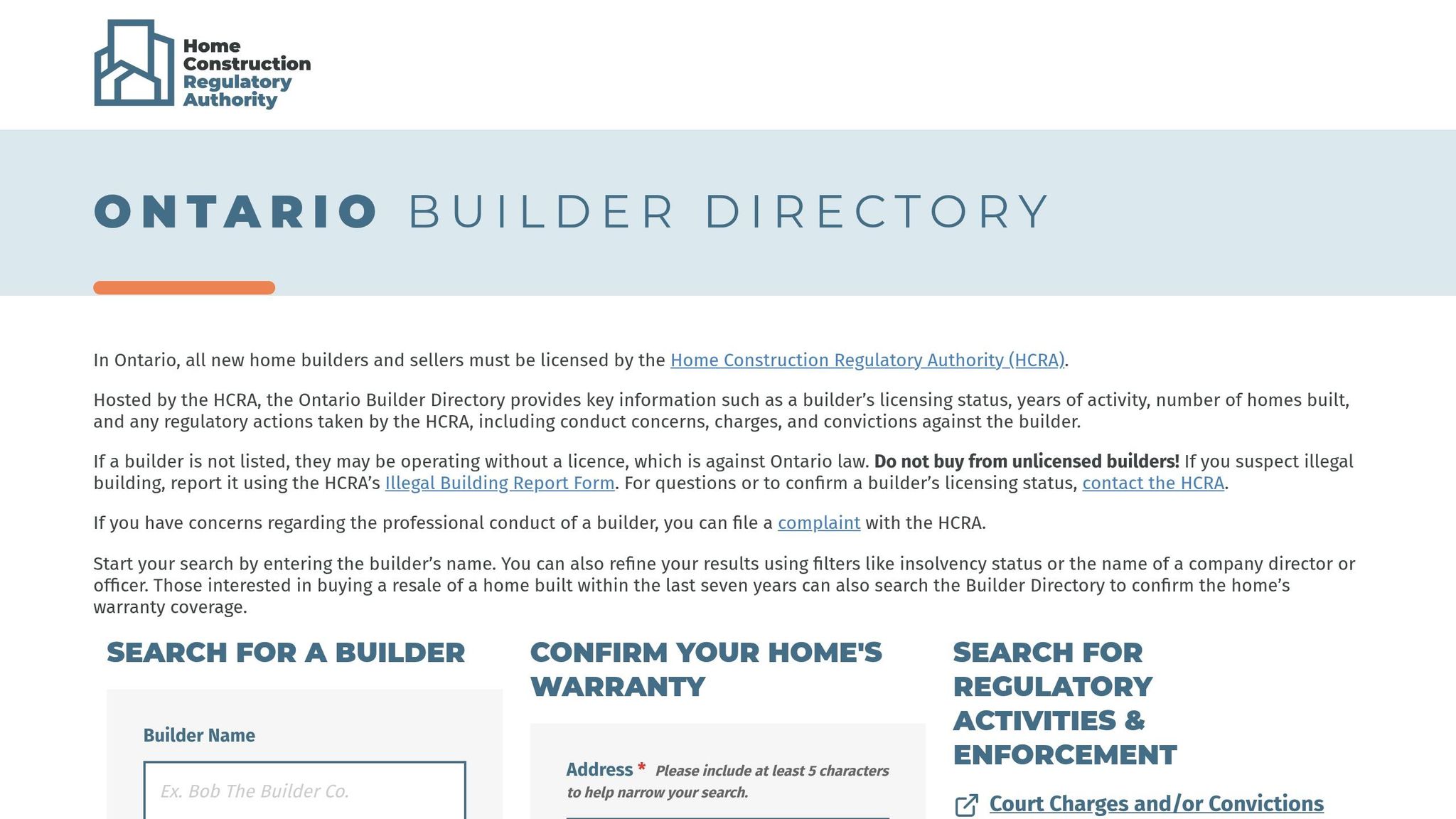
Jurisdiction: Ontario, province-wide.
If your project is in Ontario, the next place to check is HCRA’s Builder Directory.
What It Verifies
Use the Ontario Builder Directory to confirm that a builder or vendor is licensed by HCRA. According to HCRA, builders and sellers that don’t appear in the directory are likely operating illegally. That’s a big deal for custom home projects, including barndominiums.
Applicants have to meet seven competency areas, and the yearly renewal process gives HCRA a chance to review conduct on a regular basis.
Public Details
The directory includes profiles for more than 7,000 Ontario builders and sellers. A profile can show licensing status, experience history, regulatory actions, warranty claims, insolvency status, and leadership details.
| Public Detail | What It Shows |
|---|---|
| Licence Status | Licensed, Licensed with Conditions, Suspended, Revoked, or Expired |
| Experience History | Years active and total number of homes built |
| Regulatory Actions | Court charges, convictions, compliance orders, and Discipline Committee outcomes |
| Warranty Claims | Total dollars paid in claims and number of "at-fault" claims |
| Insolvency Status | Bankruptcy or receivership filings |
| Leadership | Names of principals, directors, and officers |
The directory’s public enforcement records include court charges against Goldentrust Development Inc., an administrative penalty against WRP Reid Enterprises Inc., and a compliance order against 2570970 Ontario Inc..
Best Use for Homeowners
Check the directory before you sign a contract or pay a deposit. You can search by builder name or licence number.
One status deserves extra attention: "Licensed with Conditions." That means the builder can keep operating, but only under set requirements, such as completing extra training by a stated deadline.
It’s also smart to review the "Properties" tab in the builder’s profile. That can help you spot repeat claim patterns tied to certain homes.
If you’re building a barndominium on land you already own, make sure the company is licensed as both a builder and a vendor.
3. BC Housing Licensed Residential Builder Registry
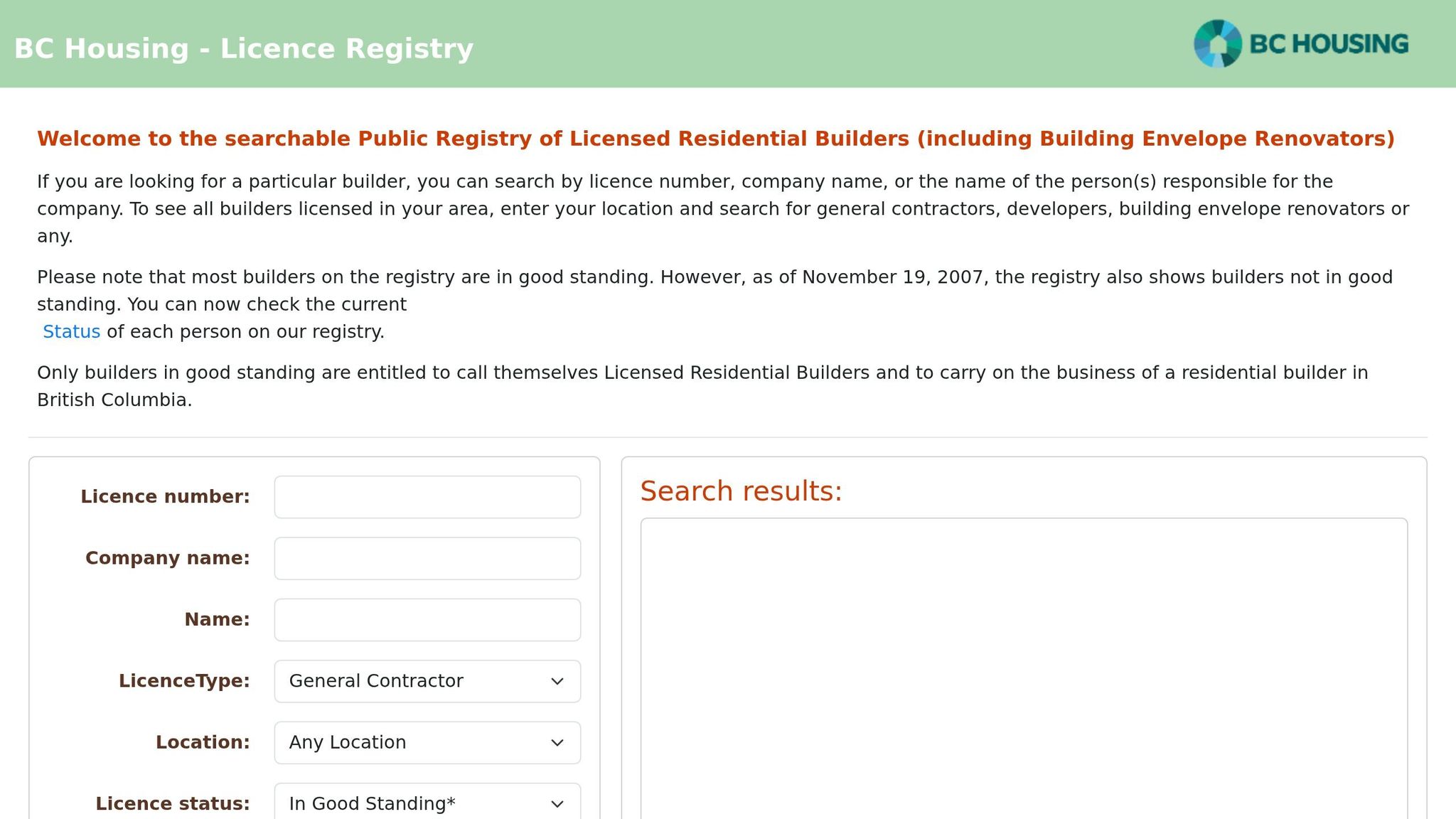
Jurisdiction: British Columbia, province-wide.
For B.C. projects, it’s smart to use the province’s licence, warranty, and enforcement registries together before you hire. One registry tells part of the story. The full picture comes from checking all three.
In B.C., use BC Housing’s registry to confirm a builder’s current licence status, licence class, and expiry date. You can search by company name or licence number.
What It Verifies
This registry applies to new residential construction across B.C. That includes single-family homes, duplexes, condos, and major envelope renovations.
Public Details Available
Start with licence status, then check warranty coverage, then look at enforcement history.
| Registry | What to Search | Key Information |
|---|---|---|
| Registry of Licensed Residential Builders | Company name, licence number | Licence status, type, and expiry date |
| New Homes Registry | Street address or legal description | Active warranty coverage and builder name |
| Enforcement Registry | Individual or company name | Compliance orders, penalties, and court convictions |
The Enforcement Registry shows compliance orders, penalties, and court convictions.
Best Use for Homeowners
Use the New Homes Registry to confirm that the property is registered and has active warranty coverage.
Owner-built homes follow different rules. If you’re buying a home built under an Owner Builder Authorization within the last 10 years, ask for the Owner Builder Disclosure Notice before signing a purchase agreement. Owner-builders don’t need a licence or third-party warranty, but they remain personally liable for construction defects for 10 years after first occupancy.
4. Alberta Builder Registry
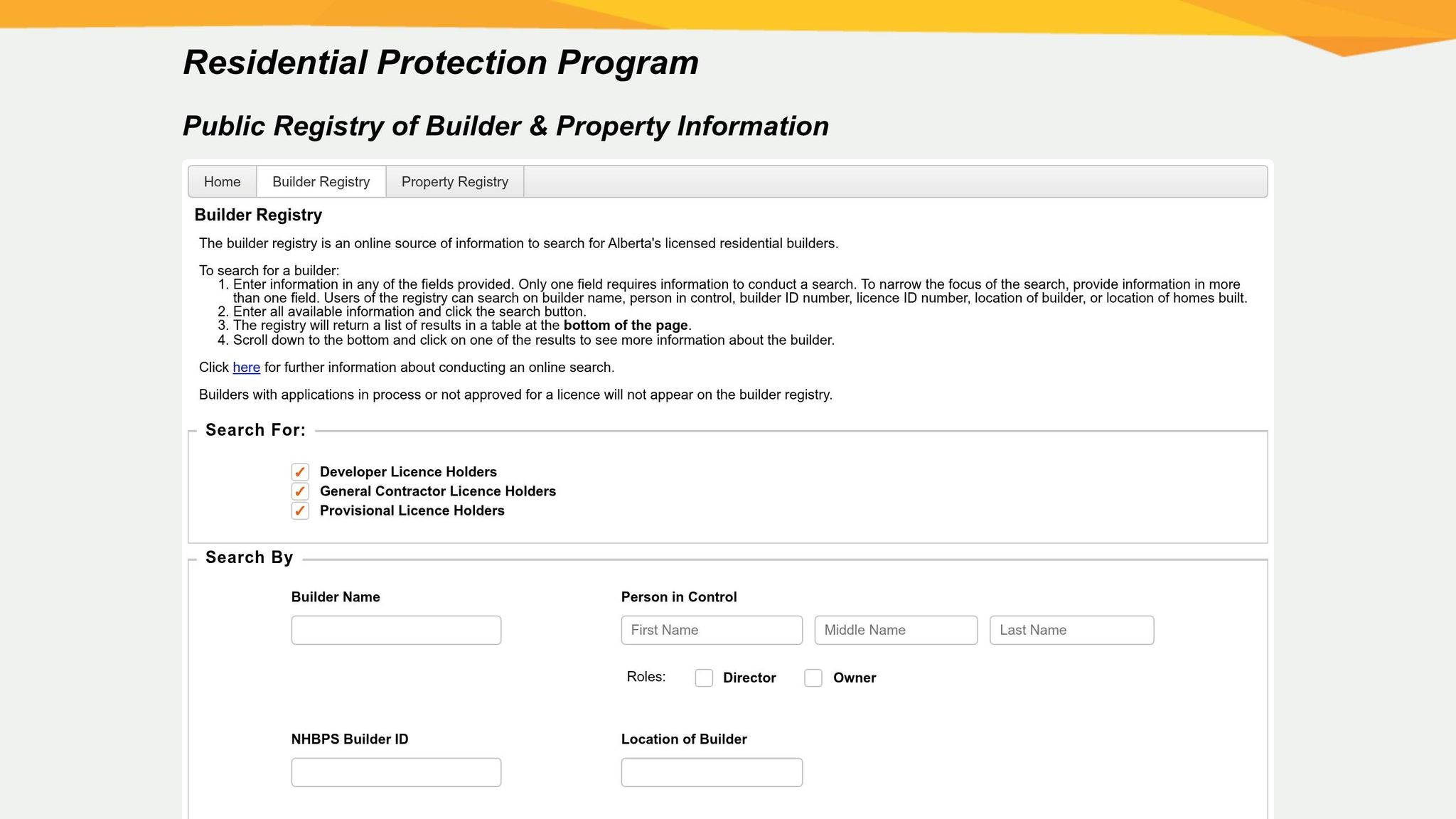
Jurisdiction: Alberta, province-wide.
Alberta’s Builder Registry is run by the Residential Protection Program under the New Home Buyer Protection Act. Since December 1, 2017, all residential builders in Alberta have needed a licence to get building permits for new homes.
For barndominiums, the type of licence matters just as much as whether the licence is valid.
What It Verifies
The registry shows whether a residential builder has a current licence, plus the builder’s licence class and status: Active, Suspended, or Cancelled. For most barndominiums versus traditional housing, a General Contractor licence covers 1–4 dwelling units, including single-family homes.
It also lists the builder’s directors and officers. That can help you spot ties to other companies with a past record of enforcement action.
Public Details Available
You can check how many properties a builder has built in Alberta since February 1, 2014, along with the locations of those homes. The registry also shows any enforcement actions taken under the New Home Buyer Protection Act.
There’s also a linked Property Registry. Use it to search a civic address and confirm warranty coverage, the coverage start date, and the warranty provider’s contact details.
Best Use for Homeowners
Start with the builder’s company name, then check the directors listed in the registry. After that, use the Property Registry to confirm that your project address is registered.
That step matters. Every Alberta home built since February 1, 2014, must have home warranty coverage.
If your project is outside Alberta, move to the next provincial registry.
5. Régie du bâtiment du Québec (RBQ) Licence Search
Jurisdiction: Québec, province-wide.
The Régie du bâtiment du Québec (RBQ) licenses contractors across Québec. If you’re hiring for barndo house kits or a new home in Québec, this is the first place to look. It helps you check a contractor’s licence status, subclass, and claims history before you sign a contract.
What It Verifies
The RBQ search shows whether a contractor has met Québec’s rules for safety, administration, and construction management. It also shows whether the contractor has posted a licence security: $40,000 for general contractors and $20,000 for specialized contractors.
That security may help cover losses tied to poor workmanship, unfinished work, or defects.
If the project is a new home, pay close attention to subclasses 1.1.1 and 1.1.2. Those subclasses require accreditation under the mandatory Guarantee Plan for New Residential Buildings (GCR).
Public Details Available
Each listing includes:
- the contractor’s legal name
- contact details
- NEQ
- RBQ licence number
- licence class and subclass
- claims history
- approved guarantors on file
Best Use for Homeowners
Match the contractor’s name on your quote or contract to the name shown in the repertory. It needs to be an exact match. A small mismatch might seem harmless, but it’s the kind of detail that can cause trouble later.
Next, check the claims history for warning signs before you sign anything or pay a deposit.
Contractors without a licence are not listed in the repertory. Hiring an unlicensed contractor increases the risk of unfinished work or lost deposits.
The repertory also won’t show complaint history for unlicensed contractors. For that, check the Office de la protection du consommateur.
For Manitoba projects, the next check is the City of Winnipeg licensed contractor list.
6. City of Winnipeg Licensed Contractor List
Jurisdiction: City of Winnipeg, Manitoba only.
This list applies only to certain trade work within Winnipeg city limits. It’s a municipal rule, not a province-wide one. For homeowners in Winnipeg, the main thing to check is simple: is the trade contractor licensed for that type of work, and is there a permit tied to your address?
"Various types of demolition, electrical, mechanical and plumbing work can only be done by a contractor licensed by the City of Winnipeg." – City of Winnipeg
What It Verifies
The list confirms whether a contractor is licensed for Electrical, Mechanical, Demolition, and Plumbing work. That said, being listed does not mean they can automatically work on your project.
There’s one detail that trips people up: licences are issued to individuals, not companies. A licensed tradesperson can link their licence to a business name, but the licence itself belongs to the person, not the business.
Public Details Available
The public listing shows:
- contractor name
- business name
- licence type
- contractor type
Best Use for Homeowners
Think of the contractor list as your first screening step, not the final answer. A licence listing shows that the person holds the right municipal licence, but it does not approve work on a specific home or job site.
To confirm project-specific approval, use the City’s Permit Search by Address tool along with the contractor list. That lets you check whether a permit exists for your address.
7. Electrical Safety Authority (ESA) Contractor Locator
Jurisdiction: Ontario only.
In Ontario, checking the builder isn’t enough when electrical work is part of the job. This tool is for electrical contractors, not general builders. So even if you’ve already checked the builder, you still need to verify the electrical contractor on its own.
For paid electrical work in Ontario, the contractor must be a Licensed Electrical Contractor (LEC) with an ECRA/ESA licence number. For barndominiums and new homes, that means two separate checks: one for the general builder and one for the electrical contractor.
What Licence It Verifies
You can search the locator by contractor name or by location. The results show the business name, licence number, the type of work the contractor is allowed to do, current licence status, and any penalties or convictions on record.
| Information Category | Details Visible to Homeowners |
|---|---|
| Identification | Business name, ECRA/ESA licence number |
| Location | City/region and distance from your search |
| Work Authorized | Work type authorized |
| Compliance History | Penalties or convictions on record |
| Operational Status | Current licence status |
Best Use for Homeowners
Before you sign anything, ask for the contractor’s ECRA/ESA licence number and check it in the locator. If they can’t give you that number, stop there and move on.
The LEC is also the party that files the ESA notification. That filing starts the inspection process and helps confirm the work meets code.
If you also need records for builders or other trades, use the next province-specific registry that applies to your area.
8. Skilled Trades New Brunswick Certification Verification
Jurisdiction: New Brunswick only.
In New Brunswick, the check is less about the builder and more about the people doing the trade work on the home. There isn’t a central provincial registry for general home builders or renovators, so if you’re building a new home or barndominium, you need to check each trade on its own.
What Trade Certification It Verifies
Skilled Trades New Brunswick verifies trade certifications, not residential builder licences. For regulated trades like electricians, plumbers, and gas technicians, you should confirm the needed Certificate of Qualification (C of Q) or the needed technical licence. You can do that through the TISConnect portal at tisconnect.gnb.ca.
"All electrical construction and maintenance work must be conducted by New Brunswick licenced electricians or supervised apprentices." – Government of New Brunswick
Public Details Available
TISConnect shows the licence type, its status, and whether it belongs to an individual or a business. Check the status before any trade work begins on site.
Best Use for Homeowners
Ask each tradesperson for their C of Q number, then verify it before work starts. If you need help confirming status, contact TIS at 1-888-659-3222 or TISFTN@gnb.ca.
If a trade works in more than one province, the Red Seal resources below can give you one more way to check.
9. Red Seal Trades Verification Resources
Jurisdiction: National standard, checked through provincial authorities.
Red Seal is a national endorsement for skilled tradespeople. It helps you confirm that a subcontractor meets a Canada-wide standard. For barndominium projects, think of it as a second check on the people doing the actual trade work.
What Licence or Credential It Verifies
Use Red Seal checks for subcontractors handling safety-critical work, including electrical, plumbing, gas fitting, HVAC, roofing, and sheet metal.
Public Details Available
Because verification happens at the provincial level, you need to use the lookup tool for the province where the work takes place.
- British Columbia: SkilledTradesBC portal
- Ontario: Skilled Trades Ontario Public Register
- Alberta: Alberta Tradesecrets Tradesperson Lookup Tool
Best Use for Homeowners
Before work starts, ask subcontractors for their certificate number or AIT ID. Many provincial lookup tools need that number along with the tradesperson’s name. It’s a small step, but it can save a lot of trouble later.
For safety-critical trades like gas fitting or electrical work, look for the "Red Seal" notation in the search results. That shows the worker meets a national standard, not just a local one.
Use Red Seal to check subcontractors. Then use the provincial and municipal registries below for builder and site-specific checks.
10. Provincial and Municipal Registries for Saskatchewan, Atlantic Canada, and the Territories
Jurisdiction: Saskatchewan and Prince Edward Island, plus municipal and association-based verification in parts of Atlantic Canada and the territories.
Not every province has one central builder registry. In these areas, you often have to check a few sources to piece together a builder’s status. If the system is split across local and regional records, start with licence checks and then match them against warranty and municipal records.
Saskatchewan Home Warranty Builder Member Directory

This is a good first stop for checking builder membership in a third-party home warranty program, which is often required in municipal developments. Public details include the builder’s name, address, phone number, and website.
City of Saskatoon Find a Builder Registry
Managed by Saskatoon Land, this municipal list gives you more than a basic membership check. To appear on it, a builder must be incorporated in Saskatchewan, hold a third-party home warranty, and complete required business management and safety training. The registry also flags Net Zero Qualified builders. Public details include the builder’s name, email, phone number, and Net Zero qualification status.
If there’s no province-wide builder registry, use the strongest public source first. Then use local lists as a second check.
Prince Edward Island Contractor Licensing List
This provincial list shows contractors allowed to work in PEI under the Contractor Licensing Program.
CHBA-PEI Member Directory

In Prince Edward Island, the CHBA-PEI member directory works as a useful second source alongside the provincial list. It includes home builders, renovators, trade contractors, and suppliers, with listings for places such as Charlottetown and Summerside. Use it as a support check, not as legal verification.
| Jurisdiction | Registry | Authority | Key Details Available |
|---|---|---|---|
| Saskatchewan | Builder Member Directory | Saskatchewan Home Warranty | Warranty membership, regional operation |
| Saskatoon, SK | Find a Builder | Saskatoon Land | Incorporation, safety training, Net Zero status |
| Prince Edward Island | Contractor Licensing List | Department of Land and Environment | Provincial licence status |
| Prince Edward Island | CHBA-PEI Member Directory | CHBA-PEI | Company name, business type, location, contact links |
In these regions, it also helps to check local building departments, territorial registries, and home builders’ associations. This is especially important when planning specialized projects like Canadian barndominiums.
Use these tools together to confirm the business name, licence status, and warranty coverage. Then compare what you find against provincial licence and warranty records before you hire.
How to Use These Resources Together Before Hiring a Builder
No single registry gives you the full picture. The smart way to handle it is simple: check the builder licence first, then the warranty registration, and then the trade licences.
Start by shortlisting three builders. From there, confirm that each one has a fixed business address and references. That step helps weed out shaky operators before you spend more time digging.
Once your shortlist is set, move to the legal check. Enter the builder’s exact company name into the right provincial registry and make sure the licence is active. The HCRA puts it plainly:
"If a builder is not licensed, do not buy from them!"
After that, check the project warranty on its own. This part matters because a valid builder licence does not mean your specific project is registered for warranty coverage.
Match the legal names exactly. The name on the quote, the licence, and the warranty record should all line up. If they don’t, that’s a red flag. It’s also worth checking whether any directors were tied to failed or unlicensed companies in the past.
Once the builder checks out, review the trade contractors separately. Electrical, gas, and plumbing subcontractors each need their own provincial trade licences.
If a contractor isn’t licensed, they can’t pull permits, and you have no regulatory recourse.
Quick Comparison of Canadian Builder Licence Check Resources
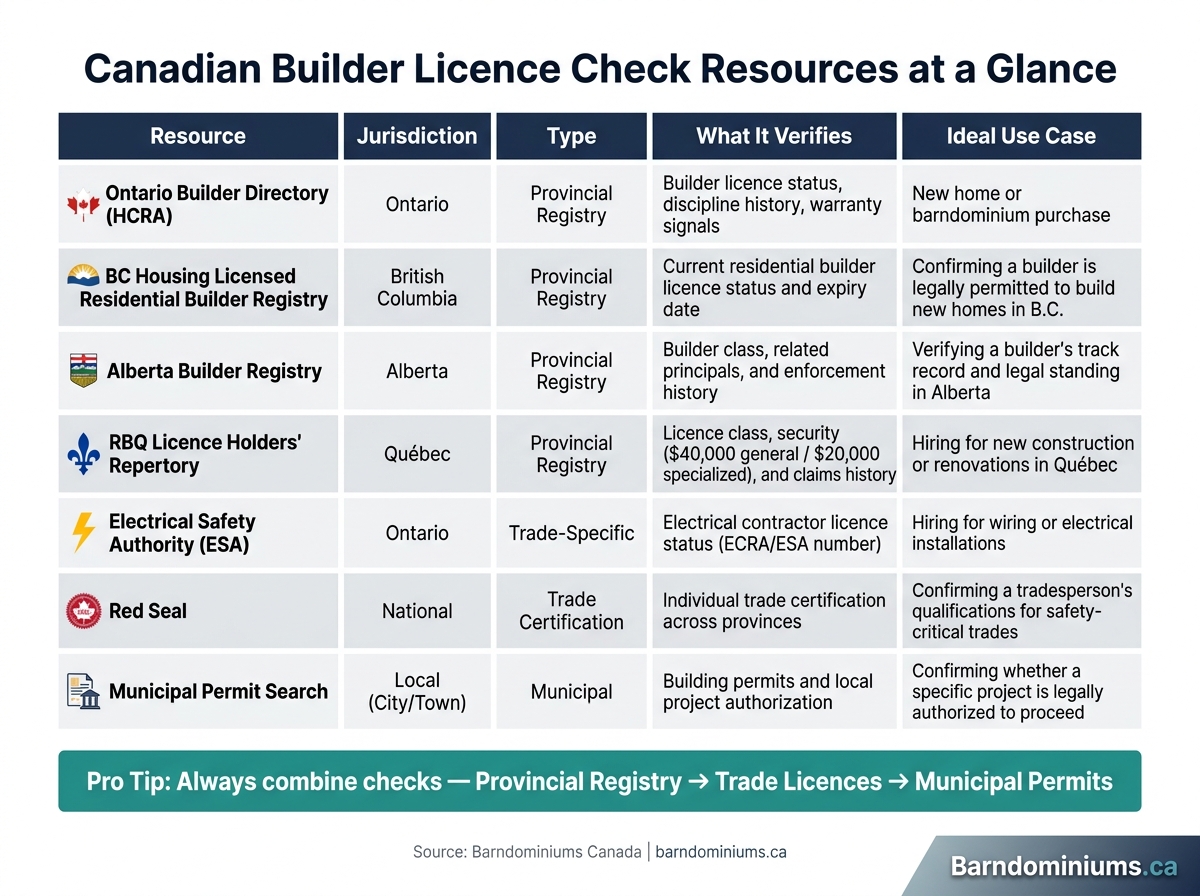
Canadian Builder Licence Check Resources by Province
Not every registry checks the same thing. Some focus on builder licences, some confirm trade credentials, and others show whether a job has the right local permits. If you pick the right tool first, you can save yourself a lot of back-and-forth.
Use this quick scan to match each resource to the check you need.
| Resource | Jurisdiction | Type | What It Verifies | Ideal Use Case |
|---|---|---|---|---|
| Ontario Builder Directory (HCRA) | Ontario | Provincial Registry | Builder licence status, discipline history, and warranty signals. | New home or barndominium purchase. |
| BC Housing Licensed Residential Builder Registry | British Columbia | Provincial Registry | Current residential builder licence status and expiry date. | Confirming a builder is legally permitted to build new homes in B.C. |
| Alberta Builder Registry | Alberta | Provincial Registry | Builder class, related principals, and enforcement history. | Verifying a builder’s track record and legal standing in Alberta. |
| RBQ Licence Holders’ Repertory | Québec | Provincial Registry | Licence class, security, and claims history. | Hiring for new construction or renovations in Québec. |
| Electrical Safety Authority (ESA) | Ontario | Trade-Specific | Electrical contractor licence status. | Hiring for wiring or electrical installations. |
| Red Seal | National | Trade Certification | Individual trade certification across provinces. | Confirming a tradesperson’s qualifications for safety-critical trades. |
| Municipal Permit Search | Local (City/Town) | Municipal | Building permits and local project authorization. | Confirming whether a specific project is legally authorized to proceed. |
The table helps you line up the right check with the right risk. Need to confirm a builder can legally take on a new home project? Start with the provincial registry. Hiring someone for electrical work? Check the trade licence. Want to know if a project can move ahead at a given address? Look at municipal permits.
For barndominium projects, it’s smart to combine checks. Start with the provincial builder registry, then look at trade credentials and local permits for electrical, plumbing, HVAC, and site approval. In Ontario, the HCRA is still the main place to check a builder licence for new homes and barndominiums.
Conclusion
The practical takeaway is simple: start with your province’s official registry, then check trade licences and municipal permits.
Then check everything again before you sign. Licence status can change, and a search from a few weeks ago may not show the current picture.
For barndominiums built with metal kits, that three-step check – provincial registry, trade licences, and municipal permits – is the safest final filter before construction begins. If you’re still in the planning stage, Barndominiums Canada can help you request pricing and planning details from a verified Canadian provider.
FAQs
What if the builder’s name doesn’t match across records?
If a builder’s name doesn’t line up across records, don’t stop there. Try searching with other details, such as:
- the builder’s licence number
- the licence ID
- the name of a principal, director, or officer
Many directories connect builders to specific people, which can help you confirm you’ve got the right business. If the mismatch still doesn’t go away, contact the provincial regulatory authority to verify the builder’s official licensing status.
Can a builder be licensed but still lack warranty coverage?
Yes. Licensing and warranty coverage are two separate things.
A builder may be licensed to operate, but a given property can still have no warranty coverage.
This often comes down to timing. For example, in Alberta, that can happen when a home was built under permits issued before February 1, 2014, which was before the law applied in that case.
So don’t stop after checking the builder. Check both:
- the builder’s licence
- the property’s warranty status
You can verify each one through the provincial registries.
Which permits should I check before paying a deposit?
Before you pay a deposit, check that your builder holds the right provincial licence for the job.
In Ontario, look them up through the HCRA. In B.C., use BC Housing. In Québec, check the RBQ and, for new homes, the GCR. In Alberta, use the Builder Registry.
One more thing: confirm the licence is active and fits your project type. And if a contractor asks you to pull permits in your own name, that’s a red flag. Don’t do it.