
5 Barndominium Mortgage Options in Canada

Building or financing a barndominium in Canada comes with unique challenges due to their mixed-use design and steel-frame construction. Here’s a quick breakdown of your top mortgage options:
- Construction Mortgage With Progress Draws: Funds are disbursed in stages during the build, with interest-only payments until completion. Requires detailed plans, permits, and a 20–35% down payment.
- Standalone Construction Loan With Takeout Mortgage: Covers construction (6–18 months) and transitions to a permanent mortgage. Involves two closings, higher rates during construction, and a 20–35% down payment.
- Conventional Residential Mortgage: For completed barndominiums that meet residential codes. Down payments range from 5–20%, but appraisals may undervalue unique features.
- Agricultural or Farm Credit Financing: Ideal for barndominiums on agricultural land with active farm income. Requires a 25–35% down payment and focuses on income potential.
- Home Equity Financing: Use equity from an existing property through a HELOC, cash-out refinance, or second mortgage. Access depends on your current home’s value and equity.
Each option has distinct requirements, costs, and benefits. Choose based on your property’s zoning, build stage, and financial situation.
Quick Comparison
| Mortgage Option | Best For | Down Payment | Key Requirement |
|---|---|---|---|
| Construction Mortgage (Progress) | Building on owned land | 20–35% | Permits, inspections |
| Standalone Construction Loan | Custom builds | 20–35% | Two closings, detailed plans |
| Conventional Residential Mortgage | Completed barndominiums | 5–20% | Residential building codes |
| Agricultural/Farm Credit Financing | Farms or large rural properties | 25–35% | Agricultural zoning, farm income |
| Home Equity Financing | Using current home equity | Varies | Sufficient home equity |
This guide helps you weigh your financing options and navigate the complexities of barndominium mortgages in Canada.
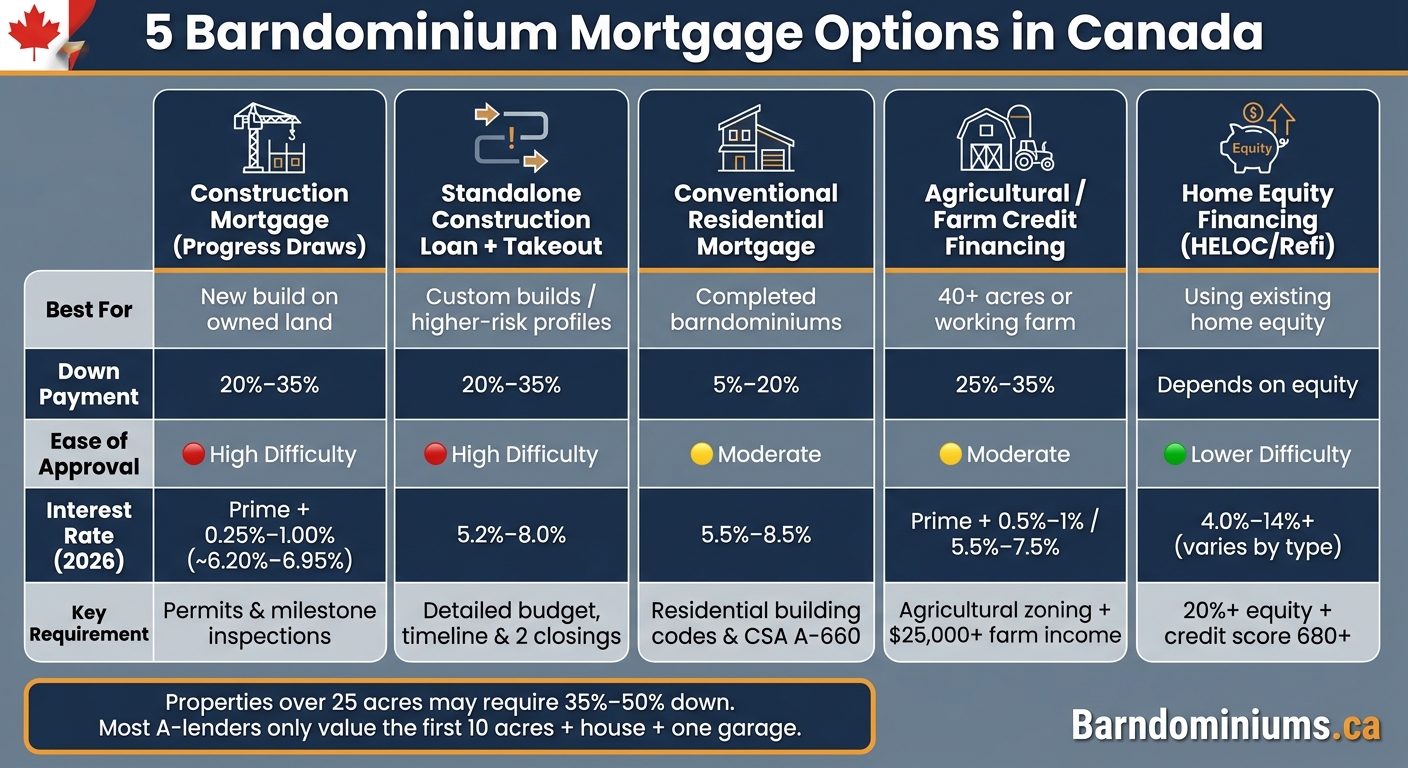
5 Barndominium Mortgage Options in Canada: Side-by-Side Comparison
Key Factors in Barndominium Mortgages in Canada
Barndominiums aren’t your typical homes, and that’s exactly why they can be tricky when it comes to mortgages. Their steel-frame construction is still relatively uncommon, which makes major banks approach them with stricter conditions. Expect higher down payments, more paperwork, and a few extra hoops to jump through.
One of the biggest challenges? Zoning. Properties zoned as "Agricultural" (AG) are often a no-go for residential lenders, who prefer "Country Residential" (CR) zoning. Things get even more complicated if the AG-zoned land generates farm income, as this adds another layer of underwriting difficulty.
Another issue is appraisals. Rural appraisers often struggle to find comparable properties for custom steel homes, and features like workshops or barns are typically excluded from valuations. This means borrowers might face down payment requirements of 20–25% for standard builds, and as much as 35–50% for properties larger than 25 acres.
"Most mainstream lenders (A-lenders/banks) will only assign value to the first 10 acres, the house, and one attached or detached garage." – Shawn Selanders, RECA-Licensed Mortgage Broker
Lenders also have specific requirements for construction financing. You’ll need stamped engineered drawings, a fixed-price contract, permits, proof of zoning compliance, and a cash contingency of 10–15%. On top of that, a credit score of 680–700 or higher is typically expected.
If this sounds overwhelming, Barndominiums Canada can help. They connect you with trusted Canadian providers who can supply the engineered drawings, permit packages, and detailed cost breakdowns that lenders demand.
sbb-itb-d6e8a6a
1. Construction Mortgage With Progress Draws
Construction mortgages with progress draws are designed to fund your barndominium project in stages. Funds are released as specific construction milestones are verified, ensuring payments align with completed work. During the building phase, you’ll only pay interest on the amount disbursed, which helps keep payments manageable. When the construction is complete and you receive an occupancy permit, the loan transitions into a standard permanent mortgage.
"This method ensures payment aligns with completed work."
Here’s a typical draw schedule for construction mortgages:
| Stage | Milestone | % of Funds Released |
|---|---|---|
| Stage 1: Foundation | Excavation, pouring, and backfill completed | 15%–20% |
| Stage 2: Lock-Up | Framing, roof, windows, and exterior doors installed | 25%–40% |
| Stage 3: Rough-In/Drywall | Plumbing, electrical, HVAC, insulation, and drywall installed | 20%–25% |
| Stage 4: Completion | Interior finishes complete; occupancy permit issued | 15%–25% |
Each draw requires a site inspection, which typically costs between $200 and $350. Additionally, provincial regulations, like Alberta’s Act, enforce a mandatory 10% holdback, which is released around 45 days after the project is completed.
Key Requirements and Costs
To qualify, lenders usually demand a minimum credit score of 680, a fixed-price contract with a licensed builder, and stamped engineered drawings. Down payments range from 20%–35%. Construction mortgage rates are generally 1%–3% higher than standard mortgage rates, averaging around Prime + 0.25% to Prime + 1.00% (approximately 6.20%–6.95% as of mid-2026).
Advantages and Disadvantages
| Advantages | Disadvantages |
|---|---|
| Interest-only payments help keep costs lower during construction. | Construction rates are higher than standard mortgage rates. |
| Staged draws ensure builders are paid only for completed work. | Requires detailed documentation like budgets and engineered plans. |
| Combines land purchase and construction financing into one loan. | Delays can occur due to missed inspections or paperwork errors. |
| Converts into a permanent mortgage after completion. | "As-completed" appraisals may undervalue the actual build costs. |
It’s wise to set aside a 10%–15% contingency fund since the loan amount is fixed once construction begins. For rural projects, specialized lenders like Farm Credit Canada (FCC) may offer more flexible draw structures. This type of financing is a practical option tailored to barndominium builds across Canada.
2. Standalone Construction Loan With Takeout Mortgage
A standalone construction loan covers the building phase (usually 6–18 months) and is later replaced by a permanent mortgage once the occupancy permit is secured. Known as a "two-time close" loan, this setup requires two separate applications, two closings, and two sets of legal fees.
During the construction phase, your payments are interest-only on the funds you’ve drawn. Once the project is complete, the takeout mortgage converts the short-term loan into a long-term principal-and-interest mortgage.
"Without a C2P loan, you would need a separate short-term construction loan and then a separate mortgage after completion – meaning two applications, two closings, two sets of closing costs." – Barns & Barndos
The main drawback of this two-step process is the uncertainty around interest rates. Since the rate for the permanent mortgage isn’t locked in until construction is nearly done, you could face higher rates if they rise during the 12–18 months it takes to build. On the flip side, this structure allows you to shop for better rates or lenders once the construction is complete.
To qualify, lenders generally require the following:
- A credit score of 680–700 or higher
- A down payment of 20–25% of the total project cost
- Stamped engineered drawings
- A fixed-price contract with a licensed builder
- Municipal building permits
If you already own the land, its equity can often be applied toward your down payment. As of early 2026, with the Bank of Canada prime rate at 4.70%, construction phase rates at A-lenders range from 5.2% to 7.0%, while takeout mortgage rates have been between 6.5% and 8.0%.
| Feature | Standalone Construction Loan | Takeout Mortgage (Permanent) |
|---|---|---|
| Payment Type | Interest-only on drawn funds | Principal and interest |
| Duration | Typically 12–18 months | 15–30 years |
| Closing Costs | Paid at start of construction | Paid at completion of build |
| Lender Flexibility | Can use a private lender for the build | Can switch to an A-lender for best long-term rate |
This option offers flexibility but comes with trade-offs compared to other financing methods discussed later.
A helpful tip: secure pre-approval for the takeout mortgage before construction begins. If your financial situation changes during the build, you could end up stuck with short-term financing. Also, set aside a 10–15% contingency budget for unexpected costs tied to construction milestones.
3. Conventional Residential Mortgage on a Completed Barndominium
Once construction financing wraps up, you can turn to a conventional mortgage to finance your finished barndominium. To qualify, the property must meet residential codes, be built on a permanent foundation, and comply with local and provincial requirements. Additionally, it should have CSA A-660 certification, a key standard for steel-frame buildings.
Lenders often require more than just the CSA A-660 certification. You’ll need a complete permit package, including stamped structural drawings, to move forward. Keep in mind, if your barndominium is on leased land rather than land you own, conventional financing usually isn’t an option. This is because lenders typically require the land as collateral.
For eligible properties, you might only need a 5% down payment if mortgage insurance is involved, or 20% for a standard conventional loan. As of early 2026, interest rates vary depending on the lender. Credit unions generally offer rates between 5.5% and 7.5%, while monoline lenders fall within the 6.5% to 8.5% range. Amortization periods typically go up to 25 years, though newly built, insured homes may qualify for up to 30 years under recent federal updates.
The Appraisal Challenge
One of the trickiest parts of conventional financing is the appraisal process. Since Canadian barndominiums are unique, appraisers often struggle to find comparable properties. This can lead to lower valuations, meaning you might need extra cash to cover funding gaps. Another hurdle is that most lenders will only finance the home and the first five acres of land on larger rural properties. Any additional acreage won’t be included in the loan.
Mixed-Use Complications
If your barndominium includes non-residential spaces – like a workshop or livestock area – financing could get more complicated. Lenders may classify the property as agricultural or commercial, which could make it ineligible for standard residential loans. To navigate these unique challenges, working with a mortgage broker experienced in rural or unconventional properties can be a big help.
Here’s a quick look at how conventional financing stacks up:
| Feature | Details |
|---|---|
| Minimum Down Payment | 5% (insured) / 20% (conventional) |
| Interest Rates (2026) | 5.5% – 8.5%, depending on lender type |
| Amortization | Up to 25–30 years |
| Requirements | Occupancy permit, permanent foundation, CSA certification, residential zoning |
| Main Limitation | Financing typically covers only the home plus the first 5 acres; appraisal gaps may require additional cash |
4. Agricultural or Farm Credit Financing for Rural Barndominiums
When barndominiums are part of active farming operations, the financing process takes a different route compared to regular residential loans. Properties on agricultural land that contribute to farming activities may qualify for farm credit financing. Unlike traditional residential lending, which leans heavily on comparable home sales, agricultural financing focuses on the income potential of the property. Here’s a closer look at how this works and what sets it apart.
Who qualifies? To access this type of financing, you need to be an existing or aspiring farmer with land zoned for agriculture. Some programs, like RBC‘s RoyFarm Mortgage, require proof that your farm generates at least $25,000 annually from operations or land rental. Additionally, you’ll need to maintain a Debt Service Coverage Ratio (DSCR) of at least 1.25x, signifying that your farm’s net income exceeds your annual loan payments by at least 25%. This focus on income generation is a key difference from the residential loan options discussed earlier.
For smaller properties under 15 acres, rural residential loans might still be an option. However, larger agricultural sites typically require specialized lenders such as Farm Credit Canada (FCC). FCC loans usually come with interest rates around Prime + 0.5% to 1%, while credit unions and alternative lenders offer rates between 5.5% and 7.5% as of 2026. Down payments are higher too, ranging from 25% to 35%, which is notably steeper than what’s required for standard residential loans.
Another option to consider is the Canadian Agricultural Loans Act (CALA). This federal program guarantees 95% of a lender’s losses, encouraging banks to support rural agricultural projects. Through CALA, new farmers can secure a Loan-to-Value ratio of up to 90%, with loans capped at $500,000 for land purchases or construction. However, there’s an important limitation: CALA funds cannot be used for improvements to the residential portion of a property – they must benefit structures tied directly to farm operations.
"Seasonal incomes and long-term capital needs in agriculture demand lenders and mortgage structures tailored to these challenges." – Enno Consulting
Here’s a snapshot of the key trade-offs:
| Feature | Advantages | Disadvantages |
|---|---|---|
| Interest Rates & Terms | Competitive rates with extended repayment terms (up to 10–15 years) | Higher down payments of 25%–35% compared to residential loans |
| Repayment Flexibility | Payment schedules can match seasonal income (monthly, quarterly, or annual) | Applications require detailed business plans and 2–3 years of financial statements |
| Property Valuation | Outbuildings, barns, and workshops are valued as assets | Lenders may appraise only a portion of the property, which can affect terms |
| Government Backing | CALA guarantees reduce lender risk and improve approval chances | CALA funds cannot be applied to the residential part of a barndominium |
Keep in mind, if your barndominium sits on a 100-acre property but only the home and the first 10 acres are financed, you’ll need to cover the cost of the remaining acreage yourself. It’s a good idea to confirm your lot size early in the process and consult with an AACI-certified appraiser. Appraising rural properties can be more complex and expensive than urban ones, so proper preparation is essential.
5. Home Equity Financing or Refinancing an Existing Property
If you’re considering alternatives to construction or specialized loans, using the equity in your current home can be a practical way to finance your barndominium.
For homeowners with substantial equity, there are three main options to consider: a Home Equity Line of Credit (HELOC), a cash-out refinance, or a second mortgage. In Canada, the 80% Loan-to-Value (LTV) rule is key here. This means that the combined borrowing – including your primary mortgage and any additional financing like a HELOC or second mortgage – cannot exceed 80% of your home’s appraised value.
"The 80% LTV rule governs all home equity access in Canada: your total mortgage borrowing (first mortgage + HELOC/second mortgage) cannot exceed 80% of your home’s appraised value." – lendsimpl
Here’s a quick example: If your home is appraised at $900,000 and you owe $450,000 on your current mortgage, you could potentially access up to $270,000 in equity. However, standalone HELOCs are capped even lower, at 65% of the appraised value, as per OSFI regulations.
Eligibility Criteria
To qualify for home equity financing, you generally need to meet the following conditions:
- At least 20% equity in your home
- A credit score above 680
- Stable income
- Passing the federal mortgage stress test (qualifying at either your contract rate plus 2%, or 5.25%, whichever is higher)
Comparing HELOC, Cash-Out Refinance, and Second Mortgage
Each financing option has its own structure, costs, and ideal use cases. Here’s an overview:
| Option | HELOC | Cash-Out Refinance | Second Mortgage |
|---|---|---|---|
| Structure | Revolving credit line | New, larger mortgage | Separate fixed-term loan |
| Rate (2026) | ~7.7% (Prime + 0.50%) | 4.0%–4.5% (5-yr fixed) | 7%–14%+ |
| Repayment | Interest-only on draw | Principal + Interest | Principal + Interest |
| Prepayment Penalty | No | Yes ($12,000–$30,000+) | No |
| Best For | Phased construction | Large lump sum at lowest rate | Can’t break 1st mortgage |
A HELOC is ideal for phased construction projects , especially when using barndo house kits since you can draw funds as needed and only pay interest on the amount used. On the other hand, a cash-out refinance typically offers the lowest interest rates but may involve significant prepayment penalties if you’re breaking a fixed-term mortgage. Always request the exact penalty details in writing before deciding. Lastly, a second mortgage allows you to avoid touching your existing mortgage, though the interest rates are considerably higher.
Important Notes
- Tax Deductibility: HELOC interest is not tax-deductible in Canada unless the borrowed funds are used for income-generating purposes, such as building a rental property. Personal-use projects, like a primary residence barndominium, do not qualify.
- Setup Costs: Refinancing can involve additional expenses like appraisals, legal fees, and title insurance, which typically range from $2,000 to $4,000.
"A HELOC is usually the most flexible fit for phased renovations, but that flexibility comes with variable rates and a real risk of carrying long-term interest-only debt." – Ryan May, Founder, Homeowner.ca
Each option comes with its own pros and cons, so it’s essential to evaluate them based on your financial situation and project needs.
Comparison Table
This table breaks down key aspects of five barndominium mortgage options. It condenses the detailed criteria discussed earlier, making it easier to compare factors like down payments, approval hurdles, and specific lender requirements.
| Mortgage Option | Best Use Case | Down Payment | Ease of Approval | Key Requirement |
|---|---|---|---|---|
| Construction (Progress Draws) | New build on owned land | 20%–35% | High | Permits and inspections at key milestones |
| Standalone Construction Loan with Takeout Mortgage | Custom builds or higher-risk profiles | 20%–35% | High | Detailed construction budget and timeline |
| Conventional Residential | Buying a completed barndominium | 5%–20% | Moderate | Must meet provincial residential building codes |
| Agricultural / Farm Credit | 40+ acres or working farm | 20%–35%+ | Moderate | Agricultural zoning; $25,000+ farm income |
| Home Equity (HELOC / Refinance) | Utilizing current home equity | Depends on equity | Low | Sufficient equity in primary residence |
A few trends stand out: construction-focused loans typically require extensive documentation, including permits and progress inspections. Conventional loans hinge on meeting residential building codes, while agricultural loans depend on zoning and income qualifications.
"Most standard mortgage lenders may not cover these properties due to their distinctive nature, making financing a bit more challenging than traditional homes." – Navigating Barndominium Financing, YourBarndom Canada
For properties over 25 acres, down payments often range from 35% to 50%, and most A-lenders only value the first 10 acres, the house, and one garage. This table serves as a handy guide to help you pick the financing option that aligns with your barndominium plans.
Conclusion
Every mortgage option – whether it’s construction loans with progress draws, standalone construction loans, conventional residential mortgages, agricultural loans, or home equity financing – caters to a specific barndominium scenario. For instance, construction loans with progress draws are ideal for new builds on land you already own. Standalone construction loans offer flexibility, allowing you to lock in appealing long-term rates. Conventional residential mortgages become relevant once your barndominium is finished and meets building codes. Agricultural loans, such as those from Farm Credit Canada, are well-suited for large rural properties. If you have equity in another property, a HELOC or refinancing can be a practical solution. This variety ensures there’s a financing pathway for almost any barndominium project.
The right choice depends on factors like land size, zoning regulations, and the stage of your build. As outlined, each option is tailored to address specific challenges and needs. However, having accurate cost estimates and a detailed plan is crucial for success.
"The most important financial decision in any barndominium project is not the flooring selection or the countertop upgrade – it is the financing structure." – Barns & Barndos
FAQs
Will my barndominium qualify for a standard Canadian mortgage?
Yes, a barndominium can be eligible for a standard Canadian residential mortgage, provided it complies with residential building codes, is appropriately zoned, and has all necessary permits. That said, because of their distinct construction style, appraisals can sometimes be tricky. Many homeowners opt for a construction loan during the building phase, which can later transition into a standard mortgage once the project is finished. For guidance on planning and financing, Barndominiums Canada offers resources and a free pricing service.
How do zoning and acreage limits affect barndominium financing?
Zoning rules and acreage limits play a key role in how lenders assess barndominium financing. Typically, lenders will only factor in the value of the home, garage, and a limited amount of land – usually between 5 and 10 acres. Any extra land or outbuildings often won’t be included in the valuation, which could mean you’ll need a larger down payment.
Financing tends to be more straightforward for properties with residential zoning. On the other hand, agricultural zoning can limit your choice of lenders and may require you to explore specialized loan options. Barndominiums Canada provides support to help you understand and navigate these zoning and financing challenges.
What documents do lenders need before approving a construction mortgage?
When applying for a construction loan, lenders typically ask for several documents to ensure the project is financially and structurally sound. These include proof of income (such as T4 slips, Notices of Assessment, or financial statements if you’re self-employed), a detailed construction budget, and a practical project timeline.
Other required documents often include:
- Stamped building plans and municipal permits
- A signed contract with a licensed contractor
- An as-complete appraisal
- Proof of down payment
- Property insurance
- Documentation of any mandatory new home warranty enrolment
Being prepared with these materials can help streamline the approval process.