
Barndominium Land: Soil Types and Drainage Explained

If I had to cut this whole topic down to one line, it would be this: dry, stable ground is usually cheaper and safer to build on than wet, shifting ground.
When I look at barndominium land in Ontario and across Canada, I focus on three things first:
- Soil type: clay, sand, silt, loam, or gravel-based pads
- Drainage: grading, swales, French drains, trench drains, sump systems, and roof runoff control
- Frost risk: wet soil plus freeze-thaw cycles can crack slabs, move footings, and add repair costs
That means a lot can change from one lot to the next. A flat parcel may look fine from the road, but if it holds water after rain or spring melt, you could be looking at more site prep, deeper footings, or added drainage work. On the other hand, land with well-drained soil and a pad that sheds water can support a simpler build path.
Here’s the short version:
- Clay is often the toughest option because it holds water and shifts as moisture changes.
- Sandy soil drains fast and often suits slab work, but bearing still needs testing.
- Silt can heave in winter and needs close moisture control.
- Loam is often easier to build on if compaction and grading are done right.
- Gravel and crushed aggregate are common base materials, but they must be compacted in lifts, often 150–200 mm at a time on engineered fills.
- Surface drainage comes first: grading, swales, and culverts often do the first job of moving water away.
- Below-grade drainage comes next when water still sticks around: French drains, trench drains, and sump systems.
- Roof runoff matters too because large metal roofs can dump a lot of water at the building edge in a short time.
Before buying, I’d do a site walk after rain or snowmelt, check for standing water, look at nearby ditches, and confirm slope direction. If the lot is wet, low, steep, or has uncertain soil, I’d get test pits or a geotechnical report before spending more money.
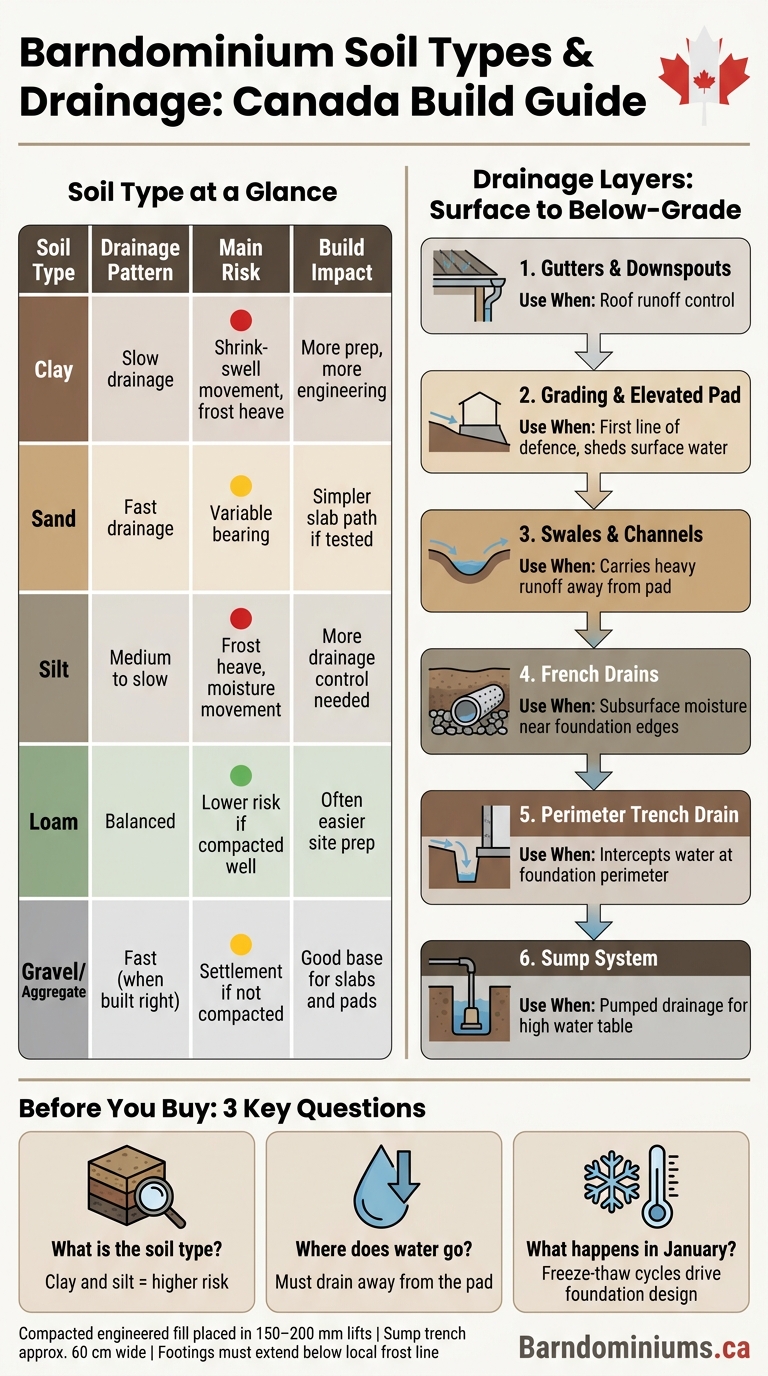
Barndominium Soil Types & Drainage Methods: Quick Reference Guide
Downspout and French Drains for Pole Barn House
sbb-itb-d6e8a6a
Quick Comparison
| Soil / Site Type | Drainage Pattern | Main Risk | Usual Build Impact |
|---|---|---|---|
| Clay | Slow drainage | Shrink-swell movement, frost heave | More prep, more engineering |
| Sand | Fast drainage | Variable bearing in some areas | Simpler slab path if tested |
| Silt | Medium to slow drainage | Frost heave, moisture movement | More drainage control needed |
| Loam | Balanced drainage | Lower risk if compacted well | Often easier site prep |
| Gravel / aggregate pad | Fast drainage when built right | Settlement if not compacted | Good base for slabs and pads |
Quick Comparison
| Drainage Method | What I’d Use It For | Main Problem It Helps Reduce |
|---|---|---|
| Grading | Almost every site | Water sitting near the slab |
| Elevated pad | Low or wet land | Water reaching the custom metal building area |
| Swales / channels | Heavy runoff or snowmelt | Surface flow near the pad |
| French drains | Wet soil around the build | Subsurface moisture near edges |
| Trench drain + sump | High water table or seepage | Groundwater pressure and pooling |
| Gutters + downspouts | Large roof areas | Roof water soaking the perimeter |
Put simply, I’d treat this as a buy-or-pass checklist: What is the soil? Where does the water go? And what happens in January, not just July? Those answers shape the lot cost, the build cost, and how well the structure holds up over time.
1. Clay Soil
Clay is one of the highest-risk soils for barndominium sites. It moves with moisture – swelling when wet and shrinking when dry – and that movement can put real stress on a foundation over time. In plain terms, clay can turn a simple build site into a costly one if the ground hasn’t been engineered the right way.
It also holds water, which is bad news in Canadian winters. Because clay drains slowly, it’s more prone to frost heave. Water can also pool on the site unless grading is done properly . On clay-heavy lots, grading has to push water away from the foundation. There’s no wiggle room there.
For buyers, this usually means higher prep costs and more foundation risk before construction even begins.
Site prep on clay land takes more work than it does on most other soil types:
- Strip all organic topsoil before building, since decomposing material can lead to settlement.
- If the native clay is too reactive, it may need to be replaced with engineered fill.
- That fill should be placed in 150–200 mm layers and compacted to 95% of Modified Proctor Density.
- Highly reactive clay sites may also need deeper footings or full soil replacement.
Clay is the hardest case; the next soil type drains faster but creates different foundation trade-offs.
2. Sandy Soil
Sandy soil drains fast, which usually makes it a good fit for foundation work. Compared with clay, it gives up shrink-swell concerns in exchange for better drainage.
That faster drainage helps cut down on pooling and lowers frost-heave risk in cold Canadian climates. Even so, bearing capacity can still change from site to site, so you’ll want a soil test to confirm it before construction starts.
If the bearing capacity is there, the foundation design is often more straightforward. A slab-on-grade can work well on a stable sandy site, as long as it includes edge insulation, thermal breaks, and a capillary break under the slab. Footings still need to go below the local frost line, no matter how well the soil drains.
A few site details matter too:
- Grade the site so water moves away from the foundation.
- Add a compacted gravel apron at shop doors to help handle runoff.
Sandy sites also tend to stay workable for longer and dry out faster after rain or snowmelt, which can make scheduling easier to plan around.
3. Silt Soil
After sand, silt is the next soil type to check because it drains more slowly and heaves more easily. Its particles sit in the middle – finer than sand, but coarser than clay. That means it can support construction, but it also brings drainage issues and foundation risks on a Canadian barndominium site.
The main problem is frost heave. Silt is highly prone to frost heave because its fine particles can pull water upward through the ground. More water in the soil means more risk. When that moisture freezes, it expands and can move a foundation, especially in cold parts of Canada where freeze-thaw cycles happen again and again.
Drainage is also slower than it is in sandy soil, so moisture control matters a lot. A steel-frame barndominium needs silty ground that is firm enough to handle point loads at post locations without settlement or shifting. Put simply, on a silty site, drainage design matters just as much as soil bearing.
Surface grading should move water away from the structure, and shallow ditches or swales may be needed to carry runoff away from the build area. Foundations should extend below the local frost line. Thickened-edge slabs or engineered frost-protected shallow foundations are common fixes on silty sites.
A percolation ("T-time") test is worth doing early, especially if you plan to install a septic system. In Canada, this test checks how fast water moves through the soil, and it directly affects septic bed placement and foundation design. It’s smart to do this before finalising the site layout, so you don’t end up changing the septic plan or foundation later.
4. Loam Soil
Loam is one of the best soil types for a barndominium site. It drains well, holds enough moisture, and is easier to work with than clay, silt, or sand. That mix can lower site prep risk and make foundation planning more straightforward.
You’ll still want to grade the site away from the foundation to deal with spring runoff. Before any slab work starts, compact the subgrade and add a gravel capillary break under the slab to help with slab support. Once that’s in place, drainage can improve even more on coarser, engineered site materials.
Even with loam, frost depth still drives foundation design across much of Canada. In colder regions, footings still need to extend below the local frost line. A slab-on-grade foundation can work for single-storey barndominiums, but only if subgrade prep and frost protection are done properly.
A soil test or geotechnical report is still needed to confirm bearing conditions before the foundation is designed. That step helps show the difference between loam and the less predictable conditions you can run into on gravel and aggregate sites.
5. Gravel and Crushed Aggregate
Gravel and crushed aggregate are base materials used to build a stable, well-drained platform for slab-on-grade, crawl space, or basement foundations. They don’t act like native soil. Instead, they’re placed on purpose to improve support and drainage. In Canada, foundation depth and frost protection still have to fit local site conditions. The main concern is simple: is the base compacted well enough to stay firm after runoff and frost move through the site?
After the base is installed, water control becomes the next thing to watch. Grade the pad so water drains away from the structure. If the site gets heavy runoff or a lot of spring melt, subsurface drainage may also be needed.
Some sites need extra care. Steep slopes and imported fill often call for a geotechnical report, since base prep and drainage design may need engineering input. And if the shop will carry trucks or hoists, the slab should be thickened where those loads will sit. If water still ponds after grading, that usually points to the need for a dedicated drainage system.
6. Grading and Elevated Building Pads
Grading is the first line of drainage control on a barndominium site because it pushes runoff away from the pad before water can reach the slab.
That matters a lot with barndominiums. Big roofs dump a lot of water, so if the grading is off, it can turn into a foundation problem fast. And when slope by itself can’t move water far enough from the building, surface channels help carry that runoff away.
Elevated building pads come into play on low-lying or wet sites where water tends to gather around the structure. In those cases, the finished floor elevation (FFE) is set above known flood levels. Pad height, insulation, and moisture control also need to line up with local frost conditions. A capillary break under the slab helps stop moisture from wicking up into the concrete.
Pad prep usually follows a pretty clear sequence:
- Strip the topsoil
- Excavate down to stable bearing soil
- Bring in engineered fill in compacted lifts
- Finish with a grade that sends water away from the building
On wet or weak ground, lifting the pad is part of the drainage plan. On marine clay or organic soils, a geotechnical report must confirm bearing capacity before fill is placed. If runoff still collects after grading, swales are the next control layer.
7. Swales and Surface Drainage Channels
When grading on its own can’t move runoff far enough, swales and surface channels carry water to a culvert, ditch, or natural outlet. The goal is simple: keep water well away from the foundation. On barndominium sites in Canada, that matters a lot on low-permeability soils and on builds with big metal rooflines, where runoff can pile up fast. Instead of letting it sit around the pad, swales send it toward culverts where it belongs.
There’s another reason open drainage works so well here. During spring thaw, buried pipes can still freeze, while surface drainage can keep working. That makes swales and open channels especially handy during fast warm-ups, when snowmelt starts moving in a hurry and needs a clear path.
Surface drainage can also cut frost-heave risk. When soil gets saturated, then freezes, it expands. That puts slabs and footings at more risk from frost heave. Swales help by pulling water away before too much of it soaks into the ground.
Site prep for swales usually includes:
- stripping off organic topsoil
- shaping the subsoil to the right slope
- sizing any culverts
If your driveway ties into a public road, check culvert sizing and approach rules with the municipality or transportation authority as early as you can. It’s one of those small details that can turn into a headache later. Also, slope concrete aprons at entries away from the building so water doesn’t pond during rain or a fast melt.
If seepage still builds below grade, buried sub-drainage becomes the next layer of defence.
8. French Drains and Perforated Sub-Drainage
When surface drainage isn’t enough, the next step is below-grade drainage. French drains and perforated sub-drainage stop water before it gets to the foundation or slab edge, then move it away from the structure.
French drains work well on clay-heavy sites or places that stay wet for long stretches. The setup is simple: a gravel-filled trench with a perforated pipe inside. Water moves through the gravel, enters the pipe, and then drains away from the building.
On larger wet sites, one drain run may not be enough. In those cases, perimeter runs with integrated catch basins are often needed to handle the full drainage load.
It also helps to pair sub-drainage with a capillary break under the slab. That cuts down on moisture wicking from below. And when groundwater pressure stays high, perimeter trench drains and sump systems are often needed to finish the job.
9. Perimeter Trench Drains and Sump Systems
When French drains still leave water sitting at the edge of the pad, it’s time to step up to a perimeter trench drain and sump system.
If groundwater stays high, grading and French drains alone may not do the job. A perimeter trench drain intercepts water before it reaches the foundation and redirects it around the building pad.
A common setup uses a trench about 60 cm wide with catch basins built into the system. That setup can deal with both subsurface seepage and surface runoff during heavy spring thaws. For slab-on-grade builds, trench drains, sump locations, sleeves, and floor drains need to be planned before the pour.
Frost heave is a major problem across much of Canada, especially on expansive clay and sites with deep frost. A perimeter system helps limit shifting and cracking by keeping water away from the foundation. And when gravity drainage isn’t enough, pairing the trench drain with a sump system gives you both passive drainage and pumped drainage.
Use the table below to match the drainage system to the site condition.
| Site Condition | Recommended System | Main Risk Reduced |
|---|---|---|
| Expansive clay soils | Perimeter trench drain + subgrade prep | Foundation shifting and cracking |
| High frost depth zones | Trench drain + foundations below frost line | Frost-heave and freeze-thaw damage |
| Low-lying or poorly drained lots | Ditch grading, culverts, and trench drains | Hydrostatic pressure and flooding |
| Heavy snowmelt areas | Perimeter trench + sump pump | Perimeter saturation during spring thaw |
Once groundwater is under control, roof runoff becomes the next drainage layer to manage.
10. Gutters, Downspouts, and Roof Runoff Control
After grading and subsurface drainage, roof runoff is the last big water source to deal with. Barndominiums usually have large roof areas, and during heavy rain or spring snowmelt, that roof can dump a lot of water near the building if you don’t direct it properly. On a barndominium, this isn’t some small finishing touch. It’s a major site-drainage issue.
A continuous gutter system catches water along the roofline and sends it into downspouts. From there, downspout extensions or buried leaders carry the water well away from the pad. That helps cut down on slab-edge saturation. Just as important, the downspouts need to empty onto ground that already slopes water away from the pad. If the soil is clay or silt, this matters even more because moisture tends to stick around near the perimeter.
In frost-prone parts of Canada, metal roofs shed snow fast. That’s often a plus, but it can be hard on gutters. Snow guards above doors and other high-traffic areas help stop sudden snow slides from damaging gutters or creating a risk at entryways. In places with freeze-thaw cycles, heat-trace cable in gutters can help stop ice dams that block drainage and buckle panels. Oversized eaves also help by pushing runoff farther from exterior walls, which lowers the moisture load on the soil right around the building.
| Feature | Purpose | Benefit |
|---|---|---|
| Heat-trace cable | Prevent ice damming in gutters | Keeps drainage clear in freeze-thaw zones |
| Snow guards | Prevent snow shedding from metal roofs | Protect gutters and entryways |
| Oversized eaves | Move runoff farther from foundation walls | Reduce perimeter soil moisture load |
| Positive grading | Ensure water flows away from the structure | Prevents foundation saturation on all sites |
Pros and Cons by Site Condition and Assessment Method
Use these comparisons to match site risk to foundation and drainage needs. The goal is simple: sort lower-risk land from sites that may need engineered drainage or foundation work.
Read the next two sections as a buy/no-buy screen. Then use the assessment methods to confirm what the ground is actually doing.
Site Conditions That Support Simpler Construction
Sandy and gravelly sites usually need less drainage work and often suit slab-on-grade construction. If the lot also has a natural slope that moves runoff away from the building pad, that’s a big plus.
In plain terms, lower-risk sites are the ones where water drains away from the building and the soil doesn’t stay soaked after rain.
Higher-Risk Site Conditions That Need Mitigation
Expansive clay can swell and shrink enough to put stress on slabs and perimeter walls. Sites like this often need piles, grade beams, or thickened-edge slabs with heavy reinforcement.
Silty soils tend to hold water, drain poorly, and carry a high frost-heave risk. Foundations must either extend below the frost line or use a Frost-Protected Shallow Foundation (FPSF) with edge insulation. Flat, low-lying lots where snowmelt and roof runoff collect near the building make those risks worse.
Basic Site Checks a Buyer Can Do Before Purchase
A simple walk around the lot can tell you quite a bit. Visit after rain or snowmelt and look for standing water, soft ground, and dark, wet patches that stay damp long after the weather clears. Check which way the land slopes. Water should move away from the planned building pad, not toward it.
It also helps to look at nearby ditches. Are they draining, or just sitting there with stagnant water? Small clues like these can point to bigger drainage costs later.
When to Use Test Pits and Geotechnical Reports
A visual walkthrough only goes so far. If the soil type isn’t clear, or you’re planning a large barndominium, it may be worth getting a professional assessment.
Test pits can show soil layers, bedrock depth, and seasonal water-table depth. A geotechnical report goes a step further by giving bearing-capacity data and foundation recommendations tied to the site.
Use the table below to match the site’s risk level to the right level of investigation.
| Assessment Type | What It Reveals | When to Use It | Decision It Supports |
|---|---|---|---|
| Basic Visual Check | Standing water, slope direction, vegetation clues, rock outcroppings, access for heavy equipment | Pre-purchase walkthrough | Immediate drainage issues or natural high-ground advantages |
| Test Pits | Soil layers, depth to bedrock, seasonal water-table depth | Before finalising foundation design | Whether a standard slab-on-grade is viable or whether fill or blasting may be needed |
| Geotechnical Report | Bearing capacity, expansive clays, organics, frost depth | Uncertain soils, steep slopes, or large structures | Whether the site can support the structure or needs engineered footings |
Conclusion
Across all the soil types and drainage setups covered above, the big issue is simple: can the ground stay dry and stable through freeze-thaw cycles? Soil behaviour, site drainage, and frost depth need to line up on your lot.
Stable, non-expansive sites with positive grading are usually the easiest places to build. They lower foundation risk and help move water away from the structure.
Once site stability drops, drainage problems tend to show up fast. Expansive clay and frost-prone lots often call for engineered foundations, such as piles, grade beams, or frost-protected shallow foundations. Flat, low-lying lots below known flood levels bring added drainage risk, especially in places where snowmelt gathers near the building.
If the site has steep slopes, streamside or floodplain conditions, soft, saturated, or organic soil, or a high water table, get a geotechnical report before you buy or build. The right lot pairs soil stability with drainage that keeps water away from the foundation.
Use Barndominiums Canada‘s free pricing service for province-specific planning support.

FAQs
What soil test should I get before buying land?
Before you buy land for your barndominium, bring in a structural engineer to arrange a geotechnical investigation.
This looks at how stable the soil is, how much weight it can carry, and whether the site has trouble spots like high-plasticity clays, organic matter, or marine clays.
That matters because your foundation has to match the ground below it. A geotechnical investigation can help confirm whether a concrete slab or a pier-and-beam system makes sense for the site, including local frost depth.
How can I tell if a lot has poor drainage?
Check the soil and see how water moves across the lot. In many parts of Canada, high-plasticity clay soil can trap moisture and shift over time. If you notice standing water, that’s a clear sign of poor drainage. In most cases, the cause is low permeability, bad grading, or both.
Poor excavation and levelling can lead to long-term structural problems, so it’s smart to bring in a structural engineer for a professional soil test. Barndominiums Canada can connect you with verified Canadian providers for planning help and pricing.
When do I need a geotechnical report?
You’ll typically need a geotechnical report when your site has unknown or questionable soil conditions, like marine clays or organic material, or when it sits on sloped or uneven ground where foundation stability could be a concern.
In some cases, local building authorities may also require one, so your foundation design accounts for regional soil conditions and frost depth.